
In the summer of 1775, a strange kind of tension blanketed the American colonies. Blood had already been spilled at Lexington and Concord. Boston was under siege. The Continental Congress had raised an army and chosen George Washington to lead it. But amid the smoke and gunpowder, there was still something deeper smoldering. Hope. Not for victory, not for revolution, but for peace. A very specific kind of peace. The colonists still believed in the idea of a “Patriot King,” a benevolent monarch who would rise above Parliament’s tyranny and deliver justice from on high. That king, they hoped, was George III.
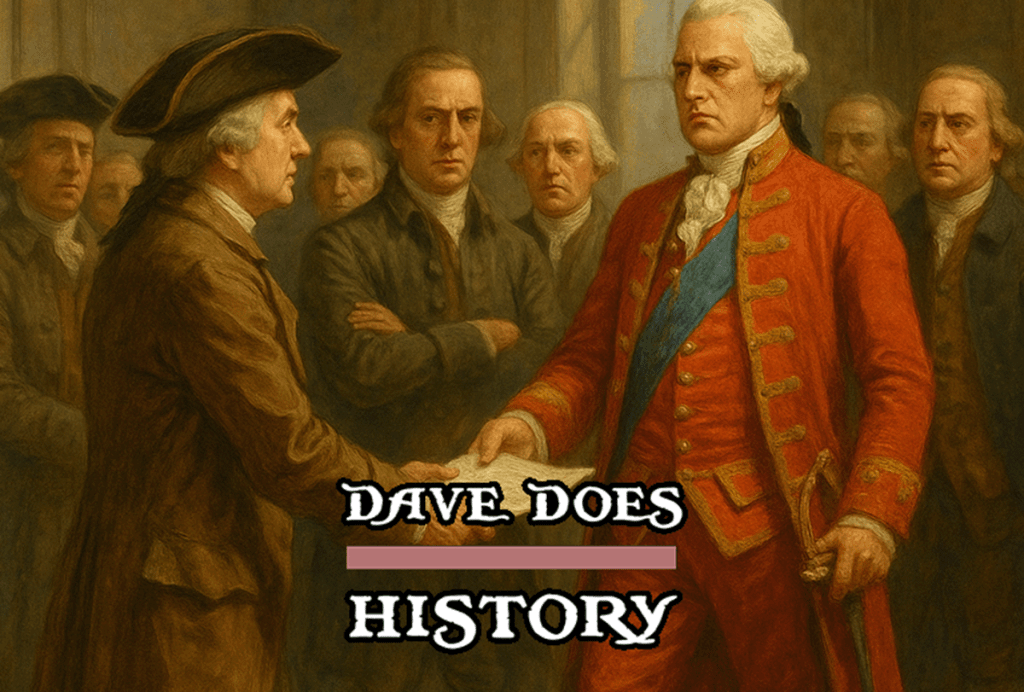
It’s almost hard to believe now, but most Americans didn’t want to leave the British Empire at this point. They weren’t cheering for independence. They were writing letters. They were praying that their king, their “most gracious sovereign,” would hear them out. So they wrote him one more time. They called it the Olive Branch Petition.
The man behind it was John Dickinson of Pennsylvania. Soft-spoken but sharp-minded, Dickinson wasn’t a firebrand like Sam Adams or Patrick Henry. He believed that reconciliation was still possible. That if only the king understood the colonists’ true feelings, he would put a stop to the madness coming out of Parliament. So Dickinson took up his pen, earning his nickname “the Penman of the Revolution,” and drafted the most loyal, respectful, downright desperate plea for peace you could imagine.
The petition, adopted by the Continental Congress on July 5, 1775, wasn’t subtle. It opened with a full-throated declaration of loyalty. It praised the bond between “our Mother Country and these Colonies,” and begged the king to believe that his subjects were still faithful. It avoided any direct blame on George himself. No, it was his ministers, his corrupt Parliament, the schemers whispering in his ear. They were the real problem. The king, they hoped, was still just. Still good. Still theirs.
The language dripped with deference. “Attached to your Majesty’s person, family, and government, with all devotion that principle and affection can inspire,” it read. These were not rebels asking for permission to leave. These were sons pleading with their father not to cast them out. They insisted they weren’t seeking independence, only their rights as Englishmen. They even closed with a prayer for the king’s “long and prosperous reign.”
But while the Olive Branch Petition clung to hope, reality was knocking on the door. The very next day, July 6, Congress approved a much different document: the Declaration of the Causes and Necessity of Taking Up Arms. Written primarily by Thomas Jefferson and revised by Dickinson himself, it was a statement of resolve. A shot across the bow. It said, in no uncertain terms, that while the colonists still wanted peace, they were ready for war. John Adams called it holding “the sword in one hand, and the olive branch in the other.” They were praying with one hand and loading muskets with the other.
And then, the moment of truth. On July 8, the petition was signed and sent to London with Richard Penn and Arthur Lee. It took weeks to arrive. And while it was sailing across the Atlantic, King George III made up his mind. On August 23, 1775, he issued the Proclamation of Rebellion. He didn’t just ignore the petition. He refused to read it. He declared the colonies to be in open revolt and ordered his loyal subjects to suppress the uprising by force. To many in the colonies, it felt like betrayal. The king hadn’t been misled. He wasn’t being tricked. He was in on it.
When news of the rejection came back, it landed like a cannonball. That was the breaking point. That was when the myth of the Patriot King died. That was when men who had once toasted George III began to curse his name. The petition, so full of loyalty and love, became a funeral dirge for the hope of reconciliation.
John Adams wasn’t surprised. He’d called the petition a waste of time and believed war was inevitable. In fact, Adams had written a private letter mocking the effort, and British officials got their hands on it right around the same time the petition arrived in London. That didn’t help. The king’s court saw the whole thing as a ruse, a trick to buy time while the colonies armed themselves.
And maybe it was. Maybe some of the signers never truly believed it would work. But that doesn’t make it meaningless. The Olive Branch Petition matters precisely because it failed. It shows that the colonists didn’t leap into rebellion. They were dragged there, one disappointment at a time. They asked nicely. They asked formally. They begged. And when even that failed, they finally stood up and said no more.
Within months, Thomas Paine’s Common Sense would thunder through the colonies, attacking the very idea of monarchy. The Declaration of Independence wasn’t far behind. But none of that could have happened without the silence that came before. The silence from a king who wouldn’t listen.
The Olive Branch Petition is a snapshot of America’s heartbreak. It’s the last love letter sent before the divorce. And like all such letters, it says more about the writer than the recipient. It tells us that Americans weren’t born revolutionaries. They were pushed. One loyal step at a time, they walked toward the edge, looked down, and finally jumped.
And they never looked back.
Alternate Version: The Patriot King That Never Was
In the summer of 1775, Americans still believed in a fairy tale. Not the kind with dragons or glass slippers, but the kind where a just and noble king rides to the rescue of his people. They called him the “Patriot King.” He was supposed to be the monarch who ruled with wisdom, virtue, and a love for liberty. The one who would rise above the squabbles of Parliament and defend the rights of his subjects, especially those across the ocean. The colonies, bruised and bitter after years of taxes and insults, still believed that King George III could be that man.
The idea wasn’t born in Boston. It came from across the Atlantic, from a disenchanted Tory philosopher named Henry St. John, Viscount Bolingbroke. In the early 18th century, Bolingbroke imagined a king who wasn’t just a figurehead or a tyrant, but a true servant of the people. This “Patriot King” would be above corruption, beholden to no faction, and committed to the good of the entire realm. He would break the grip of selfish ministers and bring moral clarity to the throne. In short, he would be everything Parliament wasn’t.
American colonists devoured this idea. It fit neatly into their worldview. They weren’t anarchists. They weren’t even republicans, not yet. They saw themselves as loyal Englishmen, wronged, yes, but loyal still. They believed that the real villain was Parliament, not the Crown. The laws that taxed their tea, quartered troops in their homes, and shut down their harbors were, in their minds, the work of corrupt ministers and disconnected aristocrats. Surely, they thought, if the king knew what was being done in his name, he’d stop it. Surely he would rise to defend them.
This belief ran deep. In July 1775, the Continental Congress sent George III a document soaked in reverence: the Olive Branch Petition. It pleaded with him to stop the bloodshed, to hear their grievances, and to restore harmony within the empire. The words were practically dripping with loyalty. “Attached to your Majesty’s person, family, and government,” they wrote, “with all devotion that principle and affection can inspire.” They didn’t want independence. They wanted justice. And they wanted it from their king.
Many American leaders genuinely thought they could appeal to his better nature. John Dickinson, the chief author of the petition, believed the king still held the high ground. Even Edmund Pendleton of Virginia referred to the effort as seeking reconciliation with our mother country. The entire tone was one of wounded children appealing to a father’s sense of fairness.
And here’s the strange thing: George III, on paper, fit the Patriot King mold almost perfectly. He was not a lazy monarch. He was deeply religious, moralistic, and genuinely committed to his role. He saw himself as the shepherd of the British people, chosen by God to rule justly. He loathed corruption and despised party politics. He was no puppet. When he ascended the throne, he declared that he would “glory in the name of Briton.” For a brief moment, even Bolingbroke’s old supporters thought their dream had come true.
So why didn’t he become the Patriot King for America?
The answer lies in how George saw his role and how he interpreted loyalty. To him, obedience to the Crown wasn’t conditional. It wasn’t something you negotiated. When colonists armed themselves, formed militias, and took up defensive positions at places like Lexington and Bunker Hill, George didn’t see desperate subjects calling for justice. He saw rebellion. To him, the sword had already been drawn. And once drawn, it was treason.
By the time the Olive Branch Petition arrived in London, George had already made up his mind. He refused to even open it. Instead, on August 23, 1775, he issued the Proclamation of Rebellion, declaring the colonies to be in open revolt and calling on loyal Britons to help crush the uprising. The dream of the Patriot King didn’t just die. It was strangled by the very man meant to fulfill it.
There are reasons, of course. The intercepted letters from John Adams, mocking the petition as a sham, didn’t help. Nor did the simultaneous Declaration of the Causes and Necessity of Taking Up Arms, passed just a day after the petition. From George’s point of view, this was not the behavior of loyal subjects. It was the maneuvering of insincere agitators, trying to have it both ways.
Still, the deeper reason may be simpler. George III was not a man of half measures. He believed in duty, hierarchy, and the divine right of kings. He saw colonial resistance not as a policy disagreement but as a moral and existential challenge to his authority. To him, bending on America meant cracking the whole structure of monarchy. Once you accept rebellion in Boston, what stops it in Dublin or Edinburgh?
He chose firmness. He chose loyalty to the system. In doing so, he thought he was preserving order. In reality, he was destroying unity.
When news of his rejection reached the colonies, something broke. Even men who had once toasted the king began to curse his name. The illusion shattered. Americans realized they weren’t just ignored. They were being hunted. Within six months, Thomas Paine would publish Common Sense, laying waste to monarchy itself and calling for full independence. By July of 1776, the Declaration of Independence would brand the same king they once pleaded with as a “tyrant unfit to be the ruler of a free people.”
It didn’t have to go that way. George could have responded. He could have opened the door to negotiation. He could have told his ministers to pull back, repeal the Coercive Acts, and start over. He could have lived up to the ideal so many of his American subjects believed he embodied.
But he didn’t. Whether it was pride, fear, or rigid principle, George III chose to be king of Parliament, not king of the people. And in doing so, he forced a decision. The colonists could submit or they could leave. They chose to leave.
In the end, the Patriot King was a ghost. A noble myth. A dream of what monarchy might have been if it had remembered how to listen. George III wasn’t evil. He wasn’t mad. He simply couldn’t see past the crown on his head long enough to hear the voices crying out from across the sea.
And so the revolution came, not as the first choice, but as the last. Not because Americans hated kings, but because their king refused to be the one they needed.
He could have been the Patriot King. He had the mind for it, the heart for it, even the soul for it. But when history handed him the crown and the cause, he chose the crown. And America turned away.



 DAVE DOES HISTORY
Leave a reply to Archangel Cancel reply