
Every so often, history hands us a coincidence so odd, so strangely poetic, that it demands a second look. June 13 is one of those days. It’s not just your average square on the calendar. It also happens to be the birthday of not one, but two kings from the same royal bloodline. Both born on June 13, just sixteen years apart. Both named Charles. One called “the Bald” and the other “the Fat.” You couldn’t make this up if you tried. It sounds like a medieval comedy duo, but these were real men who sat on real thrones and wrestled with the real collapse of Charlemagne’s mighty empire.
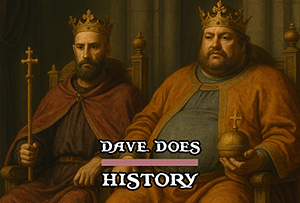
Charles the Bald came first. Born in 823, he was the youngest son of Louis the Pious and the grandson of Charlemagne himself. But young Charles didn’t exactly walk into power with open arms and royal fanfare. No, he had to fight tooth and nail for everything. His older half-brothers had already carved out their territories by the time he was toddling around the court. There was no land left for him. That’s probably where his nickname got its start. Not because he lacked hair. In fact, contemporary art shows him with a healthy mane. The “bald” bit was likely a jab at his early lack of a kingdom. A prince without a crown. A lion without a pride.
Still, Charles got his shot. When his father’s death triggered the usual Carolingian family drama, Charles aligned with his brother Louis the German to fight off their older sibling, the emperor Lothair. The result was the Treaty of Verdun in 843. Charles got the western chunk of the empire, which roughly became modern-day France. It was a rough ride. Viking raids lit up the north like a Christmas tree. The Bretons rebelled. His own nobles wouldn’t listen half the time. But Charles didn’t sit on his hands. In 864, he issued the Edict of Pistres, creating a mobile cavalry force that was the ancestor of French chivalry. He ordered fortified bridges to block Viking ships, and it worked. He even went to Italy and got crowned emperor by the pope. For a man mocked as “bald,” he sure made a lot of moves.
Then there’s Charles the Fat. Born in 839, exactly sixteen years after his bald cousin, he was the youngest son of Louis the German. Unlike Charles the Bald, he didn’t claw his way to the top so much as find kingdoms falling into his lap like dropped apples from a tree. First Swabia, then Italy. Then, as one brother after another died or got sick, Charles ended up ruling over the whole empire. East and West Francia. Italy. The imperial crown. For a brief, shining moment, he pulled together Charlemagne’s fractured realm under one rule. And then, just as quickly, it all unraveled.
Charles the Fat gets a rough reputation, and frankly, he earned most of it. He was frequently ill, possibly epileptic, and he lacked the energy or will to face the crises around him. When the Vikings laid siege to Paris, he didn’t lead the charge. He negotiated. Paid them off with silver. Let them sack Burgundy on the way out. That kind of leadership didn’t sit well with the nobles, especially when France was burning. Eventually, his nephew Arnulf of Carinthia rose up against him, and Charles lost the throne. He died a few weeks later, alone and forgotten, his empire splintering into five pieces. The Carolingian dream, barely held together with twine and prayer, collapsed for good.
Here’s the thing. Despite their nicknames, these weren’t cartoons. Charles the Bald was shrewd, battle-hardened, and not afraid to roll up his sleeves. He may have been mocked, but he built a legacy. Charles the Fat was a softer soul, perhaps too soft for the brutal politics of the ninth century. He was pious, generous, and devout, but lacked the stomach to fight or the backbone to command. One fought for his crown. The other tried to keep one balanced on a slippery head.
And yet they both shared the same birthday. Same bloodline. Same crown. Same dream of a unified empire that could live up to their grandfather’s name. History has a wicked sense of humor. One Charles was never bald. The other may not have been particularly fat. But what sticks with us isn’t the accuracy of their nicknames. It’s the story of two men, born sixteen years apart, trying in their own way to hold together something bigger than themselves.
On June 13, maybe lift a glass for the two Charleses. One tried to build. One tried to hold on. Both had the weight of history on their shoulders. One bore it. The other buckled. But both remind us that kings, like the rest of us, are just men. And history, for all its thrones and battles, often hinges on names, nicknames, and the strange accidents of birth.


 DAVE DOES HISTORY
Leave a comment