
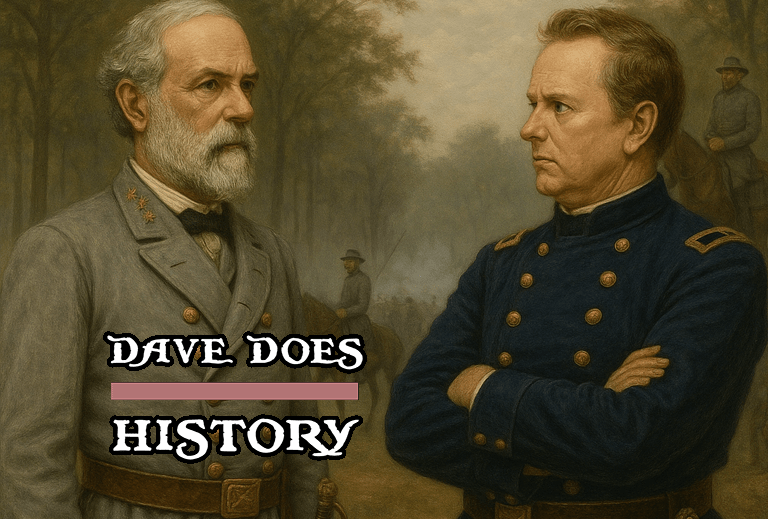
The morning of May 1, 1863, broke over the tangled thickets of Virginia’s Wilderness with the kind of deceptive peace that war often wraps itself in. The sun rose, the birds sang, and thousands of men stirred in the dew-drenched underbrush, tightening their belts, adjusting gear, preparing for something that none of them could yet name. At a brick inn called Chancellorsville—really more of a crossroads mansion than a village—Major General Joseph Hooker of the Union Army sat poised on the edge of greatness. At least, that was what he believed.
Listen to the article:
Joe Hooker had come into command of the Army of the Potomac after the bloody mess at Fredericksburg. His reputation preceded him like a brass band. He was bold, brilliant, and deeply flawed. His critics called him arrogant; his supporters called him Fighting Joe. The nickname, oddly enough, was born from a misplaced punctuation mark in a newspaper dispatch. It stuck anyway. By the spring of 1863, the war had taken a heavy toll on Northern morale, and President Abraham Lincoln needed someone to restore order and confidence. Hooker promised both.
In truth, Hooker did a remarkable job reorganizing the army. He implemented better supply systems, sanitation protocols, and furloughs. He even introduced corps badges to foster unit pride. He took an army that had been humiliated and gave it reason to believe again. By late April, Hooker stood atop a well-oiled military machine. He was sure that this time, the Army of the Potomac would not only beat Robert E. Lee, it would destroy him.
The plan was clever. Hooker sent General John Sedgwick to demonstrate near Fredericksburg with 40,000 men, creating the illusion of a frontal attack. Meanwhile, Hooker led over 70,000 men in a sweeping march westward, crossing the Rapidan and Rappahannock Rivers to land squarely on Lee’s left flank. It was a double envelopment designed to trap Lee’s outnumbered army between two pincers. On paper, it was brilliant. In execution, it began well enough.
By April 30, Hooker’s main force had reached Chancellorsville without serious resistance. The Confederates, already thin due to General James Longstreet’s detachment to forage in southeastern Virginia, were slow to grasp the full scope of Hooker’s maneuver. Lee had just 60,000 men stretched across miles of riverbank. By all the laws of war, Lee should have withdrawn.
But Robert E. Lee had never been one to play by the book. He smelled blood, or at least the chance to strike before Hooker could consolidate. Leaving just 10,000 men under Jubal Early to hold the Fredericksburg line, Lee and his indispensable lieutenant, Stonewall Jackson, turned west toward the Wilderness.
The Wilderness was a dense, brambly forest, the aftermath of old charcoal operations and ironworks. It was a terrible place to fight a modern battle. Visibility was limited. Artillery was all but useless. Units became disoriented within minutes. But it favored those who knew the terrain and fought with aggression. It favored men like Jackson.
At 3:00 a.m. on May 1, Stonewall Jackson rode out toward Zoan Church, where two Confederate divisions under Generals Anderson and McLaws were hurriedly digging in. Jackson, seeing the opportunity, ordered them to stop entrenching and start marching. He did not wait for his full corps to arrive. He did not wait for detailed maps. He simply ordered an advance. It was the kind of bold stroke that had made his name a legend in the Shenandoah Valley the year before.
Meanwhile, Hooker finally gave the order to advance eastward from Chancellorsville. His goal was to link up with Sedgwick and punch through Lee’s thin line. Generals Meade and Slocum led columns down the Orange Turnpike and the Plank Road. The march began smoothly. Skirmishers pushed ahead, scouts reported sparse resistance, and the mood in the Union ranks was upbeat.
Then, quite suddenly, they ran into Jackson.
The Confederates were outnumbered, but they were aggressive. Anderson and McLaws deployed skillfully along ridges and ravines, firing from behind trees and rocks. Jackson sent additional brigades into the fray as they arrived. Union officers, expecting a clear path to Fredericksburg, were shocked to find well-positioned rebels firing volleys at close range. Messages flew back to Hooker’s headquarters at the Chancellor House. The enemy was not retreating. The enemy was attacking.
What happened next would be debated for decades. Faced with stiffer resistance than expected, Hooker panicked. He abruptly canceled the eastward movement and ordered his columns back to Chancellorsville. He would fight a defensive battle. The army dug in, forming a giant arc around the crossroads inn.
To his corps commanders, this retreat felt like betrayal. Darius Couch, one of Hooker’s most seasoned officers, was aghast. He had believed they were on the verge of victory. Now, they were backpedaling into the Wilderness, giving up the initiative. Couch later said he walked away from Hooker’s headquarters believing his commanding general was a whipped man.
Hooker, however, told a different story. “I have got Lee just where I want him,” he said. “He must fight me on my own ground.”
It was a delusion. Lee was not trapped. He was emboldened. By late evening on May 1, Lee and Jackson had reunited near the Furnace Road intersection. They set up camp under the stars and mulled over their next move. Jeb Stuart, the dashing Confederate cavalry commander, arrived with astonishing news: the Union right flank was in the air—unanchored, vulnerable.
That revelation changed everything. Over discarded cracker boxes and in the flickering light of a campfire, Lee and Jackson hatched one of the most daring maneuvers in military history. Jackson would take his entire corps on a 12-mile march around Hooker’s right, using back roads and local guides. He would strike the exposed flank at dawn on May 2. Lee, meanwhile, would hold the center with just 14,000 men, bluffing a much larger force.
But that was tomorrow. For now, May 1 ended in an eerie, unsettled quiet. The Union army, once poised to win the war in Virginia, now sat crouched in defensive positions amid the tangled undergrowth. Confederate soldiers, exhausted but energized by their commanders’ resolve, waited for orders. Somewhere in the thickets, a fox barked. Somewhere else, a soldier scribbled a letter home, unaware that tomorrow would bring thunder.
In the cold light of hindsight, May 1 is not remembered as a day of heavy casualties or clear victories. It was, instead, the day the campaign turned. It was the day momentum shifted. Hooker, with the advantage, surrendered it. Lee, facing annihilation, seized his chance.
It is easy to judge from a distance. Hooker had good reason to be cautious. He was operating in hostile territory, with unproven subordinates and a supply line that stretched thin. But wars are not won by the cautious. They are won by those who recognize fleeting moments and seize them.
Robert E. Lee understood that. So did Stonewall Jackson. Their decision on the night of May 1 would lead to one of the most lopsided and legendary flank attacks in military history. It would also cost the Confederacy one of its greatest generals. But that is the story of May 2.
For now, we leave the armies as they were: one sitting tight in a forest it never wanted to enter, the other preparing to strike like a thunderbolt. Chancellorsville was far from over. In many ways, it had just begun.



 DAVE DOES HISTORY
Leave a comment