
The Cold War was in full throttle by the early 1960s, a world locked in an uneasy standoff between the United States and the Soviet Union, where the threat of nuclear war loomed like an unrelenting storm. This was an era of Strategic Air Command (SAC) bombers crisscrossing the skies on airborne alert missions, ready at a moment’s notice to unleash devastation should the Cold War ever turn hot. One of these bombers, a Boeing B-52F Stratofortress from Mather Air Force Base, took off on the morning of March 14, 1961, as part of Operation Coverall. Its mission was standard: a 24-hour airborne alert sortie designed to keep American nuclear capabilities poised and ready. But what was routine quickly unraveled into a near-catastrophe when a mechanical failure set in motion a desperate struggle for survival, the loss of a multi-million-dollar aircraft, and the harrowing realization of how close two thermonuclear bombs came to being lost in California’s Central Valley.
The crew of the B-52F, designated “Doe 11,” consisted of eight experienced airmen under the command of Major Raymond V. Clay. Alongside him in the cockpit were co-pilot 1st Lt. Robert Bigham and a third pilot, Captain Joseph Ethier, who was undergoing flight training. Behind them, the electronic warfare officer, Tech. Sgt. Alexander Baltikauskas, kept a watchful eye on enemy detection systems, while the lower deck housed radar navigator Captain William Hart, navigator Major Morris Levy, and an additional spare radar navigator, Captain Robert Dobson. Rounding out the crew was tail gunner Tech. Sgt. Stephen Oarlock, who sat alone in the pressurized tail section of the aircraft, responsible for manning its .50-caliber defensive guns. Packed within the aircraft’s bomb bay were two Mark 39 Mod 2 hydrogen bombs, each boasting a 3.8-megaton yield—enough destructive power to obliterate an entire metropolitan area.
Within the first twenty minutes of the flight, a technical failure emerged that would prove disastrous. The crew noticed an unbearable blast of hot air coming from the cockpit vents, a malfunction that resisted every attempt at correction. The B-52F relied on bleed air from its engines to regulate cabin temperature, but in this case, a failed relay kept a key air valve locked in the fully open position, continuously dumping blistering hot air into the cockpit. With temperatures soaring between 125 and 160 degrees Fahrenheit, the environment became intolerable. The pilot’s instruments suffered, with glass casings cracking from the heat. Even worse, the situation had the potential to degrade the aircraft’s sensitive avionics and cause an outright system failure.
Despite the deteriorating conditions, SAC doctrine encouraged perseverance. Ground control instructed Clay and his crew to press on, as long as they could endure. They did, for hours, cycling pilots in and out of the cockpit to prevent heat exhaustion. But the situation worsened dramatically when, nearly fifteen hours into the mission, the outer panel of the pilot’s L-4 window shattered under the heat stress, causing rapid decompression.
With the aircraft now losing pressurization, the crew was forced to descend to 10,000 feet, significantly increasing fuel consumption. The B-52, designed to cruise at high altitudes where its engines burned fuel more efficiently, now found itself gulping down its reserves at an unsustainable rate. The bomber’s survival hinged on a critical mid-air refueling, but efforts to coordinate a rendezvous with a KC-135 tanker were futile. The aircraft simply wouldn’t make it.
At 18:03 UTC, with fuel nearly exhausted, Major Clay issued the order to abandon the aircraft. The process of ejection was far from simple. Tail gunner Oarlock, seated in the rear of the plane, reached for his turret ejection handle, expecting a swift escape. Instead, he was met with unyielding resistance—the safety pin hadn’t been removed. In a harrowing moment of survival, he discarded his flight gear and began clawing his way forward through the narrow bomb bay catwalk, mere feet from the nuclear payload, until he reached the forward hatch where Captain Hart guided him to safety.
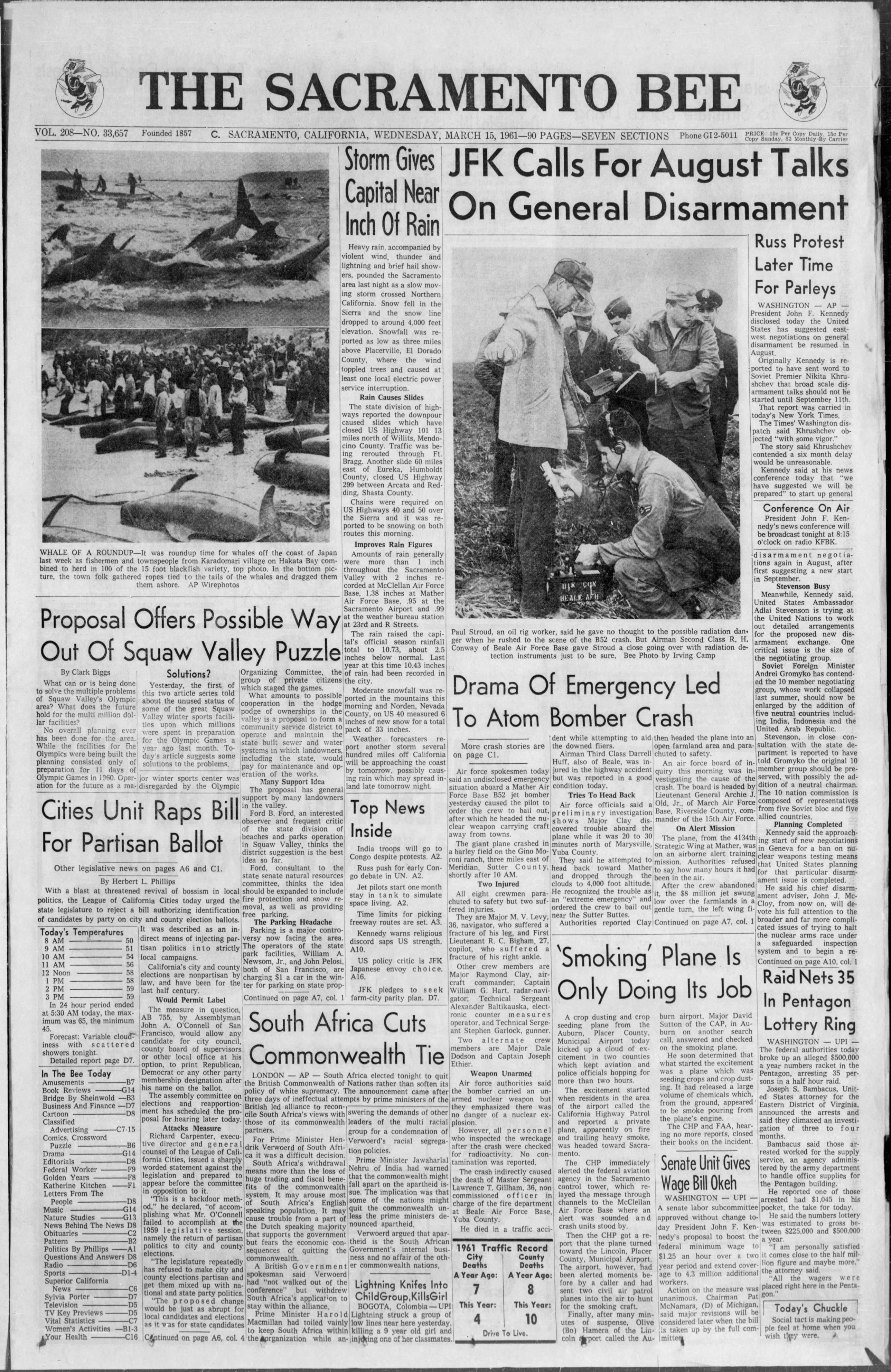
One by one, the crew ejected at altitudes between 4,000 and 7,000 feet. All eight airmen survived, though two suffered broken legs upon landing. A farmer near Yuba City spotted the descending parachutes and rushed to help, pulling the injured airmen to safety before military recovery teams arrived.
Meanwhile, the B-52, now a ghost ship, hurtled earthward and crashed 15 miles west of Yuba City in a fiery explosion. The impact wrenched the Mark 39 nuclear bombs from the wreckage, scattering them upon the soil of Sutter County. The detonation sequences, fortunately, remained intact—this was not to be another Palomares or Goldsboro. The safety interlocks held firm, preventing what could have been one of the most catastrophic nuclear accidents in U.S. history.
While no civilians were harmed by the crash itself, tragedy still found its way to the scene. A fireman from Beale Air Force Base, responding to the emergency, was struck and killed by a motorist near the crash site. It was a sobering reminder of the collateral dangers that came with the Cold War’s ever-present risks.
The legacy of the Yuba City B-52 crash is one of both caution and relief. It highlighted the real dangers of airborne nuclear alert missions, demonstrating the razor-thin margin between control and catastrophe. The Strategic Air Command’s commitment to constant readiness meant that such risks were part and parcel of the era’s military doctrine. Yet the event also underscored the reliability of the safety mechanisms in America’s nuclear arsenal. The fact that neither of the hydrogen bombs detonated was a testament to the rigorous safeguards engineered into these weapons, preventing a worst-case scenario.
Ultimately, the crash of Doe 11 served as a stark reminder of just how close the world often came to unthinkable disaster during the Cold War. For the citizens of California’s Central Valley, it was a surreal experience—one where the apocalypse momentarily brushed against their reality before retreating into history. Today, it stands as another chapter in the long, tense history of nuclear brinkmanship, a near-tragedy with lessons still echoing into the present.



 DAVE DOES HISTORY
Leave a reply to williamrablan Cancel reply