
Shays’ Rebellion, an uprising that unfolded in Massachusetts between 1786 and 1787, stands as a significant event in the early history of the United States. This rebellion, led by Daniel Shays, a former captain in the Continental Army, was primarily fueled by economic grievances and political injustice faced by rural farmers and war veterans in the post-Revolutionary War period. The Springfield Armory, a central site of conflict during the rebellion, played a pivotal role in this historical narrative. The events leading up to the crucial confrontation on January 25, 1787, at the Springfield Armory, illuminate the depths of discontent among the American populace and the challenges facing a young nation struggling to define its governance and societal structure.
Shays’ Rebellion originated from widespread discontent among farmers and veterans who, after the American Revolution, found themselves in dire economic straits. These individuals were heavily burdened by debts and taxes imposed by the state government. The economic policies of the time, which favored creditors and the merchant class, exacerbated the plight of the lower economic classes, particularly in rural areas. The inability to pay debts often led to imprisonment or loss of property, further deepening the sense of injustice.
This period was marked by economic instability, partly due to the lack of a strong central government under the Articles of Confederation. The Confederation Congress lacked the power to regulate commerce or levy taxes, leading to disjointed economic policies across states. In Massachusetts, the situation was particularly severe, with the state government choosing to pay its debts in full, imposing heavy taxes on its citizens.
The Springfield Armory, established in 1777, was the primary arsenal of the young United States and held significant strategic and symbolic importance. As a repository of military equipment, including muskets and ammunition, it became a focal point for both the rebels and the state militia. The control of the armory was crucial, as it represented not only a cache of weapons but also a symbol of the authority and power of the government. The Armory’s role in the rebellion highlights the tension between state power and the grievances of the populace.
The escalation of tensions in Massachusetts reached a critical point in 1786. The state legislature, despite the economic hardship of many of its citizens, continued to levy heavy taxes. This action prompted widespread protests and the closure of several county courts to prevent debt collections and property seizures. In response, Governor James Bowdoin of Massachusetts authorized the formation of a privately funded militia to suppress the growing unrest.
Daniel Shays, disillusioned by the government’s indifference to the plight of the common people, emerged as a leader among the disgruntled citizens. By the end of 1786, Shays had organized a sizable force of rebels. The planned seizure of the Springfield Armory in January 1787 was intended to arm the rebels and challenge the authority of the Massachusetts government. This confrontation would not only be a decisive moment in the rebellion but also a critical juncture in the evolution of the United States as a nation grappling with the balance between state authority and the rights of its citizens.
After achieving independence, the United States faced a multitude of economic problems. The war had left the nation in debt, and the government under the Articles of Confederation struggled with fiscal challenges, including an inability to levy taxes or regulate trade effectively. This weakness led to a fragmented economic policy across states, causing widespread discontent.
In Massachusetts, the situation was particularly dire. The state government, in an effort to pay off its war debts, imposed heavy taxes on its citizens. These taxes disproportionately affected small farmers and war veterans, who were already struggling with economic hardships. Many faced the harsh realities of debt, high taxes, foreclosures, and even imprisonment for unpaid debts. The economic policies favored creditors and the merchant class, deepening the divide between the economic classes.
Daniel Shays, a former captain in the Continental Army, emerged as a leader among those disenchanted with the state government’s policies. Shays, like many veterans, was frustrated with the lack of compensation for his service and the government’s indifference to the suffering of the common people. His leadership resonated with many who felt marginalized and oppressed by the political and economic system.
The discontent led to widespread protests across Massachusetts, beginning in 1786. These protests were primarily aimed at closing county courts to prevent debt collections and the seizure of properties. The movement rapidly gained momentum, as it echoed the sentiments of a significant portion of the population who felt betrayed by a government they once fought to establish.
As the protests grew, the movement began to take a more organized form. Daniel Shays and other leaders started to mobilize a rebel force, comprising mainly of poor farmers, veterans, and those affected by the economic policies of the Massachusetts government. This force sought not only to close courts but also to directly challenge the state government’s authority.
The planning for the seizure of the Springfield Armory in January 1787 was a strategic move by the rebels. Controlling the Armory would not only provide them with much-needed weapons but also symbolize a significant pushback against the state authority. The Armory, holding a large stockpile of military weapons, represented a tangible target for the rebels’ growing frustration and desperation.
January 25, 1787, marked a defining moment in the early history of the United States. On this day, the tensions and frustrations that had been simmering in post-Revolutionary America culminated in a dramatic confrontation at the Springfield Armory in Massachusetts. This encounter between rebel forces, led by Daniel Shays, and the state militia, represented not just a physical clash but a battle over the direction of the young nation.

On that fateful morning, Daniel Shays and his band of rebels, composed largely of distressed farmers and war veterans, marched towards Springfield. Their objective was clear: to seize the Springfield Armory and arm themselves in a stand against what they perceived as an unjust economic and political system. The march to Springfield was fueled by desperation and a sense of injustice, reflecting the deep-seated grievances of many rural Americans in the post-Revolutionary period.
The Springfield Armory held immense strategic importance. It was one of the primary federal arsenals and contained a significant stockpile of weapons and ammunition. For Shays and his followers, capturing the Armory was crucial to leveling the playing field against the better-equipped state militia and making a bold statement against the Massachusetts government. For the state authorities, retaining control of the Armory was vital in maintaining law and order and upholding the power of the government.

Anticipating the attack, the state militia, under the command of General William Shepard, had fortified the Armory. The militia, largely composed of local townsmen and funded by eastern merchants and creditors, was determined to protect the Armory and suppress the rebellion. They had prepared for the confrontation with strategic positioning and readiness to defend the state’s authority.
As the rebels advanced on the Armory, they were met with a formidable defense. General Shepard, having taken a defensive stance, refused to surrender the Armory. The confrontation escalated quickly into an armed encounter. Shepard’s men, positioned strategically, opened fire on the advancing rebels, leading to a short but intense exchange of gunfire.
The rebels, though determined, were outmatched in terms of organization and firepower. The state militia’s strategic positioning and readiness played a crucial role in the outcome of the clash. Shays’ men, lacking the same level of armament and training, found themselves at a significant disadvantage.
The encounter led to several casualties, with fatalities on the rebel side. The exact number remains a matter of historical debate, but the impact was clear: Shays’ Rebellion suffered a significant blow. The defeat at Springfield led to the dispersal of the rebel forces and marked the beginning of the end of the uprising.
The aftermath of the clash at Springfield had far-reaching implications. It underscored the weaknesses of the Articles of Confederation in dealing with internal conflicts and paved the way for the Constitutional Convention, which would result in the drafting of the U.S. Constitution. The events of January 25, 1787, at the Springfield Armory, thus, were not just a moment of confrontation but a catalyst for change in the burgeoning nation.
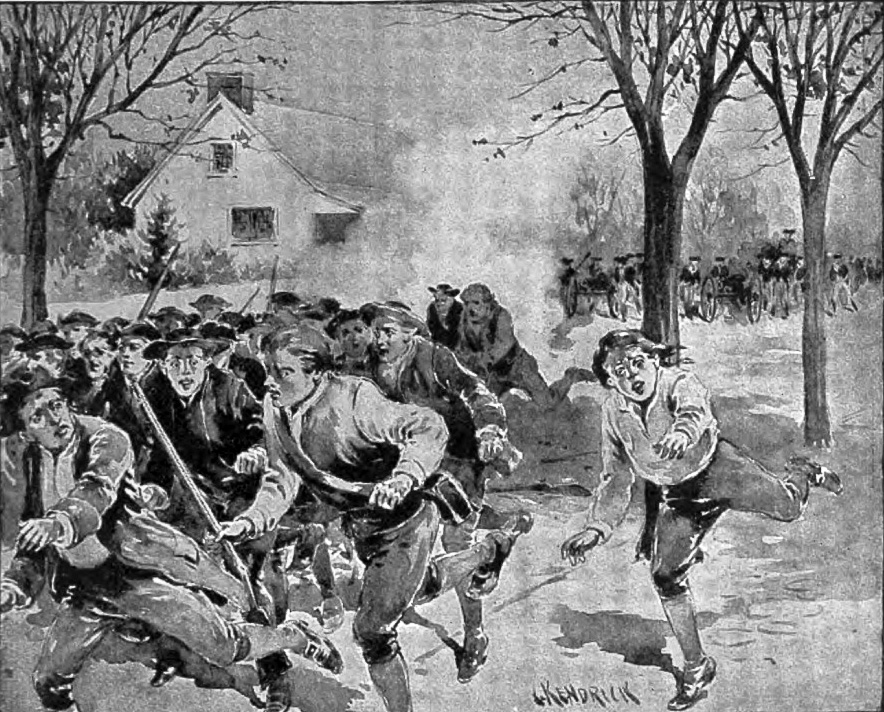
The defeat at the Springfield Armory was a significant blow to Shays’ Rebellion. The rebels’ failure to capture the Armory, a critical arsenal, deprived them of the necessary resources to continue their fight effectively. This setback marked the beginning of the end for the rebellion, as it led to the rapid disintegration of the rebel forces and diminished their influence and capability to challenge the state authority.
The skirmish had immediate political consequences in Massachusetts. It highlighted the weaknesses of the state government under the Articles of Confederation in dealing with internal uprisings. The rebellion and its suppression led to a shift in public opinion and policy in Massachusetts, including reforms in taxation and debt laws. More broadly, the event underscored the need for a stronger federal government, significantly influencing debates at the Constitutional Convention and the eventual drafting of the U.S. Constitution.
In historical memory, Shays’ Rebellion occupies a complex space. It is often viewed both as a symbol of resistance against economic and political injustice and as a demonstration of the challenges facing a new nation in establishing a stable, democratic government.
The rebellion effectively ended shortly after the Springfield skirmish. Many of its leaders, including Daniel Shays, were initially condemned but later pardoned. The rebellion’s end marked a return to stability but left an enduring legacy in American political thought and policy.
The Springfield Armory, the site of this critical skirmish, has since been etched into American history as a symbol of the early challenges and resilience of the United States. It stands as a testament to the nation’s tumultuous journey towards establishing a stable and democratic government.
The legacy of January 25, 1787, extends beyond the immediate events of that day. It represents a moment when the young nation had to confront its internal contradictions and embark on a path towards a more robust and balanced system of governance. The skirmish at Springfield and the broader context of Shays’ Rebellion continue to offer valuable insights into the ongoing journey of American democracy.




 DAVE DOES HISTORY
Leave a reply to FTB1(SS) Cancel reply