
In my lifetime, I have watched Thanksgiving go from a complete holiday – everything was closed and time was spent at home for family, friends, food and football – to a complete non-Holiday, where “Black Friday” started as early as 9am on Thanksgiving Day. Now it’s back to something of a Holiday, with many people rejecting the commercialism that FDR wanted in favor of an actual holiday. But now we also have two more football games (which sucked this year). I personally could go for Thanksgiving every month, as I love the turkey and fixings…
The period between 1939 and 1941 in the United States was marked by an unusual and contentious chapter in the history of Thanksgiving, known as the “Franksgiving” controversy. This term, a portmanteau of “Franklin” (as in Franklin D. Roosevelt) and “Thanksgiving,” refers to President Roosevelt’s decision to move the date of Thanksgiving, stirring a blend of confusion, political debate, and public uproar.
Traditionally, Thanksgiving had been celebrated on the last Thursday of November, a practice that was generally followed since Abraham Lincoln’s proclamation in 1863. However, in 1939, November had five Thursdays, and Thanksgiving was slated to fall on the last day of the month, November 30. Concerned about the economic implications of a shortened holiday shopping season during the Great Depression, particularly for retailers, President Roosevelt announced a significant change: Thanksgiving would be celebrated a week earlier, on the fourth Thursday, November 23.
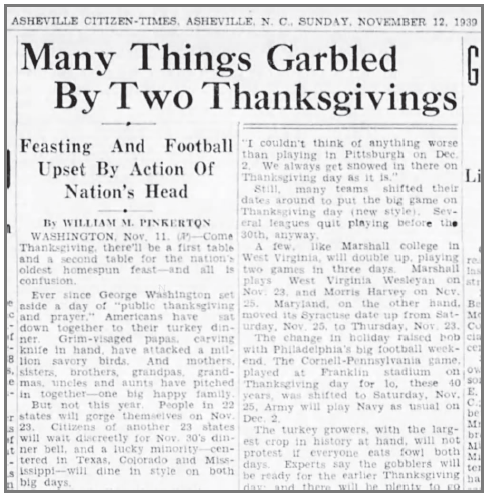
Roosevelt’s decision was met with immediate and widespread controversy. The change was not merely a matter of shifting a date but touched on deeper cultural, political, and economic issues of the time:
1. Economic Divide: Roosevelt’s rationale was economic — to extend the shopping period before Christmas and thus aid in the economic recovery. However, this reasoning did not sit well with everyone, especially those who saw it as an undue commercial influence on a cherished tradition.
2. Political Tensions: The move was seen by some as an overreach of presidential power, exacerbating existing political tensions. Roosevelt was already a polarizing figure due to his New Deal policies, and this decision only heightened the divide.
3. Public Confusion and Division: The sudden change caused considerable public confusion. Not all states complied; some celebrated on the fourth Thursday, while others stuck to the traditional last Thursday. This split led to two different Thanksgiving celebrations across the country.
4. Cultural Impact: Thanksgiving, a holiday deeply ingrained in American culture, symbolizes unity and gratitude. The alteration of its date, therefore, struck a chord with the American public, many of whom viewed it as an unnecessary tampering with tradition.
The “Franksgiving” controversy continued for two years, with some states celebrating on one date and others on another. Recognizing the division it had caused, Congress passed a joint resolution in 1941, which Roosevelt signed, officially setting the date of Thanksgiving as the fourth Thursday in November, a compromise between the traditional last Thursday and Roosevelt’s earlier proposal.
The “Franksgiving” controversy is more than a historical footnote; it reflects the complexities of balancing economic considerations with cultural traditions. It also demonstrates how even a well-intentioned change can become a point of contention in a politically charged environment. The resolution of the controversy, through legislative action, underscores the role of compromise in addressing national issues.
The “Franksgiving” episode from 1939 to 1941 serves as an intriguing example of how traditions, politics, and economic factors can intersect and create significant national debates, leaving an indelible mark on the tapestry of American history.

 DAVE DOES HISTORY
Leave a comment