
The books were some of my favorite early adult reading, and the TV show remains a nostalgic pleasure… (bold and italic my emphasis)
-db
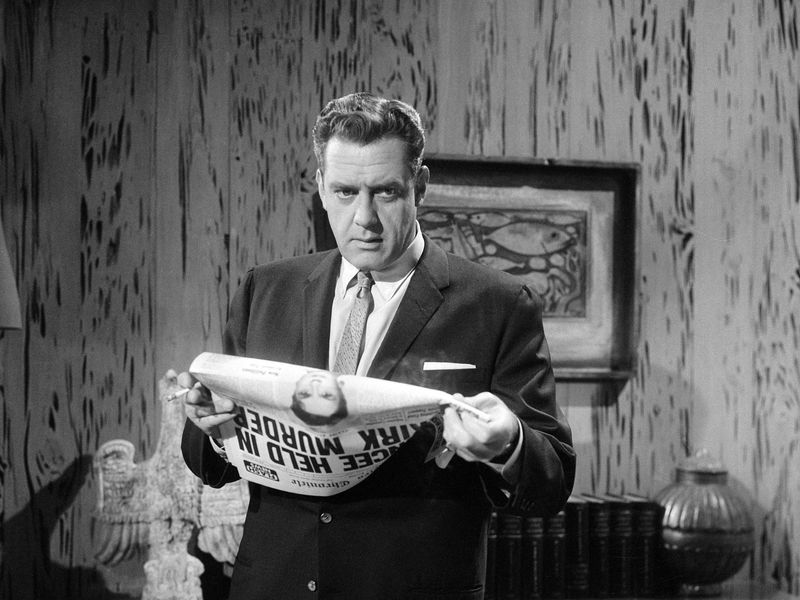 How one of the first courtroom dramas has shaped what we watch and how we see the law
Source: The History of ‘Perry Mason’ | Arts & Culture | Smithsonian Magazine
When it launched on television in the late 1950s, “Perry Mason” represented the birth of the courtroom procedural; it’s still a familiar, if not over-used, genre. For decades, Raymond Burr’s Perry Mason, a criminal defense attorney who almost always emerged from the court victorious was America’s most loved lawyer. The character has been cited in more than 250 judicial opinions, and when Black Panther leader Huey P. Newton was charged with murder in 1968, a party official reportedly asked their potential attorney, “Are you as good as Perry Mason?”
The Perry Mason character, who first appeared in a 1933 novel by Erle Stanley Gardner, is part of a long-lasting franchise that has included more than 80 detective novels, TV programs, Hollywood films, a radio serial, comic books, and most recently, a new series on HBO starring Matthew Rhys of “The Americans.”
The most successful gambit in the franchise by far was the famed hour-long CBS television series starring Raymond Burr, which aired from 1957-1966. Burr was Perry Mason. The Navy veteran, over six feet tall and sturdily built, cut an imposing figure. His wide, brooding eyes and piercing gaze were hallmarks of the character’s trustworthiness and quiet intelligence; the well-dressed L.A. lawyer charmed his way into the confidences of doubtful witnesses. A host of famous faces appeared in guest roles, including Robert Redford, Bette Davis, Angie Dickinson and Burt Reynolds.
Today, you’ll find “Perry Mason” in the DNA of nearly every legal show produced since, from powerhouses like” L.A. Law,” “The Practice” and “Law & Order,” to dozens of one-season flops. The show was the first to make heroes of investigators and defense attorneys, established a longstanding two-act structure and defined conventions like the unexpected confession in a dramatic cross-examination.
The enduring popularity of these tropes and the embrace of the character, however, may mask a more complicated legacy. The show depicted a legal system that worked only for the innocent and the wrongfully accused, a paradigm that fed broader misperceptions about the “blind” infallibility of the judicial system. In the world of “Perry Mason,” justice was neatly served in the end.
A Compelling Formula
If you’ve seen one episode of “Perry Mason,” you’ve seen them all. The show hewed to a two-part structure not unlike the one for which Dick Wolf’s “Law and Order” became famous in the 1990s: A violent crime, usually a murder, comes early in the episode, and Mason agrees to defend the innocent person the police have fingered as their suspect. The first half of the episode is devoted to an investigation of the crime, and the second to a courtroom scene that peaks in a dramatic, often startling confrontation.
Unlike “Law & Order,” however, “Perry Mason” has no allegiance to the police, and the character regularly skirts the law in defense of justice. Mason usually conducts his own investigation alongside the homicide detectives, who invariably come to the wrong conclusion.
With the help of steadfast secretary Della Street and private investigator Paul Drake, Mason pursues the leads and theories the police have failed to see. Mason is not only smarter, but nimbler than the detectives he routinely outwits: They are regularly on the cusp of arresting the falsely accused suspect just as the defense attorney agrees to represent them.
Importantly, this depiction of police work is fairly positive. “Perry Mason” appeared in the same year that muckraking journalist Albert Deutsch released The Trouble with Cops, a stunning indictment of law enforcement corruption in the U.S. The show’s main policeman, Lt. Arthur Tragg, by contrast, isn’t incompetent so much as he is less imaginative than Mason, who also benefits from fewer procedural restraints; in the service of his clients, Mason conceals evidence and misdirects the detectives. It’s little wonder that an early episode finds Tragg shooting rubber bands at a photo of Mason tacked on his office wall. Mason and the homicide squad also have a common enemy in the district attorney, and their shared frustration occasionally produces an unusual and comic congeniality.
In each episode’s second half, always set in the courtroom, Mason reveals the true story of the case, exonerates his client and induces the real offender to come forward, either by standing up among the spectators or through cross-examination on the witness stand. Hapless District Attorney Hamilton Burger, played by William Talman, can do little more than lodge vigorous objections to his opponent’s courtroom theatrics and sputter with outrage. But he, too, takes the defense of the innocent seriously, and he usually congratulates Mason on a case well-argued with some pleasure. (In 1963, California’s governor complained that Burger was a perennial loser. In response, the actor quipped, “Does he want me to convict innocent citizens?”)
Unlike “Law & Order,” however, “Perry Mason” has no allegiance to the police, and the character regularly skirts the law in defense of justice. Mason usually conducts his own investigation alongside the homicide detectives, who invariably come to the wrong conclusion.
With the help of steadfast secretary Della Street and private investigator Paul Drake, Mason pursues the leads and theories the police have failed to see. Mason is not only smarter, but nimbler than the detectives he routinely outwits: They are regularly on the cusp of arresting the falsely accused suspect just as the defense attorney agrees to represent them.
Importantly, this depiction of police work is fairly positive. “Perry Mason” appeared in the same year that muckraking journalist Albert Deutsch released The Trouble with Cops, a stunning indictment of law enforcement corruption in the U.S. The show’s main policeman, Lt. Arthur Tragg, by contrast, isn’t incompetent so much as he is less imaginative than Mason, who also benefits from fewer procedural restraints; in the service of his clients, Mason conceals evidence and misdirects the detectives. It’s little wonder that an early episode finds Tragg shooting rubber bands at a photo of Mason tacked on his office wall. Mason and the homicide squad also have a common enemy in the district attorney, and their shared frustration occasionally produces an unusual and comic congeniality.
In each episode’s second half, always set in the courtroom, Mason reveals the true story of the case, exonerates his client and induces the real offender to come forward, either by standing up among the spectators or through cross-examination on the witness stand. Hapless District Attorney Hamilton Burger, played by William Talman, can do little more than lodge vigorous objections to his opponent’s courtroom theatrics and sputter with outrage. But he, too, takes the defense of the innocent seriously, and he usually congratulates Mason on a case well-argued with some pleasure. (In 1963, California’s governor complained that Burger was a perennial loser. In response, the actor quipped, “Does he want me to convict innocent citizens?”)
Across nine seasons and nearly 300 episodes, Perry Mason never loses—or, more accurately, he never fails. In the famous 1963 episode “The Deadly Verdict,” Mason’s client is found guilty and sentenced to death—but the episode ends with Mason once again saving the day by finding exonerating evidence that springs her from prison. In another episode, he represents a guilty client, but secures a mistrial on the basis of faulty prosecutorial evidence. Perry Mason’s clients are vindicated not because there is reasonable doubt about their guilt, but because the audience has no doubt about their innocence. Perry Mason’s world is one of moral order from beginning to end.
The show is set in Los Angeles, a city that saw serious racial conflicts over residential and housing segregation in the years “Perry Mason” aired. In 1963, the ACLU filed a major racial discrimination lawsuit against the Los Angeles Unified School District; the following year, California voters overturned fair housing legislation. And in August 1965, a clash over a traffic stop turned into six days of civil unrest as residents of the segregated Watts neighborhood rebelled against years of discrimination and police brutality.
Television dramas had begun to grapple with social problems in these years; joining “Perry Mason” on CBS in the 1963-1964 season was “East Side/West Side,” which starred George C. Scott and Cicely Tyson as a white New York City social worker and his black secretary. By glaring contrast, the real-life social and political tumult of Southern California never intrudes on Perry Mason’s world, which is almost exclusively white. Mason defends a Chinese client in one episode and secures the conviction of a Chinese restaurant owner in another. In a 1959 episode, “The Case of the Blushing Pearls,” he defends a Japanese client, played by Nobu McCarthy; actor George Takei plays her attentive nephew.
Mason never defends a black client; on the one occasion when a black actor guest-starred—the Jamaican-born mixed-race actor Frank Silvera—he played a white character. By and large, black men and women appear only in bit parts and uncredited roles. “The Case of the Blushing Pearls” is the first in which a black actor has a small speaking role. Only one episode includes a black character, and his identity is “played for plot and a profit,” as critic Ann duCille observes: He appears in a brief courtroom reveal and settles a question of mistaken identity. This episode, “The Case of the Nebulous Nephew,” aired in September 1963, four weeks after the March on Washington. That year, another episode caused controversy because the trial judge, who had no lines, was a black man.
This was as close as the show got to dealing with race relations, and they considered it adequate. Burr once said in an interview that “people who have watched the show over the years, particularly the minorities, they found out the system of justice was for them.”
But it clearly wasn’t. In its avoidance of race and racism in the legal system, “Perry Mason” presented a distorted view of the world to its overwhelmingly white audiences— one that has, over the years, normalized injustice.
Perry Mason’s victories are always moral, never technical or legal. The tacit message is that the system works when the innocent are vindicated and the guilty convicted. There is never any need to contemplate thornier questions about the biases built into the system.
The Legacy of “Perry Mason”
The trope of the defense attorney as arbiter of moral justice may be the show’s most enduring influence, at least as important as the structural formula the show established. You see this over and over again on legal dramas and cop shows today: defense attorneys are contemptible characters unless they serve the wrongly accused, take on the noble but impossible role of the public defender, or take no satisfaction in their success.



 DAVE DOES HISTORY
Leave a comment