
World War II Diary: 75 Years Ago, Today
By Mark Olivares
Saturday, September 23, 1944
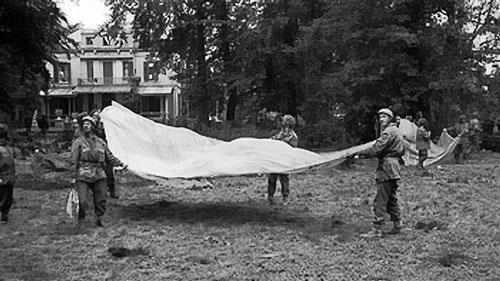
The fighting in Arnhem, Holland continues between the Allied paratroops and the Germans. The British XXX Corps continues attacks in its attempts to advance.
The Germans had figured out what the Poles were attempting to do and they spent the rest of the day trying to cut off the British in their northern bridgehead from the riverside. The British managed to hold on and both sides suffered heavy losses. The Germans also attacked the Poles on the south side in order to tie them down but several tanks arrived from XXX Corps and the German attack was defeated. South of the river, the Poles prepared for another crossing.

That night, they awaited the arrival of assault boats from XXX Corps, but these did not arrive until after midnight, and many were without oars. The crossings started at 03:00, with fire support from the 43rd Wessex Division. Through the remaining hours of darkness, only 153 men were able to cross – less than ¼ of the hoped for reinforcement.
To the south several more German attacks from their position astride the road were stopped but the road was still cut. XXX Corps then sent a unit of the Guards Armoured Division 19 kilometers (12 miles) south and re-took the road. The rest of the force to the north continued to wait for infantry to move up, still only a few kilometers south of Arnhem.
The 325th Glider Infantry Regiment was finally delivered to reinforce the 82nd Airborne, originally planned for 19 September, and while it was immediately 75% effective, arrived far too late to affect the battle in that sector.
The British and Poles have a shortage of food, water, medicine and ammunition due to the fact that most of the supplies dropped fall into enemy hands. Only the long range artillery fire from XXX corps keeps the perimeter intact. It’s uncertain how long the perimeter can hold out.
559 US Eighth Air Force P-38 Lightnings, P-47s and P-51s bomb and strafe flak positions and other ground targets in 2 landing zones in the Nijmegen, the Netherlands area, immediately preceding the arrival of the remainder of the US 82d and 101st Airborne Divisions and the Polish 1st Brigade; the P-38s are flown by Eighth and Ninth Air Force units; they engage 150+ Luftwaffe fighters; USAAF claims 27-2-6 aircraft in the air; 4 P-47s and 10 P-51s are lost.
During the day, RAF Bomber Command sent 50 aircraft, 34 Halifaxes, ten Mosquitos and six Lancasters, to bomb coastal batteries at Domburg; 49 bombed the target without loss. One particularly large explosion is seen.
Versailles, France: with two million men now under his command, Eisenhower is moving his HQ forward to Versailles. The US Seventh Army which landed on the Riviera last month, has linked up with Patton’s Third Army; the Allied front now runs in an unbroken line from the Swiss frontier to the Channel. Since D-Day, the Germans in the west have lost upwards of a million men, half of them prisoners.
Under pressure from Admiral Sir Bertram Ramsey, the naval C-in-C, Eisenhower is giving top priority to clearing the Scheldt estuary of enemy forces and bringing Antwerp’s port into use. The task will be assigned to the Canadians.
As Allied forces begin pushing into Germany itself, resistance is stiffening, though there are signs of divisions between regular German forces and fanatical SS units. When US troops yesterday entered Stolberg, a small town about 40 miles west of Cologne, the mayor offered to help the Americans in locating pockets of resistance. Two German officers appeared with a white flag and said they wished to surrender their platoon. SS units came up and put a stop to that. Deserters are a growing problem. The CO of the German 18th Panzergrenadier Division has issued an order which says that the families of “these bastards who have given away important military secrets” will have to atone for their treason.
In the U.S. Third Army’s XX Corps area, 7th Armored Division drops plans for crossing the Seille River upon receiving orders to join XIX Corps of the First Army. 1st Battalion of the 10th Infantry, 5th Infantry Division, relieves the weakened 2d Battalion at Pournoy-la-Chetive, during the night of 23/24 September. Combat Command R, 6th Armored Division, is attached to corps as mobile reserve and moves to the Jarny area on 24th.
In the U.S. Third Army’s XII Corps area, the 80th Infantry Division extends eastward in the center and on the right as the Germans withdraw, but the enemy retains the hill mass east of Serrieres. The 35th Infantry Division clears Bois de Faulx of enemy rear guards, capturing many. The 4th Armored Division rests after its lively tank battles. In the XV Corps area, the 79th Infantry Division clears Foret de Mondon, the 3d Battalion of the 314th Infantry suffering heavy casualties during frontal assaults. A French patrol crosses the La Vezouse River and takes Domjevin but the Germans restore positions along the river. After nightfall, the final enemy remnants fall back across the river to organize a new defence line.
In the U.S. Seventh Army’s VI Corps area, the 157th Infantry, 45th Infantry Division, is unable to expand its bridgehead toward Girmont; the 179th Infantry takes Mossoux and cuts the road leading northwest from there; the 180th Infantry clears that part of Epinal west of the Moselle River and crosses at 3 points near there. The 36th Infantry Division’s 42d Infantry finishes clearing Remiremont and begins crossing the Moselle; other elements of the division are pushing northward. The 7th Infantry, 3d Infantry Division, reaches the Moselle across from Rupt and about midnight begins crossing over a bridge, which is found to be intact.
In the French 1st Army area, General Jean de Lattre de Tassigny revises his plan of attack as a result of Lieutenant General Lucian K Truscott’s decision to make the main effort with the U.S. Seventh Army while French forces provide flank protection. He calls for an offensive limited in strength to one combat command of the French 1st Armored Division and one regimental combat team of the French 1st Infantry Division. The armor is to attack on an axis Melisey-Le Thillot; the infantry is to conduct diversionary attacks.
In the air, 162 USAAF Eighth Air Force B-24s fly a TRUCKIN’ mission to France delivering fuel.
USAAF Ninth Air Force fighters support the US Third Army in the Chateau-Salins area.
U-267 was the last one to leave the U-boat base at St. Nazaire, France (U-255 remained and eventually surrendered there in May, 1945). She arrived on 29 Oct at Stavanger, Norway.
Canadian units cross the Escaut canal in Belgium during their advance to clear the north bank of the Scheldt.
USAAF Ninth Air Force B-26s and A-20s sent against targets in Germany are recalled due to weather; fighters support the US First Army in western Germany, escort bombers (recalled), and fly armed reconnaissance over wide areas.
The 78th Fighter Group using P-47Ds will receive a Distinguished Unit Citation for its actions over the last six days, covered troop carrier and bombardment operations and carried out strafing and dive-bombing missions during Operation Market-Garden.
During the night of 23/24 September, RAF Bomber Command sent 549 aircraft, 378 Lancasters, 154 Halifaxes and 17 Mosquitos, to bomb Neuss; 492 aircraft bombed the target with the loss of five Lancasters and two Halifaxes. Bomber Command’s report states that most of the bombing fell in the dock and factory areas. In a second raid, 136 Lancasters and five Mosquitos are sent to bomb the banks of the two parallel branches of the Dortmund-Ems canal at a point near Ladbergen, north of Münster, where the level of the canal water is well above the level of the surrounding land. Ninety nine aircraft bombed the Munster Aqueducts with the loss of 14 Lancasters, more than 10 per cent of the Lancaster force. Despite the presence of 7/10ths cloud in the target area, breaches are made in the banks of both branches of the canal and a 6-mile (9,7 kilometer) stretch of it is drained. Most of this damage is caused by two direct hits by 12,000 pound (5 543 kilogram) Tallboy bombs dropped by aircraft of No 617 Squadron at the opening of the raid. In a third raid, 113 aircraft, 107 Lancasters, five Mosquitos and a Lightning, carried out a supporting raid on Handorf Airfield the local German night-fighter airfield just outside Münster; one Lancaster is lost. No photographic reconnaissance flight is carried out after this raid. Sixty five aircraft also bombed Münster itself; the town records 100 high-explosive bombs but no fatal casualties. Two other raids are flown by Mosquitos, 42 bombing Bochum and six bombing the Rheine marshalling yard.
In the Baltic Sea a man was washed overboard from U-370. [Matrosengefreiter Erwin Stiegeler].
U-979 was rammed slightly by a convoy escort in naval grid AE 57, suffering damage to her periscope.
Ten USAAF Fifteenth Air Force B-17s, escorted by P-38s and P-51s bomb the marshaling yard at Wels, Austria.
130 USAAF Fifteenth Air Force B-17s, escorted by P-38s and P-51s bomb the synthetic oil refinery at Brux, Czechoslovakia. Four bombed visually and 126 used H2X radar.
229 B-24s attack communications targets in Italy, including a viaduct at Venzone and road and railroad bridges at Casarsa della Delizia, Pinzano al Tagliamento, Ponte di Piave, Latisana, San Dona di Piave, and Susegana.
Although several missions are aborted because of bad weather in Italy, US Twelfth Air Force medium bombers attack several railroad bridges in the Po River Valley; fighter-bombers hit guns and rail and road targets in the battle area as the US Fifth Army pushes on through the Gothic Line defenses.
Soviet troops reach the Hungarian border after capturing Arad in Romania.
Soviet Army troops reach the Gulf of Riga at Paernu, Estonia.
The Soviet Navy corvette Brilliant (No 29) was torpedoed and sunk by Kriegsmarine (German Navy) U-boat U-957, commanded by Oberleutnant zur See Gerd Schaar, north of Kravkov Island in the Kara Sea in the Arctic Ocean. All of the ship’s complement of 64 died.
The British Special Boat Squadron, Mediterranean, is dropped on Araxos, Greece, on the northwest coast of the Peloponnesian Peninsula, to seize an airfield, from which retreating enemy can be harassed, and to occupy Patras.
The US 5th Army north of Florence, Italy attacks the Futa Pass through the Appennines Mountains.
In the U.S. Fifth Army’s II Corps area, the 34th Infantry Division, with the capture of Montepiano by the 133d infantry, is through the Gothic Line. The 91st Infantry Division rests in preparation for its next task–clearing Mt. Oggiolo, west of the Radicosa Pass. The 338th Infantry, 85th Infantry Division, pushes slowly northward from Mt Coloreta; The 337th Infantry, replacing the 338th in the line, takes the western part of Mt la Fine. The 88th Infantry Division, committing the 351st Infantry between the 349th and 350th, reaches a line Mt la Fine-Mt della Croce. In the British 13 Corps area, the 1st Division occupies Poggio Cavalmagra and pushes on toward Palazzuolo on the left and Marradi on the river. The Indian 8th Division occupies Mt Villanova.
In the British Eighth Army area, 5 Corps is vigorously engaged with the enemy north of the Marecchia River on a delaying line San Arcangelo-Poggio Berni-Montebello. The Canadian I Corps continues to pursue the enemy toward the Uso River. The 5th Armored Division takes responsibility for the left flank of the corps, releasing the British 4th Division for reserve.
In the air, several missions are aborted by bad weather but USAAF Twelfth Air Force medium bombers attack several railroad bridges in the Po River Valley; fighter-bombers hit guns and rail and road targets in the battle area.
In the air, 229 USAAF Fifteenth Air Force B-24s attack communications targets including a viaduct at Venzone and road and railroad bridges at Casarsa della Delizia, Pinzano al Tagliamento, Ponte di Piave, Latisana, San Dona di Piave, and Susegana.
Major General Patrick J Hurley in China sends a report to President Franklin D Roosevelt on telling him of Generalissimo Chiang Kai-shek’s reaction to his (Roosevelt’s) message of 19 September.
On the Salween front, the Japanese send a rescue column to extricate the garrison at Pingka.
In the air, 19 USAAF Tenth Air Force B-24s fly fuel to Liuchow while two others deliver fuel to Kunming.
Fifteen USAAF Fourteenth Air Force B-24s bomb the Burma Road in the Chefang area; 36 B-25s hit Chuanhsien and targets of opportunity in surrounding areas; 6 B-25s bomb Kuanyang, 5 hit Yungming, 12 bomb Lungling, and 2 knock out a bridge near Jinyang; 2 B-24s bomb docks at Amoy; 90+ P-40s and P-51s hit numerous targets of opportunity throughout southeastern China concentrating on Japanese troops in the Chuanhsien area and various targets around Jungyun, Yuankiang, Yungming, Lingling, and Hsuchang.
Six USAAF Fourteenth Air Force B-25s damage the Dara bridge in Thailand.
Nineteen US Tenth Air Force P-47 Thunderbolts attack bridges in Burma along a line Wanling-Bhamo-Myitkyina destroying 1 bridge; 6 B-25s hit bridges south of Meza, destroying 1 and extensively damaging several others.
The German U-boat U-859 is sunk near Penang in the Straits of Malacca, in position 05.46N, 100.04E, by torpedoes from the Royal Navy submarine HMS Trenchant (P 331), commanded by Lt. Commander Arthur R. Hezlet. Twenty of the 67 U-boat crewmen survive. Escaping at an unknown depth an unknown number self escape with Drager gear, the 20 survivors become PoWs. The HMS Trenchant was positioned to patrol off the Penang North Channel due to ULTRA code breaking information.
On Morotai, work is begun on another airfield, named Pitoe Drome, about 1,200 yards (1097 meters) north of Wama Drome.
In the air, during night and day raids USAAF Far East Air Forces B-24s and B-25s concentrate on Sidate and Mapanget Airfields on Celebes Island while P-47s pound Kaoe Airfield on Halmahera Island.
At Allied headquarters in Hollandia, Dutch New Guinea, U.S. Lieutenant General Stephen J. Chamberlin, Deputy Chief of Staff South West Pacific Area, tells Australian Lieutenant General Sir Frank Horton Berryman, General Officer Commanding I Australian Corps, that for planning purposes, the roles of I Australian Corps are (1) Aparri, Philippine Islands, with the earliest date of 20-30 December 1944; (2) Sarangani, Philippine Islands after Lingayen Gulf; and (3) after Sarangani an advance down the west coast of Borneo with Java as an ultimate objective.
In the air, USAAF Far East Air Forces P-47s and P-40s bomb AA guns at Manokwari, Moemi, and Ransiki Airfields.
On Peleliu, Regimental Combat Team 321 of the 81st Infantry Division arrives from Angaur and is attached to the 1st Marine Division. After relieving the 1st Marines on the left flank just north of the third phase line, north of the village of Ngarekeukl, RCT 321 reconnoiters along the coast to Garekoru, near the fourth phase line, without difficulty. Efforts to make a general advance northward, however, fail because of intense fire from the center ridges. The 7th Marines has the task of supporting the drive of the infantry.
On Angaur, the 322d Infantry again drives into the Lake Salome bowl from south but pulls back again when forward positions become untenable.
A U.S. Navy PBY Catalina sank the Japanese auxiliary vessel Toshu Maru off Wowoni, Celebes, Netherland East Indies.

A U.S. Navy PBY Catalina sank the cargo ship Heiho Maru in Celebes Sea.
The Japanese gunboat HIJMS Nankai and transport Hokkai Maru were damaged by mines (laid by submarine USS Bowfin on January 29) off Balikpapan, Borneo. Both vessels would be towed to Surabaya, Java for repairs.
U.S. Navy Task Group 33.19, under command of Rear Admiral William H.P. Blandy, landed the 323d Army Regimental Combat Team (81st Division) on undefended Ulithi Atoll, Caroline Islands. Ulithi would supplant Eniwetok as the U.S. Navy Pacific Fleet’s foremost advanced base in the Pacific theater.
The U.S. Navy submarine USS Apogon (SS-308), commanded by Lt. Commander Arthur C. House Jr., sank the Japanese guardboat No.6 Choyo Maru east of Honshu, Japan.
Fifteen USAAF Seventh Air Force B-24s from Saipan bomb Chichi Jima, Haha Jima, and Ani Jima.
Two USAAF B-24s on armed reconnaissance bomb Marcus Island.
During the night of 23/24 September, a USAAF Seventh Air Force B-24s from Kwajalein Atoll, Marshall Islands, bombs Wake Island.
A USAAF Seventh Air Force on a training mission bombs Pagan Island in the Marianas.
The U.S. Navy battleship USS West Virginia (BB-48) reaches Pearl Harbor and rejoins the Pacific Fleet, marking the end of the salvage and reconstruction of 18 ships damaged at Pearl Harbor on 7 December 1941.
U.S.A.: The motion picture “Arsenic and Old Lace” is released today. This comedy, based on the play by Frank Kesselring, is directed by Frank Capra and stars Cary Grant, Priscilla Lane, Raymond Massey, Jack Carson, Edward Everett Horton, Peter Lorre, James Gleason, Josephine Hull and Jean Adair. The plot has Grant discovering that his kindly old aunts (Hull and Adair) and his sinister brother (Massey) are all serial killers and tries to sort it out fast so he can go on his honeymoon with Lane.





 DAVE DOES HISTORY
Leave a comment