
Did the ancient Greeks name their ships? The answer to that is yes. And with rare exception, the ships were given female names.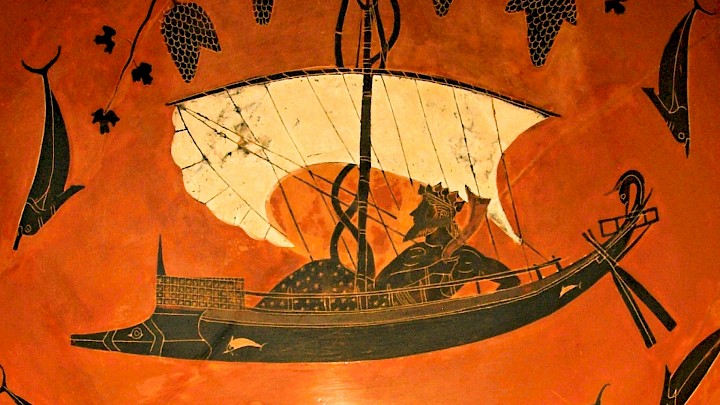
Source: Names of ancient Greek ships – Ancient World Magazine
In the game Assassin’s Creed: Odyssey, the player eventually gets a ship called the Adrestia. A reader sent in a question to ask if, historically, the ancient Greeks did indeed name their ships. The answer to that is: yes.
Literary evidence
The earliest evidence that the Greeks named their ships comes from the story of Jason’s quest for the Golden Fleece, which was already known to Homer (ca. 700 BC). The Fleece itself was located in Colchis (modern Georgia). Jason gathered heroes from all around Greece to get this object, and to reach their destination they made use of a ship called the Argo(“Swift”, a male name) in honour of its builder, Argos (Latinized: Argus). The heroes who sailed in the vessel were the Argonauts, from Greek Argonautai; nautai means “sailors”.
We have no idea if the thousand ships that the Greeks used in the Iliad to reach Troy had names. Homer doesn’t tell us. Likewise, we have no idea if Odysseus’ ships were named, since this is left unmentioned in the Odyssey. It seems likely that unless the ship was somehow special, like the Argo, a poet wouldn’t bother with burdening his audience with the names of his heroes’ ships.
As far as I know, the next reference to named ships can be found in Xenophon’s Hellenika. Two ships are mentioned. The first is the Paralos, a ship that was used to convey news about the loss at Aegospotami (405 BC) to Athens (Xen. Hell. 2.1.28-29 and 2.2.3). The second was the Salaminia(6.2.14), named after the island of Salamis, where the Athenian fleet had won a major victory over the Persians in 480 BC.
Both vessels were so-called “sacred ships”, used mostly as messenger ships or to transport special delegations to, for example, Delphi. It’s interesting that the Paralos is mentioned alongside the Salaminia in the sixth book of the Hellenika. The date for the second reference is 373 BC: if this is the same Paralos that escaped from the Spartan Lysander at Aegospotami in 405 BC, that means it served in the Athenian fleet for more than three decades.
Attic inscriptions
In any event, the ancient literary evidence for ancient Greek ship names is a bit meagre. Fortunately, we also have a series of inscriptions from Athens that are known as the Tabulae Curatorum Navalium. These inscriptions date to the fourth century BC, between 377 and 322, and are currently in the Epigraphical Museum in Athens. These inscriptions, often fragmentary, are inventories of Athens’ fleet and its equipment, and were compiled each year. They give an overview of ships and what equipment is missing or damaged for each of them, such as ladders, masts, rudders, and sails.
On his Classics Pages, Andrew Wilson gives a brief rundown on the Tabulae Curatorum Navalium and provides an overview of the names immortalized in the inscriptions. The names – all female – are derived from heroines and goddesses (like Pandora and Aphrodisia), places (including Hellas and Eleusis), animals (e.g. Dolphin), objects (e.g. Sling), concepts (e.g. Freedom, Breeze, Justice), descriptions (e.g. Swift, Conquering, Beast), and even two verbs. The lists preserve around 300 names in total.
The inscriptions themselves are also available online. You can start at IG II² 1614 and then use the navigation options along the top to work your way to IG II² 1628. Even if you don’t know any ancient Greek, you’ll be able to make out some names from Andrew Wilson’s list even on the very first of the pages about these inscriptions, such as Euetêria (“Prosperity”), Parataxis(“Fighting alongside”), Asklepia (the daughter of the healing god Asclepius).
Closing thoughts
Of course, the Greeks weren’t alone in naming their ships. In chapter 15 of his Ships and Seamanship in the Ancient World (1995 [1971]), Lionel Casson describes how the ancient Egyptians, long before the rise of Athens, had named their ships primarily after the king (e.g. Ramses II Who Propitiates the Aton or Merenptah Beloved of Sakhmet), but sometimes also after other deities, animals, or the country itself.
For the Romans, we have a wealth of evidence, especially for the Imperial period. They named their vessels in a similar manner to the Athenians, except that they included many male names, such as Cupido, Hercules, Aquila(“Eagle”), Taurus (“Bull”). The inclusion of Cupido might seem strange, but the Julio-Claudian imperial dynasty was descended via Julius Caesar and Aeneas from his mother, Venus (Aphrodite).Show




 DAVE DOES HISTORY
Leave a comment