
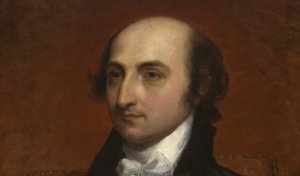
 On February 28, 1794, future Treasury Secretary Albert Gallatin was denied his elected U.S. Senate seat after a group of Federalists claimed he didn’t meet a constitutional citizenship requirement for office.
Source: An early citizenship controversy in the U.S. Senate – National Constitution Center
There was a considerable debate at the Constitutional Convention in 1787 about the citizenship requirements for elected federal officials to hold office. The Committee of Detail wanted a four-year citizenship requirement for Senators, while Gouverneur Morris pushed for a 14-year requirement. A compromise led to a nine-year requirement for Senators that became part of Article 1, Section 3. (A person also needed to be at least 30 years old was assuming a Senate seat.)
A year before Gallatin’s removal, the Pennsylvania legislature met to elect a Senator to represent the state in Congress in December 1793. At the time, Pennsylvania didn’t use the popular vote to elect Senators, and the federal Congress met in Philadelphia for a transitional period between 1790 and 1800.
Gallatin, a Swiss émigré, came to America in 1780 and traveled around quite a bit. He had also served briefly as a volunteer in the Continental army, taught French at Harvard, and bought land in western Pennsylvania and Virginia. Gallatin was named to the convention that considered and ratified Pennsylvania’s state constitution in 1789, and he had served in the state legislature since 1790.
Gallatin was also a member of a political faction, what we now call the Democratic-Republicans, that opposed many of the financial policies promoted by Alexander Hamilton and the Federalists. However, the Federalist-dominated Pennsylvania legislature chose Gallatin over Henry Miller, a Federalist from York County, as its next Senator.
When Gallatin arrived in Philadelphia, Vice President John Adams administered Gallatin’s oath on December 2, 1793. But as soon as Gallatin was seated in the Senate, a group of 19 Federalists from York County petitioned the Senate to disqualify Gallatin for not meeting the Article I citizenship requirement.
The controversy forced the Senate to consider the debate in a new way by opening its meetings to the public. And in the end, Gallatin lost his seat when a key supporter, Robert Morris, switched his vote to fall in line with the Federalists in the Senate.
The Senate heard testimony from Gallatin and William Lewis, a Federalist attorney representing the York County group. Gallatin argued that he had resided in the United States since 1780 and made various arguments based on state constitutions and common laws. Lewis insisted that Gallatin hadn’t qualified for citizenship in Virginia because of its residency and property requirements, and questioned if Gallatin was even a citizen at that very moment.
During the same period, Gallatin was allowed to take part in Senate activities and he proposed a series of annual reports from Hamilton’s Treasury Department to Congress, which angered Hamilton. On February 28, 1794, Morris cast the deciding vote against Gallatin, going against a prior commitment to remain neutral in the proceedings.
Today, the Gallatin hearing is best known as the first procedure that opened the Senate’s doors to the public. It would take several years for galleries to be added to the Senate chamber in Philadelphia.
Gallatin’s citizenship was not an issue when he was elected to the House of Representatives in 1795. He continued to fight with Hamilton and served 13 years as Treasury Secretary under Thomas Jefferson and James Madison. Gallatin also helped to found the House Ways and Means Committee.
Scott Bomboy is the editor in chief of the National Constitution Center.




 DAVE DOES HISTORY
Leave a comment