
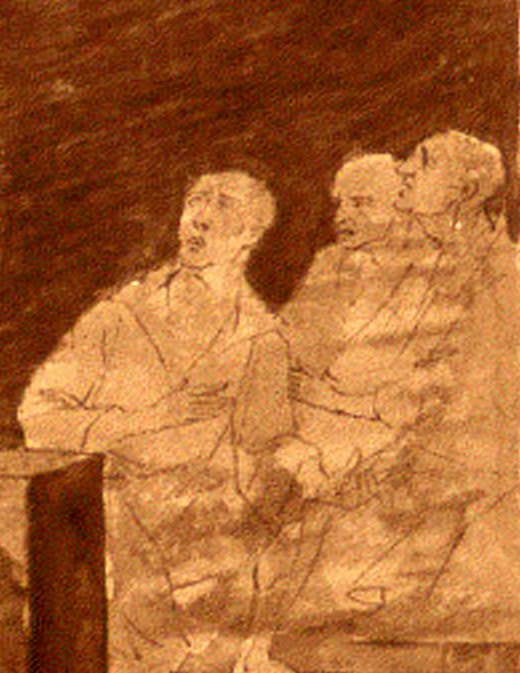
 The British Army held New York City from 1776 to November 25, 1783. In prisoner exchanges, royal forces in New York periodically released prisoners of war who were “sickly and emaciated.” Sometimes the prisoners numbered a few dozen, sometimes a few hundred. In 1776, however, British military commander Lt. Gen. Sir William Howe released more than 2,000 prisoners. The sudden appearance of 2,000 dying men was a national trauma for the United States.[1]
Source: 1776—The Horror Show – Journal of the American Revolution
In a series of clashes, from the Battle of Long Island (August 27, 1776) to the capture of Fort Lee (November 20, 1776), Howe secured New York City. Joshua Loring, a Massachusetts Loyalist, served Howe as commissary general of prisoners. According to Loring, Howe captured 4,101 privates, 304 officers and 25 staff of the Continental Army. Historian Edwin G. Burrows noted Loring’s list overlooked an unsuccessful Patriot raid on Montresor’s Island, now Randall’s Island (September 23, 1776), that brought the number of captive soldiers to 4,114 and captive officers to 305.[2]
On October 7, Howe extended to Continental officers the customary right of parole. On their pledge as officer-gentlemen to not escape British lines, the American officers found lodging on British-held sections of Long Island. Continental soldiers, however, remained warehoused in prison ships, and in sugar refineries, non-Anglican churches, and other large buildings appropriated by Howe. Many paroled Continental officers visited the captive soldiers. As the health of the soldiers deteriorated, however, some officers found it unbearable to witness suffering they could not alleviate.[3]
From late December 1776 through January 1777, Howe released just under 2,300 Continental soldiers on parole, an arrangement usually reserved for officers. On January 29, Howe informed Gen. George Washington that only an “inconsiderable Number” of prisoners remained in New York. There was a discrepancy between the 4,114 soldiers Howe captured and the remnant he released. Several hundred had joined Loyalist regiments like the Royal Highland Emigrants, but one sarcastic Patriot nonetheless remarked that Howe sent out all the soldiers, but “one half he sent to the world of spirits for want of food.”[4]
Former-prisoners recalled the spike in prisoner deaths that prompted Howe’s frantic mass-release. Pvt. John Adlum wrote, “In the churches and sugarhouse the mortality was dreadful in the latter part of the month of December and January.” Pvt.William Darlington recalled the moment prisoners “began to die like rotten sheep” from “cold, hunger, and dirt.” Likewise, Pvt.Thomas Boyd’s fellow-prisoners “began to die in heaps.”[5]
To preserve a claim on British soldiers held by Patriot forces, Howe loaded prisoners by the hundreds onto transport ships. The Glasgow, for instance, dropped about 200 soldiers near Milford, Connecticut. Two ships carried about 300 prisoners to South Amboy, New Jersey. Col. Ethan Allen, an officer on parole in New York, recalled several prisoners “fell dead in the streets of New York, as they attempted to walk to the vessels in the harbor, for their intended embarkation.”[6]
Several prisoners died on their voyage. Pvt. Oliver Woodruff recalled twenty-eight prisoners passed away on the Glasgow in the several days it took to reach Milford; the Connecticut Journal put the number at twenty. The two ships bringing prisoners to South Amboy anchored only one night off Staten Island. In that night, six prisoners died, three on each vessel, recalled John Adlum, one of the prisoners dumped at South Amboy.[7]
Once ashore, the prisoners kept dying. Woodruff recalled nineteen prisoners died the first night after landing at Milford. Adlum helped a tottering prisoner off a boat, only to find him dead moments later.[8]
Many prisoners languished for weeks where they landed. Based on information from Col. William Humpton, the Continental Congress Executive Committee reported to John Hancock, president of Congress, that most prisoners in South Amboy were too “weak & sickly” to travel any further. The Connecticut Journal published the names and hometowns of thirty-two returned Connecticut residents who “lie sick at Milford.”[9]
The unexpected arrivals tested a town’s resources. South Amboy residents were “carting” the prisoners from house to house, “to get the burthen of them from one to another.” The Executive Committee asked William Shippen Jr., director of hospitals for the Flying Camp in New Jersey, to secure medicine and provisions for the “poor Creatures,” who “perish for want of Physick & food.”[10]
Sadly, John Adlum wrote, “Numbers of those who were prisoners died on the road in going home.” Writing from Wethersfield, Connecticut, Col. John Chester described returning prisoners “dying along the road.” In their joint deposition, privates William Houston and Samuel Young of Pennsylvania claimed that “many of those who were released died upon the road before they reached home.”[11]
As prisoners struggled to return home, shock rippled through the country.According to John Chester, returnees were “mere skeletons.” Chester wrote, “Humanity cannot but drop a tear at sight of the poor, miserable, starved objects.” In a 1777 sermon in Lancaster, Pennsylvania, Continental Army chaplain Hugh Henry Brackenridge cried, “We saw them—oh spectacle of horror and commiseration!” Brackenridge described the typical figure with “belly contracted to the ribs,” “the eye sunk and hid within the head” and “the voice shrill, feeble and not to be distinctly heard.” Brackenridge even mentioned swollen lower extremities of famine edema, “legs swollen, and from the ankle to the knee of an equal shape.”[12]
Brackenridge described what might have been a typical experience for survivors who reached home. The chaplain described townspeople crowding around a returnee, begging to know about missing loved ones. “Ask one of these what became of his companion whom we see not? He died the first week partly with hunger and partly with cold. He recommended his wife and infant children to God . . . What became of another whom we see not? He died the second week on board the ships by the badness . . . of the food which was served to us.”[14]
The mass prisoner release ended January 27, 1777. James McHenry, a surgeon with the Continental army captured at the Battle of Fort Washington (November 16, 1776), left New York on parole with eighty-one Continental soldiers. These, McHenry wrote, were “the sick privates and those that remained of the well.” From Hightstown, New Jersey on January 31, McHenry reported, “Six have died since our leaving New-York.”[15]
A month after the mass release ended, most of the returnees were probably dead. Two Continental officers, recruiting in different regions of the United States, offered George Washington two similar assessments in February 1777. From York, Pennsylvania, on February 12, Col. Thomas Hartley reported that most returning prisoners lived just long enough to see their families again. The prisoners “return Home to tell the doleful Story of their Captivity and Distress” and “almost all these Die in a few Days after they have joined their Families.” Reporting from Lyme, Connecticut, on February 19, Brig. Gen. Samuel Holden Parsons estimated “about Three Quarter parts” of returnees in that area were already dead.[16]
On January 23, before sending out the last returnees, Howe appointed a British officer, Lt. Col. William Walcott, to negotiate for Washington’s release of an equal number of British prisoners. Washington authorized Continental Lt. Col. Robert Hanson Harrison to negotiate what proportion of the returnees were fit to consider for exchange. Meeting Walcott on February 17 and March 10, 1777, Harrison explained that Continental forces would not release a number of British soldiers equal to the number of prisoners Howe released, because so many of the returnees died on their way home, or shortly after arriving, “owing to their close & rigorous confinement.”[17]
Walcott observed the returnees were “delivered over alive.” For Walcott, it hardly mattered that prisoners died a month or a minute after their return. The prisoners were alive the instant Howe released them. Besides, Walcott added, Howe could not prevent high mortality among the returning prisoners, if prolonging their lives was “contrary to the will of the Supreme Being in whose Hands only are life and death.”[18]
The mass release preempted an official exchange, but Howe and Walcott implied the returnees were virtually exchanged. Walcott, however, sabotaged this pretense. When talks with Harrison stalled, Walcott relayed a note to Washington through British officer Lt. Gen. Charles, Earl Cornwallis. The officers and privates released on parole were subject to recall to New York at Howe’s discretion, until they were formally exchanged. Walcott no doubt meant to threaten the officers with recall to New York when he reminded Washington that the officers, as well as the privates, were still considered Howe’s prisoners “untill They shall be regularly exchanged.”[19]
Washington capitalized on Walcott’s slip. Washington informed Howe, “It is confessed . . . on all sides, that after their delivery they still continued your prisoners & would be so, till regularly exchanged.” Even if paroled Continental soldiers died at their homes, they were still Howe’s prisoners when they died. Hastily dumping prisoners just before they expired hardly exonerated Howe in the “speedy death of a large part of them.”[20]
Washington wished Howe released the prisoners on humanitarian grounds much sooner, “before these ill fated men were reduced to such extremity.” Washington’s expectation was not outlandish by the standards of the age. In his 1758 work The Law of Nations, first published in English in 1760, Swiss jurist Emmerich de Vattel wrote that if prisoners of war are too numerous “to be kept or fed with safety,” even if it strengthens the enemy, “These prisoners are sent back on their parole, not to carry arms for a certain time, or to the end of the war.”[21]
The dispute over the returnees lasted for the remainder of Howe’s command. The protracted dispute provided several estimates of returnee numbers. In January 1778, Henry Hugh Ferguson, the Scottish-born Loyalist who served as commissary of prisoners in Philadelphia, listed 1,701 privates as “Returned by Sir William Howe and for whom none are sent back in exchange.”[22] Howe and Walcott offered an estimate higher than Ferguson offered. Walcott insisted Howe released “upwards” of 2,200 Continental privates. Writing to British Gen. John Burgoyne on November 16, 1777, Howe mentioned the 2,200 Continental soldiers “that I sent in last Winter, in full Confidence of receiving an equal Number in Return, which . . . has been pointedly refused under the most frivolous Pretences.”[23]
In March 1778, American commissary of prisoners Elias Boudinot mentioned “1821 Privates in dispute.” This figure was a subset of the returnees. Joshua Loring showed his ledger of prisoners to Ambrose Serle, the civilian secretary of Royal Navy Adm. Richard, Viscount Howe, a brother of General Howe. In his diary, Serle raged that “above 2000 of them have been released (1800 & upwards of those taken at Fort Washington) upon their Parole, and the Rebels refuse to return us a man in their Room—such is their insult towards us!” By March 1778, Howe apparently only demanded a full return for the Fort Washington soldiers.[24]
With the surrender of Fort Washington, 2,607 Continental privates became prisoners. About two months later, Howe released only 1,821 of those soldiers. From death and recruitment, soldiers from Fort Washington lost thirty percent of their number.[25]
Walcott indicated the returnees totaled over 2,200, implying the number did not reach 2,300. Allowing for 2,299 returnees leaves 1,815 (about forty-four percent) who disappeared from Howe’s custody. Some prisoners escaped. Historian Francis D. Cogliano estimated about eight percent of the Patriots held at Mill Prison, in Plymouth, England, escaped during the war. The British military prisons of New York left no comparable records, but Edwin G. Burrows documented several escapees who met little resistance. Patriots detained in Britain, however, had the sympathy of nearby civilians. The care of the civilian populace also meant captive Patriots in Britain were in better condition than prisoners in British-occupied New York.[26]
Royal recruiting officers siphoned off some prisoners. In his memoirs, Continental Ens. Isaac Van Horne recalled “a great number” of soldiers “enlisted with the enemy” to escape starvation. Lt. William Sterett, however, indicated Royal recruiters had little success with prisoners. Thomas Boyd even “thanked heaven” that most prisoners preferred to die rather than serve “the emissaries of the Prince of Darkness.”[27]
Loring claimed “upwards” of 700 Continental soldiers in 1776-77 offered to enlist, but Howe refused the offer. Loring was probably incorrect about Howe refusing prisoner-enlistees, but probably right about the numbers. If 799 prisoners enlisted with Howe, then perhaps 1,016 (24.7 percent) of captive Patriot soldiers died in 1776. The figure drops below seventeen percent if, as in Mill Prison, eight percent of prisoners escaped from New York facilities.[28]
By the customs of European warfare, Patriot authorities owed Continental soldiers pay and clothes during their custody. On December 5, 1776, Howe warned Washington that prisoners, namely the sick and wounded, needed “Accomodation, Refreshments, & Attendance” that Howe could not provide. After releasing the prisoners, though, Howe claimed he provided them “proper Habitations, sufficient and wholesome Food, and Medicines.” In 1777, Howe claimed Patriot prisoners lacked only money and clothes, items Patriots owed the prisoners.[29]
Washington noted that returnee testimony was unanimous. Prisoners alleged they received insufficient food, and what they did get was often “bad in quality.” Washington believed returnee testimony was “confirmed by their appearance.” Washington repeatedly claimed proof of neglect was in the “emaciated bodies” or “miserable emaciated” faces of returnees.[30]
A third party, however, neglected its duty in 1776. Historians found the British public sustaining French prisoners in Britain during the Seven Years’ War (1756-1763). A 1777-78 fundraiser for Patriot prisoners in Britain had the support of students from a Quaker boarding school and patrons of a London tavern. During the American Revolution (1775-1783), the death rate for Patriots in two English prisons was below five percent.[31]
Patriots knew Britain’s reputation for compassion toward enemy prisoners. Consequently, Patriots were slow to respond to reports of prisoner suffering. In 1777, the Board of War of the Continental Congress claimed that “a Remembrance of what Britons once were lull’d us into an Inattention to what they now are.”[32]
The prisoners themselves were shocked. Thomas Boyd claimed death “stared each [prisoner] in the face, in a city possessed by pretended Christians.” Pvt. James Stuart found “the inhabitants of the city were implacably cruel and hard hearted to the prisoners.” A committee of the Continental Congress, appointed to investigate war crimes by royal forces, asserted the lack of charity from “inhabitants who remained in or resorted to the city of New-York” was “never known to happen in any similar case in a Christian country.”[33]
The Loyalists who “resorted to” New York City were hostile toward Patriot prisoners. Most New Yorkers fled the city before the British occupation. Based on information from British Maj. Gen. James Robertson, the British press reported that Howe’s forces found New York City “almost without Inhabitants.” Thanks to an influx of Loyalists from the rest of the United States, by February 17, 1777, the city had “upwards of 11,000” inhabitants.[34]
John Witherspoon was a Presbyterian minister, a New Jersey delegate to Congress, and the sixth president of the College of New Jersey (now Princeton University). Witherspoon believed Loyalists were “insensibly biassed” from overusing the word “rebel.” Signifying an illegal combatant, “rebel” was a powerful slur in the eighteenth century. Witherspoon also knew many Loyalist were “roughly handled by the multitude” early in the conflict. The combination of indoctrination and resentment radicalized many Loyalists to militance.[35]
People least able to help were the most likely to try. Ethan Allen wrote, “Some poor women contributed to their necessity, till their children were almost starved.” Continental Lt. Robert Troup recalled that prisoners had the assistance of “some poor persons and common prostitutes.”[36]
Historian John Fabian Witt suggested most prisoners in 1776-77 died from smallpox, not starvation. Privation, however, facilitates illness. Smallpox is more damaging to the undernourished than to the sated. Starvation benefits lice-borne diseases like typhus, by causing lethargy and heightening sensitivity to cold. Washing clothes at least once per week breaks the life cycle of lice. Even if prisoners had water and soap for washing clothes, starving people might neglect the chore, especially in winter. Alas, an unsympathetic observer blamed sickness among prisoners on “their own Laziness and Filth.”[37]
Patriots recognized the interaction of hunger and disease. Oliver Woodruff spoke of “disease occasioned by hard treatment and hunger.” A Patriot editorial from 1779 claimed it “requires no great sagacity” to predict “crowding people together” and “starving them” would “unavoidably produce a contagion.”[38]
The trauma of 1776 lingered with many Patriots. John Adams was rattled in 1777, as Congress investigated prisoner abuse. Adams lamented, “I who would not hurt the Hair of the Head of any Animal . . . am obliged to hear continual Accounts of . . . the most tormenting Ways of starving and freezing, committed by our Enemies.” As late as November 1782, Adams mentioned “the Prison Ships, and the Churches at New York, where the Garrisons of Fort Washington were starved in order to make them inlist.”[39]
In November 1782, John Witherspoon also remembered the gaunt figures of 1776. Delivering a sermon in New Jersey, Witherspoon said every part of the United States knew prisoners suffered, “But we in this state, through which they passed to their homes, can never forget the appearance of the emaciated spectres.”[40]
[1]The Continental Journal, and Weekly Advertiser (Boston), February 4, 1779; The Connecticut Gazette; and The Universal Intelligencer (New London), August 24, 1781; Paper From Lieutenant Colonel William Walcott, April 2, 1777, Founders Online, National Archives, founders.archives.gov/documents/Washington/03-09-02-0049(Walcott Paper); Edwin G. Burrows, Forgotten Patriots: The Untold Story of American Prisoners of War During the Revolutionary War (New York: Basic Books, 2008), 64-65; Jabez Fitch, The New-York Diary of Lieutenant Jabez Fitch, ed. William H. Waldon Sabine (New York: Colburn & Tegg, 1954), 93n1; David Hackett Fischer, Washington’s Crossing (New York: Oxford University Press, 2004), 378.
[2]Joshua Loring, “Return of Prisoners taken during the Campaign, 1776,” enclosed in Sir William Howe to Lord George Germaine, December 3, 1776, The New-York Gazette; and the Weekly Mercury, March 17, 1777; Burrows, Forgotten Patriots, 296n1.
[3]John Nice, “Extracts from the Diary of Captain John Nice, of the Pennsylvania Line,” ed. Edward Burd, The Pennsylvania Magazine of History and Biography 16 (1893): 404; Burrows, Forgotten Patriots, 21-26, 50-53; Fitch Diary, 54, 148; Alexander Graydon, Memoirs of a Life. . . (Harrisburg, PA: John Wyeth, 1811), 211-212; Ethan Allen, “Narrative of Colonel Ethan Allen’s Treatment during His Captivity,” The Pennsylvania Packet or the General Advertiser, November 16, 1779.
[4]Walcott Paper; William Howe to George Washington, January 29, 1777, Founders Online, founders.archives.gov/documents/Washington/03-08-02-0189; Extract of a Letter from Peeks kill (Peekskill, New York), January 19, 1777, The Continental Journal, and Weekly Advertiser (Boston), February 13, 1777.
[5]John Adlum, Memoirs of the Life of John Adlum in the Revolutionary War, ed. Howard H. Peckham (Chicago: The Coxton Club, 1968), 125 (Adlum Memoirs); affidavit of William Darlington, February 27, 1777, Pennsylvania Evening Post, May 3, 1777; affidavit of Thomas Boyd, February 27, 1777, Pennsylvania Evening Post, May 3, 1777 (Boyd Affidavit).
[6]Burrows, Forgotten Patriots, 63; Allen, “Narrative,” Pennsylvania Packet, November 20, 1779; The Connecticut Journal (New Haven), January 8, 1777; Adlum Memoirs, 135-137.
[7]Oliver Woodruff, Revolutionary War Pension Application, September 27, 1832, Pension Number s14885, National Archives, at Fold3 by Ancestry.com, www.fold3.com/image/28402390 (Woodruff Application); Connecticut Journal, January 8, 1777; Adlum Memoirs, 137.
[8]Woodruff Application; Adlum Memoirs, 137.
[9]Executive Committee to John Hancock, January 30, 1777, Letters of Delegates to Congress, 1774-1789, vol. 6, January 1, 1777-April 30, 1777, ed. Paul H. Smith (Washington, DC: Library of Congress, 1980), 163; Connecticut Journal, January 8, 1777.
[10]Executive Committee to Hancock, January 30, 1777.
[11]Adlum Memoirs, 143; Webb Correspondence, 184; Affidavit of Samuel Young and William Houston, December 15, 1776, in Pennsylvania Evening Post, May 3, 1777.
[12]John Chester to Samuel Blachley Webb, January 17, 1777, in Correspondence and Journals of Samuel Blachley Webb, vol. 1, ed. Worthington Chauncey Ford (Lancaster, PA: Wickersham Press, 1893), 184 (hereafter Webb Correspondence); Hugh Henry Brackenridge, “The Bloody Vestiges of Tyranny,” in Hugh Henry Brackenridge, A Hugh Henry Brackenridge Reader, 1770-1815, ed. Daniel Marder (Pittsburgh: University of Pittsburgh Press, 1970), 66 (Brackenridge Reader); Joseph Stein and Henryk Fenigstein, “Pathological Anatomy of Hunger Disease,” Myron Winick, ed., Hunger Disease: Studies by the Jewish Physicians in the Warsaw Ghetto, trans. Martha Osnos (New York: John Wiley & Sons, 1979), 227; Todd Tucker, The Great Starvation Experiment: Ancel Keys and the Men Who Starved for Science (Minneapolis: University of Minnesota Press, 2007 [2006]), 140.
[13]Christopher Marshall, The Diary of Christopher Marshall, ed. William Duane (Albany, NY: Joel Munsell, 1877 [1839]),110.
[14]Brackenridge Reader, 66-67.
[15]James McHenry to Washington, January 31, 1777, Founders Online, National Archives, founders.archives.gov/documents/Washington/03-08-02-0214.
[16]Thomas Hartley to Washington, February 12, 1777, in George Washington,The Papers of George Washington, Revolutionary War Series, vol. 8, January-March 1777, ed. Dorothy Twohig (Charlottesville: University Press of Virginia, 1998), 317-318, also in Founders Online, founders.archives.gov/documents/Washington/03-08-02-0341; Samuel Holden Parsons to Washington, February 19, 1777, inFounders Online, founders.archives.gov/documents/Washington/03-08-02-0406.
[17][Alexander Hamilton], List of Questions Regarding a Prisoners Exchange, undated, enclosed in Washington to the Continental Congress, March 18, 1777, The Papers of the Continental Congress, 1774-1789, National Archives Microfilm Publication M247, roll 167, item 152, Record Group 360, at Fold3 by Ancestry.com, http://www.fold3.com/image/395942 (Washington to Congress, March 18, 1777), William Walcott and Robert H. Harrison, Objections, etc., undated, enclosed in Washington to Congress, March 18, 1777, www.fold3.com/image/395973. Harold C. Syrett, editor of the Papers of Alexander Hamilton, supposed Hamilton’s list dated from 1778; Questions Concerning A Proposed Cartel for the Exchange of Prisoners of War, [April 10-11, 1778], Founders Online, founders.archives.gov/documents/Hamilton/01-01-02-0426.
[18]Walcott and Harrison, Objections.
[20]Washington to Howe, April 9, 1777, Founders Online, founders.archives.gov/documents/Washington/03-09-02-0103.
[21]Washington to Howe, April 9, 1777; M. [Emmerich] de Vattel, The Law of Nations; or Principles of the Law of Nature: Applied to the Conduct and Affairs of Nations and Sovereigns (Dublin: Luke White, 1787), 528.
[22]Henry Hugh Ferguson, “A General Return of Prisoners,” January 10, 1778, Peter Force Collections, Series 7E, item 12: Elias Boudinot Papers, Library of Congress (hereafter Boudinot Papers); Elias Boudinot to Washington, June 28, 1778, Boudinot Papers.
[23]Walcott Paper; Howe to John Burgoyne, November 16, 1777, in Jane Clark, “The Convention Troops and the Perfidy of Sir William Howe,” The American Historical Review 37 (July 1932): 722.
[24]Boudinot to Washington, March 2, 1778, Founders Online, founders.archives.gov/documents/Washington/03-14-02-0015; Ambrose Serle, The American Journal of Ambrose Serle, ed. Edward H. Tatum, Jr. (New York: New York Times, 1969 [1940]), 305.
[25]Loring, “Return of Prisoners.”
[26]Burrows, Forgotten Patriots, 107-109; Francis D. Cogliano, American Maritime Prisoners in the Revolutionary War: The Captivity of William Russell (Annapolis: Naval Institute Press, 2001), 94-112; 147; Ferguson, “General Return;” Boudinot to Gouverneur Morris and Henry Knox , March 14, 1782, Letters of Delegates, 17: 397.
[27]Isaac Van Horne, “Isaac Van Horne Memoirs,” August 1776-May 1778, in Dennis P. Ryan, ed, A Salute to Courage: The American Revolution as Seen through the Wartime Writings of Officers of the Continental Army and Navy(New York: Columbia University Press, 1979), 52; Affidavit of Lt. William Sterett, January 19, 1777, in The Pennsylvania Evening Post, April 29, 1777; Boyd Affidavit (emphasis in original).
[28]Joshua Loring, “State of the Prisoners,” undated, Boudinot Papers.
[29]Howe to Washington, December 5, 1776, Founders Online, founders.archives.gov/documents/Washington/03-07-02-0199; Howe to Washington, April 21, 1777, Founders Online, founders.archives.gov/documents/Washington/03-09-02-0211; Erica Charters, Disease, War, and the Imperial State: The Welfare of the British Armed Forces during the Seven Years’ War (Chicago: University of Chicago Press, 2014), 177; Erica Charters, “The Administration of War and French Prisoners of War in Britain, 1756-1763,” in Erica Charters, Eve Rosenhaft and Hannah Smith, ed., Civilians and War in Europe, 1618-18152(Liverpool: Liverpool University Press, 2014), 93.
[30]Washington to Howe, June 10, 1777, Founders Online, founders.archives.gov/documents/Washington/03-09-02-0657; George Washington to William Livingston, February 14, 1777, Founders Online, founders.archives.gov/documents/Washington/03-08-02-0359; Washington to Howe, January 13, 1777, Founders Online, founders.archives.gov/documents/Washington/03-08-02-0063; Washington to the Continental Congress Executive Committee, January 12, 1777, Founders Online, founders.archives.gov/documents/Washington/03-08-02-0047.
[31]“American Prisoners: King’s Arms Tavern, Cornhill, Jan. 26,” The Public Advertiser, January 26, 1778; Charters, Disease, War, and the Imperial State, 182-184, 186; Cogliano, American Maritime Prisoners, 61-63; 149, 156-158; Jesse Lemisch, “Listening to the ‘Inarticulate:’ William Widger’s Dream and the Loyalties of American Revolutionary Seamen in British Prisons,” Journal of Social History 3 (1969): 10.
[32]Board of War to Boudinot, June 24, 1777, in Paul Hubert Smith, ed., Letters of Delegates to Congress, 1774-1789:Vol. 7: May 1, 1777-September 18, 1777 (Washington, D.C.: Library of Congress, 1986), 242-243, American Memory, Library of Congress, memory.loc.gov/ammem/amlaw/lwdg.html.
[33]Boyd Affidavit; Affidavit of James Stuart, February 27, 1777, in Pennsylvania Evening Post, May 3, 1777; Worthington Chauncey Ford, ed., Journals of the Continental Congress, 1774-1789, Vol. 7, January 1-May 21, 1777 (Washington, D.C.: Government Printing Office, 1907), 278, American Memory, Library of Congress, memory.loc.gov/ammem/amlaw/lwjclink.html.
[34]Public Advertiser (London), March 24, 1777.
[35]Jeffrey H. Morrison, John Witherspoon and the Founding of the American Republic (Notre Dame, Indiana: University of Notre Dame, 2005), 2-4; John Witherspoon, The Works of the Rev. John Witherspoon, ed. John Rodgers, vol. 3, (2nd ed., Philadelphia: William W. Woodward, 1802 [1800]), 75 (Witherspoon Works); Witherspoon Works, 4:445; Burrows, Forgotten Patriots, 34-36, 141-142.
[36]Allen, “Narrative,” Pennsylvania Packet, November 20, 1779; Affidavit of Robert Troup, January 17, 1777, in Journals of the Provincial Congress, Provincial Convention, Committee of Safety and Council of Safety of the State of New-York, 1775-1776-1777 (Albany: Thurlow Weed, 1842), 2: 411, Hathi Trust Digital Library, babel.hathitrust.org/cgi/pt?id=nnc2.ark:/13960/t0ks9fh9v;view=1up;seq=421.
[37]Elizabeth A. Fenn, Pox Americana: The Great Smallpox Epidemic of 1775-82 (New York: Hill and Wang, 2002 [2001]), 22; Violetta Hionidou, “Why Do People Die in Famines? Evidence from Three Island Populations,” Population Studies 56 (2002): 65-80, www.jstor.org/stable/3092942; Arthur Allen, The Fantastic Laboratory of Dr. Weigl: How Two Brave Scientists Battled Typhus and Sabotaged the Nazis (New York: W. W. Norton & Company, Inc., 2014), 13-14; Julian Fliederbaum, Ari Heller, Kazimierz Zweibaum, Jeanne Zarchi, “Clinical Aspects of Hunger Disease in Adults,” in Winick, Hunger Disease, 14, 27, 36; Politicus, “Case of the Rebel Prisoners Truly Stated,”Public Advertiser (London), August 13, 1777; Victoria A. Harden, “Typhus, Epidemic,” Kenneth F. Kiple, The Cambridge World History of Human Disease (Cambridge: Cambridge University Press, 1993), 981-982.
[38]John Fabian Witt, “Ye Olde Gitmo: When Americans were Unlawful Combatants,” Slate, December 9, 2008, slate.com/news-and-politics/2008/12/when-new-york-harbor-was-guantanamo-bay.html; Woodruff Application; Continental Journal, February 4, 1779.
[39]John Adams to Abigail Adams, February 17, 1777, Founders Online, founders.archives.gov/documents/Adams/04-02-02-0118;November 17, Sunday [1782; from the Diary of John Adams], Founders Online, founders.archives.gov/documents/Adams/01-03-02-0001-0004-0012.

 DAVE DOES HISTORY
Leave a comment