
 Author Jess Montgomery shares the background historical inspiration for her new novel, THE WIDOWS, which takes place in the Appalachian foothills of Ohio.
Source: The History Reader – A History Blog from St. Martins Press
“Well. At least we weren’t coal miners.”
I heard that many a time, at family reunions or other gatherings, as I grew up.
On the surface, it sounds, well. snooty. Or worse—condescending.
But I don’t think that’s how the members of my family of origin meant it. After all, I had great uncles who’d gone off to work as coal miners and send money to their families back home on tobacco farms in eastern Kentucky. And several aunts who married into coal mining families.
Tobacco farming in my family of origin meant subsistence farming for food plus a bottom of tobacco to sell off each year, if it had been a good year, for cash to get through the winter. I think what my kin meant was that as difficult as tobacco farming was, it was at least easier and safer than coal mining.
I was from the first generation in my family of origin, going back generation after generation, to be born outside Appalachia. My parents left behind tobacco farming for my father to work as a tool and die machinist, first in a union shop, and then on his own.
So, when I landed upon the story behind The Widows, and realized it was set in the Appalachian foothills of southeastern Ohio, I was immediately drawn to the setting, though it was in a different part of the vast range of Appalachia.
The Widows was inspired by the first true female sheriff of Ohio, in 1925. Maude Collins was appointed sheriff after her husband was killed in the line of duty, and went on to win election as sheriff in her own right in a landslide in 1926.
But just as my protagonist, Lily Ross, is inspired by Maude—but becomes a character in her own right—the setting for The Widows is similarly inspired by the southeastern area of Ohio.
In real life, Maude was sheriff in Vinton County, which included buckwheat farms and a bit of coal mining, sometimes by individuals who happened on a seam or two, and mined out what they could for cash. As I researched the area, though, I learned about the “Little Cities of Black Diamonds,” about 70 mining communities in a microregion of southeastern Ohio, which had its heyday from the late 19th through the early 20th centuries. Counties included in the microregion abut Vinton, and so I decided to create a fictional county for Ohio, Bronwyn County, which takes in part of the geography of Vinton as well as coal mining territory.
In so doing, I created a challenge for myself: learn as much as I could about the region and, in particular, coal mining in that area and in the era leading up to 1925.
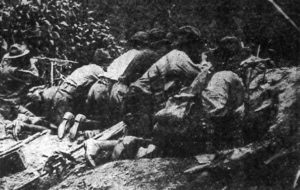
My research led me to the story of the Battle for Blair Mountain, which took place August 25 – September 2, 1921, in West Virginia.
It’s the second largest civilian uprising in U.S. history—surpassed only by the Civil War. And the largest labor uprising in the U.S.
And yet, I’d never heard of it. When I’ve asked other people if they’ve heard of it, the answer is usually ‘no,’ unless the group includes someone who comes from a long line of coal miners.
Ten thousand or so coal miners—weary of unsafe and harsh working and living conditions, low pay, and triggered by the blatant murder of a pro-union mayor at the hands of hired guns working for coal company management—finally rose up. It was, as one of the books I read on the subject put it, an “undeclared war.” (The book is the excellent The Battle of Blair Mountain by Robert Shogan.)
As tensions mounted, the law and community members took sides—some officers of the law and shop owners supporting the miners, and some in favor of management. The battle lasted ten days, with more than 10,000 coal miners armed with rifles, battling 3,000 much better equipped strikebreakers, including police, and, ultimately, by order of President Warren Harding, federal troops, and even a U.S. Army bomber—the only time, per an NPR story on this historic event, that U.S. military air power has been used against U.S. civilians.
In the end, about a hundred coal miners were killed in the battle. Nearly a thousand more were arrested. Defending the arrested coal miners nearly bankrupt and broke the back of the United Mine Workers union.
An interesting note: Mother Jones, the great female unionizer, warned against this uprising, sure that it would end in a bloody outcome for the miners. She turned out to be right. Mother Jones’ spirit was the inspiration for the feisty spirit of another character in The Widows, Marvena Whitcomb, a unionizer who lost her husband to a coal mining cave-in caused by poor safety practices.
Both Lily and Marvena, in 1925 Ohio, in a coal-mining region close to West Virginia would have been aware of the Battle for Blair Mountain.
In an early scene in The Widows introducing Marvena, she speaks with a miner, Jurgis, of Daniel, Lily’s husband and sheriff of Bronwyn County, and his desire to avoid bloodshed:
“I trust Daniel. He don’t want no Blair Mountain.”
Jurgis shudders at the reference to the bloody standoff between miners and management just four years before in West Virginia. It was legendary, and had nearly killed off unionization efforts across America.
It would take the Great Depression and President Franklin D. Roosevelt’s New Deal era before the Blair Mountain region of West Virginia could begin unionizing efforts anew in the mid-1930s.



 DAVE DOES HISTORY
Leave a comment