
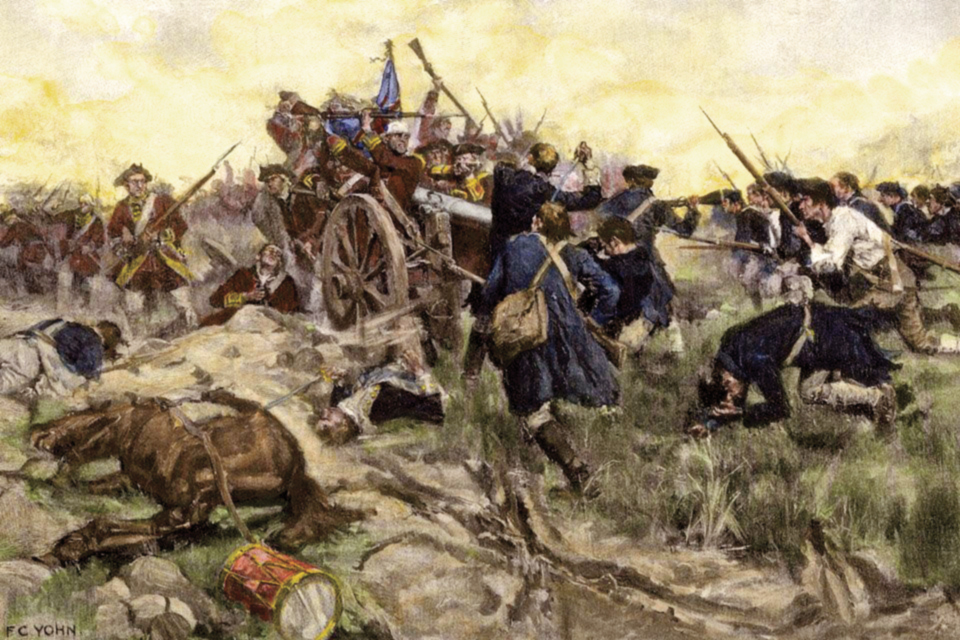
 Source: The Decision that Lost Britain the War: An Enigma Now Resolved – Journal of the American Revolution
n this article I address the absurdity of Cornwallis’s decision to march from Wilmington, North Carolina, to Virginia and the light thrown on it by The Cornwallis Papers.[1] The central enigma of the Southern Campaigns, it had until their publication never been able to be satisfactorily resolved.
Lt. Gen. Charles Earl Cornwallis, the British General Officer commanding in the South, arrived in the vicinity of Wilmington on April 7, 1781 after the disastrous winter campaign and his pyrrhic victory at Guilford. His troops were badly in need of refitment. In the meantime Maj. Gen. Nathanael Greene, the opposing commander, had begun his march for South Carolina, leaving Ramsey’s Mill on Deep River on the 6th.
As early as April 5 and 6 Cornwallis advised Lt. Col. Nisbet Balfour, the Commandant of Charlestown, that he would not remain at Wilmington but run all hazards if Greene attempted any serious move towards South Carolina.[2] As interpreted by Balfour, the letters indicated Cornwallis’s intention of coming after Greene in case of his movement that way.[3] Indeed, they are capable of no other interpretation. And as late as the 22nd Cornwallis reaffirmed to Balfour his intention to return, stating that he could not positively ascertain whether he would keep as low as Georgetown or pass by the head of the Waccamaw River.[4] He went on to direct that supplies coming from Charlestown had better be detained, so that sufficient appear to have been available at Wilmington for his march, a fact borne out by the ample provisions he took with him to Virginia and by the assessment of Major James Henry Craig, who commanded the post at Wilmington, that on May 5, the following were in store there for 1,500 men: “flour 150 days, rum the same, salt meat 60 days.”[5] So much, then, for Cornwallis’s protestations elsewhere that he found it impracticable to return overland to South Carolina, for clearly by these letters he is damned with his own pen. Therefore we must look to other reasons for his failure to keep his word.
Cornwallis was, in fact, in two minds as to what he should do. Not revealed to Balfour during this period but disclosed on the 10th to Major Gen. William Phillips, who was commanding a British diversionary force in the Chesapeake, was Cornwallis’s preference to forsake South Carolina and Georgia in favour of desultory operations in Virginia.[6] Matters came to a head on the 23rd, perhaps at a council of war, at which Cornwallis’s views would have been decisive. On that day he wrote to Lord George Germain, the Secretary of State, and to Sir Henry Clinton, the Commander-in-Chief in North America, advising them of his decision to march northward. Why?
If we are to take Cornwallis’s words at face value,[7] he did not expect any considerable corps left by him in South Carolina to be lost by Greene’s movement, so high was his opinion of Col. Francis Lord Rawdon, commanding at Camden, and the precautions taken by Rawdon and Balfour. Yet, contradictorily, he went on to fear the worst and cite it as a reason for his not marching southward. Yes, he could have provided no immediate assistance, but fulfilling his expectations, Rawdon maintained his post at Camden, defeating Greene in the Battle of Hobkirk’s Hill, and would have remained there if Cornwallis had marched promptly to relieve him, sending messengers ahead. As to Cornwallis’s protestation that he would have had to return by sea, it is controverted by his letters to Balfour. All in all, Cornwallis’s words are not those of an officer desiring in a perfectly feasible way to retrieve the situation in South Carolina, but rather those of one who was seeking any excuse to shore up his preference to swan around the highways and byways of Virginia, a preference which, as he readily admitted to Phillips, was very unlikely “to overturn the rebel government [there] and to establish a militia and some kind of mixed authority of our own.”[8] At the end of the day it does not take an accomplished strategist to see that desultory operations which did not involve the possession of Virginia would in no way compensate for the loss of South Carolina and incidentally Georgia. Nor, contrary to Cornwallis’s protestations, is it unreasonable to assume that, in line with Clinton’s instructions,[9] they could have continued to be held defensively, albeit tenuously. So, if Cornwallis’s stated reasons for his decision do not make sense, were there others propelling him on? Almost certainly, yes.
A dynamic officer best suited to offensive action, Cornwallis was, as stated in The Cornwallis Papers,[10] temperamentally ill at ease with defensive warfare, a prospect now facing him in his immediate sphere of operations. A humane, cultivated man, he was moreover sickened by the murderous barbarity with which the war was waged by the revolutionary irregulars and state troops of the Carolinas and Georgia. Deterrence was essential, but in keeping with his character he had no stomach for the disagreeable measures involved, a point also made elsewhere in The Cornwallis Papers.[11] In short, as the Wickwires make clear, “Cornwallis had no place in a civil war.”[12] Also contributing to his malaise was the mental and physical fatigue of commanding a whole year’s hard and solid campaigning, fatigue which can be glimpsed during his stay at Wilmington. In his letter to Phillips of the 10th he remarked in a jocular but nevertheless sincere way, “I am quite tired of marching about the country in quest of adventures,” to which there need to be subjoined a few revealing words in the draft of his letter of April 18 to Jeffrey Lord Amherst, the Commander-in-Chief of the British Army: “I can with great truth assure your Lordship that I have experienced as much care, anxiety and responsibility as ever fell to the share of any commanding officer.”[13] Altogether, it is fairly clear that the weight of his command was bearing down heavily on him. Against this background it is not entirely surprising that Cornwallis should have cast around, perhaps subconsciously, for reasons to release him from the predicament of dealing with a situation which he had come to detest. Always keen to act offensively, he simply opted for the more congenial alternative of doing so in Virginia, well way from the distasteful nature of the war farther south, an alternative, incidentally, which pricked his pride less than the perceived ignominy of conducting a defensive war to the southward after another unsuccessful campaign. These, then, were more likely the real reasons why Cornwallis took the absurd and fateful decision that he did.

 DAVE DOES HISTORY
Leave a comment