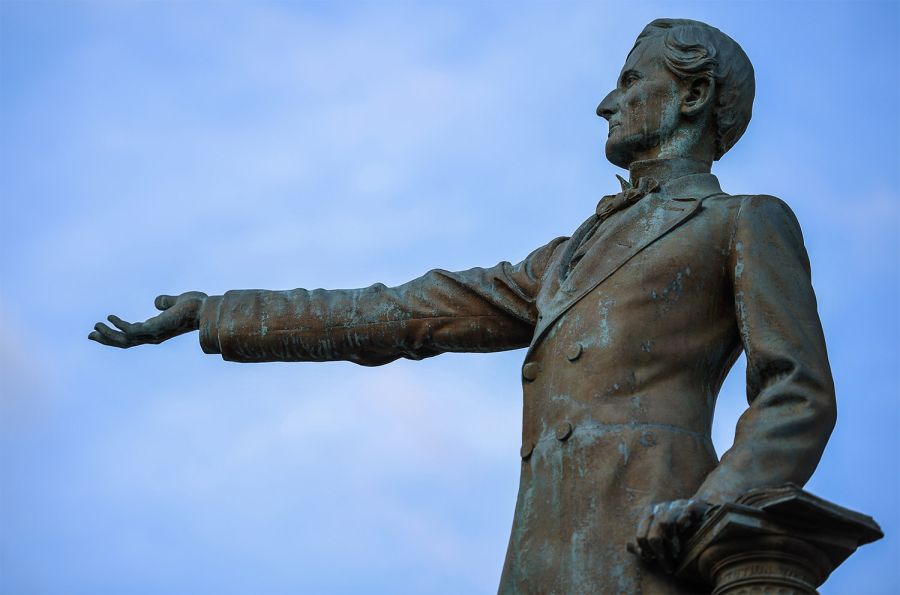
 Jefferson Davis was loathed by much of his military, Congress and the public — even before the Confederacy died on his watch. Since then, several historians have made the case that, regardless of whether Davis was a hero or a traitor, he was a lousy president.
Source: Why Jefferson Davis was loathed in the Confederacy he led – Military history – Stripes
WASHINGTON — Veterans Affairs Secretary Robert Wilkie has long been fascinated by the Confederacy, which his ancestors fought for during the Civil War.
For years, he belonged to the Sons of Confederate Veterans, a group that defends public displays of Confederate symbols. And he used to attend the annual memorial ceremonies in Washington to mark the birthday of Jefferson Davis, the president of the Confederacy.
This week, new details emerged about his veneration of Davis, whom Wilkie praised as a “martyr to the ‘Lost Cause’” in a 1995 speech at the U.S. Capitol for a Davis birthday celebration. CNN found a transcript in the United Daughters of the Confederacy Magazine.
The Washington Post reported that while the VA leader condemned slavery as “a stain on our story as it is a stain on every civilization in history,” he defended the generals and soldiers who fought to preserve it. He also called Davis an “exceptional man in an exceptional age.”
In fact, Davis was loathed by much of his military, Congress and the public — even before the Confederacy died on his watch.
Since then, several historians have made the case that, regardless of whether Davis was a hero or a traitor, he was a lousy president.
“You will see many errors to forgive, many deficiencies to tolerate, but you shall not find in me either a want of zeal or fidelity to the cause,” Davis told the Confederate Congress in his inaugural speech in 1861 — a rush job, apparently.
He had resigned from the U.S. Senate a few weeks earlier with a rousing defense of slavery, and was selected to lead the new Confederacy. But Davis had waited until the day before his inauguration to start writing his address — “like a feckless college student with a term paper deadline looming,” as author Adam Goodheart noted in The New York Times.
Davis’ “many deficiencies” had in fact been apparent long before his political rise, William Davis writes in his book, “Jefferson Davis: The Man and His Hour.”
The author calls Davis’ early career “a classic portrait of insecurity, of a man almost wandering through life allowing others to make his decisions for him.”
He had, for example, “categorically rejected the notion of running for governor, got a Senate seat, then four years later resigned it to run for the governorship,” William C. Davis writes. “And through all of his political career, down to his swearing in as president of the Confederacy, he maintained that he took office against his wishes.”
Expecting a war that would, in fact, break out within weeks of his inauguration, Davis began the job with bold ambitions, according to the author.
He tried to make alliances with England and France, countries he hoped would send money, ships and troops to fight the Union army.
In fact, no European country would recognize the Confederacy, and Davis would have trouble enough rallying his own people behind him.
“A man who would not relax into informality with his own wife at the table could hardly be the ‘man of the people’ that nineteenth-century Southerners needed to inspire their loyalty and enthusiasm,” William Davis writes.
Take, for example, one of his generals, Louisiana’s P.G.T. Beauregard.
“If he were to die today, the whole country would rejoice at it,” Beauregard once wrote, when the Confederate States existed.
He was one of several generals who wanted to launch a massive assault on the North, according to a New York Times review of “The Man and His Hour” — advice rejected by the president, who concentrated on defending the Confederacy’s long frontier.
After much conflict between the two men, Davis eventually relieved Beauregard of command and replaced him with a friendly general, James McPherson writes in “Embattled Rebel: Jefferson Davis as Commander in Chief.” But Davis eventually had to reinstate his rival “because of the general’s popularity among segments of the press and public.”
“He did not practice the skillful politician’s art of telling others what they wanted to hear,” McPherson writes of Davis. “He did not hesitate to criticize others but was often thin-skinned about their criticisms of him.”
Beauregard’s criticism of the president was expressed in private, as quoted in the book: Davis was a “living specimen of gall and hatred,” the general once said, “. . . either demented or a traitor to his high trust.”
Davis also feuded with Confederate Gen. Joe Johnston, whom he publicly blamed for the fall of Vicksburg, a key Confederate stronghold, in 1863.
But Johnston was popular with the troops. An aide to Davis once returned from a military inspection, McPherson writes, and told the president “that every honest man he saw out west thought well of Joe Johnston . . . [whose] hatred of Jeff Davis amounts to a religion.”
This criticism was not universal throughout the Confederacy, McPherson notes in his book — which argues that Davis was more competent and gracious than other historians have portrayed him.
Davis maintained a close partnership with Gen. Robert E. Lee, for example, and could count on at least one newspaper in the rebel capital of Richmond to publish leaks against his enemies.
But other Southern journalists were openly hostile to Davis, McPherson writes. The editor of the Richmond Examiner, for example, once wrote that the president “has alienated the hearts of the people by his stubborn follies” and “chronic hallucinations that he is a great military genius.”
As military defeats mounted and inflation spiraled, the end of Davis’ presidency became a cascade of humiliations and traumas.
In 1864, Davis buried his young son, who had fallen off a balcony at the Confederate White House.
A day later, the president had to deliver a speech to Congress on the state of the Confederacy.
“Every avenue of negotiation is closed against us,” Davis told the rebel members. “Our enemy is making renewed and strenuous efforts for our destruction.”
It was a very brief speech — and not a pleasant one.
About a year later, Davis would give his wife nearly all his gold — keeping just $5 for himself — and tell her to pay or bribe her way to safety with their children, James L. Swanson writes in “Bloody Crimes: The Funeral of Abraham Lincoln and the Manhunt for Jefferson Davis.”
The Union Army was about to march on Richmond.
“Many who saw me walking toward my residence left their houses to inquire whether the report was true,” Davis later recalled of his last day as president.
“They all, the ladies especially, with generous sympathy and patriotic impulse responded, ‘If the success of the cause requires you to give up Richmond, we are content.’ ”
Davis escaped by train with the remnants of his government in April 1865 — hours before Richmond fell.
The Confederate capital had already been ravaged by hunger riots, Swanson writes. The president’s troops accidentally set fire to it after he had fled.
With a bounty on his head, the president-in-exile was pursued across the collapsing South for more than a month and was finally captured by Union troops in Georgia.
His reputation had been shaky when he had a rebellion behind him. Now that he did not, it went into free fall.
A false rumor that Davis had been captured in his wife’s clothing inspired caricatures across the once-again-United States. “Ingenious photographers doctored images of Davis by adding a skirt and bonnet,” Swanson writes.
He was thrown in prison for two years, where his jailers refused to call him president — preferring “Jeffy” or “the rebel chieftain,” according to Swanson’s book.
He was shackled, insulted and deprived of sleep, Swanson writes. “Hate mail poured in to the Confederate president, taunting him about the terrible doom that must await him.”
That doom did not turn out to be execution, as had been threatened, but rather his release into what Swanson calls “a shocking predicament for a member of the elite, planter class.”
Jefferson Davis had to find a job.
It took years, Swanson writes, but he finally became president again — of a life insurance company that soon went bankrupt.
And yet, before his death in 1889, Davis would partially repair his reputation by discovering what Swanson calls “the true purpose of his remaining days — remembering and honoring the dead.” In other words, the Confederate memorials that are being debated — and sometimes dismantled — around the country.
After the war, Swanson writes, “the idea of a vast army of the departed who haunted the Southern landscape and memory swept the popular imagination.”
Confederate empathizers “labored to recover the dead from anonymous wartime graves, to build cemeteries for them and to mark the land where they shed their blood with monuments of stone, marble, and bronze.”
Davis latched onto this movement with a eulogy for Robert E. Lee in 1870, Swanson writes — but later became “the titular head of a shadow government, no longer leading a country, but leading a patriotic cause devoted to preserving the past.”
And that’s how Davis got his own memorial in New Orleans in 1911 — and a sympathetic vigil when it fell before dawn in 2017, a century and a half after his presidency failed.





 DAVE DOES HISTORY
Leave a reply to Thomas G McGrath Cancel reply