

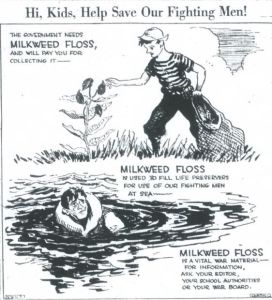
Late in World War II, the common milkweed was often the only thing that kept a downed aviator or soaking-wet sailor from slipping beneath the waves. The plant’s floss was used as the all-important filler for flotation devices.
The northwest part of the Lower Peninsula, particularly the area around Petoskey, became the country’s picking and processing center for milkweed floss. By the time the war ended, an army of citizens—including schoolchildren—led by a visionary doctor had helped keep America’s servicemen safe from harm.
In the early 20th century, the typical filler for life preservers was a material called “kapok.” A cottony fiber extracted from the pods of the ceiba tree, kapok was cultivated in the rainforests of Asia. America’s primary source for this material was the Dutch East Indies (present-day Indonesia).
Then, in 1937, came Japan’s invasion of China, which initiated World War II in the Pacific.
Enter Dr. Boris…
View original post 571 more words





 DAVE DOES HISTORY
Leave a reply to GP Cox Cancel reply