
There are some stories that do not sit quietly in the past. They wait. They linger. They tap on your shoulder at odd hours and ask a question you are not entirely sure you want answered.
On paper, the loss of the USS Thresher in April 1963 has always been treated as a tragedy explained. A mechanical failure. A cascading problem. A sudden and merciful end. That is the version told in classrooms, printed in summaries, passed along with the steady confidence of something settled long ago.
But history has a habit of resisting neat conclusions.
Because when you begin to look closer, when you step away from the official language and into the lived experience of the men who followed, the story shifts. It becomes less about a single failure and more about something harder to define. Something quieter. Something that does not announce itself but presses on everything just the same.
There is a phrase tied to Thresher’s legacy. Vis tacita. Silent force. Unspoken power.
It fits better than anyone might like to admit.
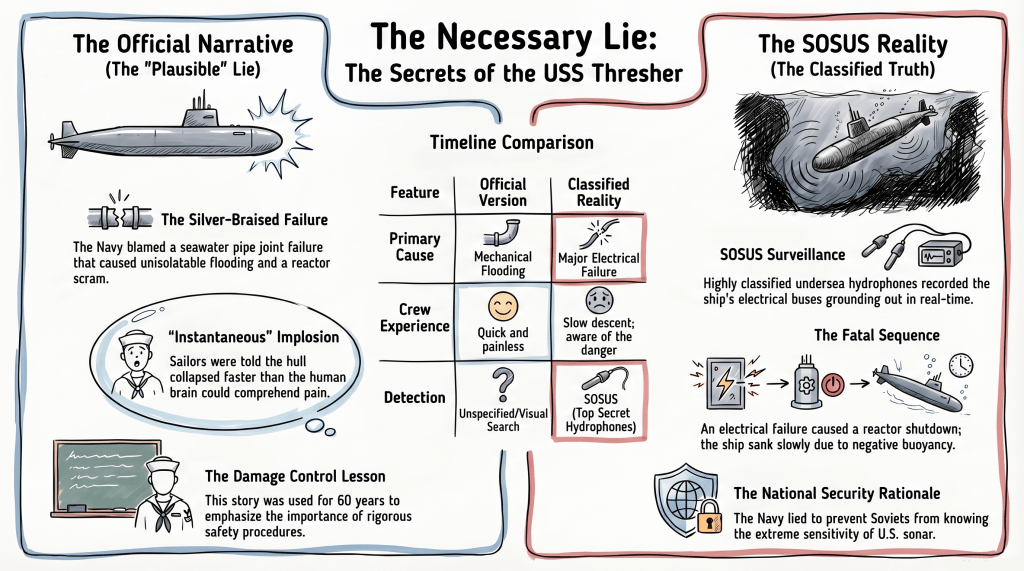
What this episode wrestles with is not just what happened to a submarine deep beneath the Atlantic, but what we were told about it, and why. It asks the uncomfortable question that historians are supposed to ask but often hesitate to voice. What if the story we accepted was not the whole story? Not because of malice, not because of carelessness, but because there are moments when truth collides with necessity, and something has to give.
In the early years of the Cold War, the ocean floor was not empty. It was listening. Systems like the SOSUS were doing exactly what they were designed to do, quietly gathering information that could not be openly acknowledged. To reveal too much was to reveal capability, and to reveal capability was to hand your adversary a map.
So what do you say instead?
You tell a story that makes sense. A story that protects what must be protected. A story that comforts families, trains sailors, and keeps secrets buried where they belong. And over time, that story becomes accepted truth, repeated often enough that it no longer feels like a choice.
Until someone starts asking questions.
This episode does not claim easy answers. In fact, it does the opposite. It pulls at the threads. It listens to the echoes. It considers what was known, what was said, and what may have been left unsaid. And in doing so, it brings us face to face with something far more human than machinery or procedure.
The men aboard Thresher were not characters in a report. They were sailors, trained to trust their systems, their ship, and their Navy. Whatever happened in those final moments, it was not abstract. It was immediate. It was real.
And that is where the story lives.
Not in the official version, but in the space between what is said and what is understood.
Silent force. Unspoken power.
Vis tacita.
And once you hear it, it is very hard to ignore.

 DAVE DOES HISTORY
Leave a comment