
There are moments in history when victory does not arrive with a thunderclap, but with a quiet, almost disbelieving exhale. March 17, 1776, was one of those moments.
In this episode of Dave Does History, we step into a Boston that has been holding its breath for nearly a year. Since the smoke cleared at Lexington and Concord, the British Army has been trapped inside the city, surrounded not by a polished professional force, but by a restless, stubborn collection of farmers, tradesmen, and militiamen who refused to go home. It was, by any conventional military standard, a situation that should not have worked. And yet, there it stood, an empire bottled up by what London would have called a rabble.
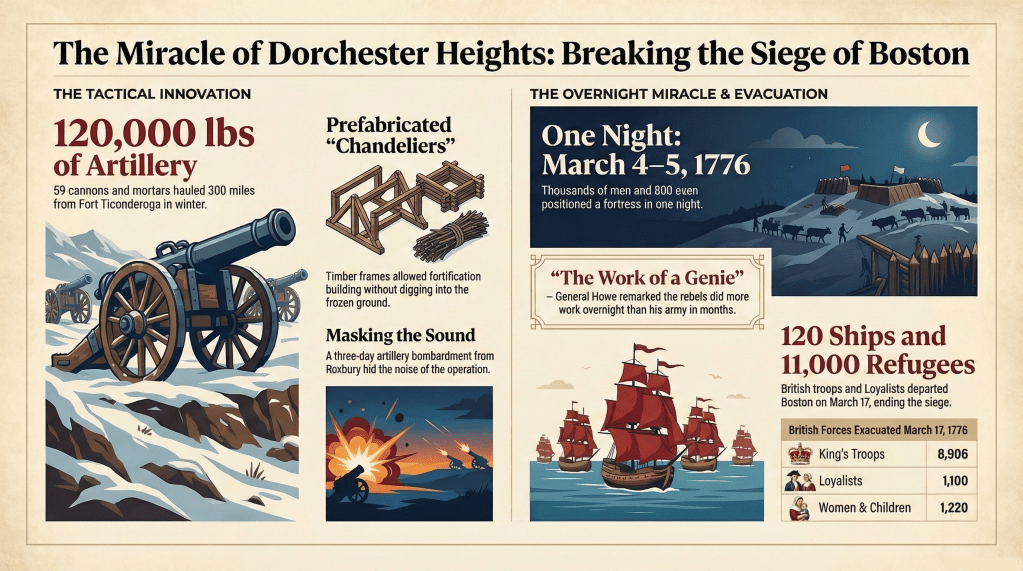
The story that unfolds is not one of brute force. It is a story of hesitation, miscalculation, and the dangerous comfort of underestimating your enemy. Both sides knew the key to the entire struggle sat quietly overlooking Boston Harbor. Dorchester Heights. A position so obvious that both armies acknowledged its importance, and then, remarkably, did nothing about it for months. It is the kind of detail that makes historians rub their temples and wonder if war is less about brilliance and more about who blinks first.

Enter George Washington, still learning the weight of command, still wrestling with the urge to charge headlong into glory. Around him are men who begin to shape his thinking, forcing him to see that winning a war is not about heroic gestures, but about choosing the ground on which the fight will be decided. And then there is Henry Knox, hauling artillery across frozen wilderness like some determined force of nature, delivering the one thing Washington lacked. Teeth.
What follows is one of the most astonishing single-night operations in American military history. Under darkness, deception, and just enough audacity to make it work, the Continental Army does what even British officers believed impossible. They build a fortress where none existed. They drag cannon into position. They change the entire geometry of the war before the sun has time to rise.
By morning, the balance has shifted. Not with a grand battle. Not with a dramatic charge. But with a simple, devastating reality. The British are no longer in control.
And then, as if history itself decided to add a flourish, nature intervenes. A storm rises at precisely the wrong moment for the British and the perfect moment for the Americans, snuffing out any hope of immediate counterattack. You can call it luck. You can call it providence. Soldiers on both sides had their own opinions, and none of them were casual about it.
What happens next is something rarely discussed in the grand sweep of the Revolution. An evacuation. Not a rout, not a surrender in the formal sense, but something quieter and, in its own way, more humiliating. Thousands of soldiers, families, and Loyalists pack what they can and leave behind what they cannot. A city tears itself apart in the process. And the men who once marched in as masters depart in silence.
There is no triumphant speech in that moment. Just the realization, slowly settling in, that something impossible has just happened.
The Revolution, fragile and uncertain, has survived its opening act. And for the first time, there is a whisper, carried on the cold March air, that maybe, just maybe, this thing could actually succeed.
That is where we begin.




 DAVE DOES HISTORY
Leave a comment