
Christmas Eve in 1944 did not feel like the end of the war, but it felt close enough to pretend. The English Channel was gray and restless, the kind of water that never quite settles, even when nothing appears to be happening. Aboard the Belgian troopship Léopoldville, American soldiers leaned against rails and bulkheads, sang fragments of carols they half remembered, and stared toward the French coast where the lights of Cherbourg glimmered faintly through the winter haze. Liberation was visible now. The continent was back under Allied control, Paris had been free for months, and the Germans were supposed to be running out of time, men, and miracles. The distance between ship and shore was measured in miles, but the distance between expectation and reality would turn out to be immeasurable.
The Léopoldville had left Southampton that morning in a routine convoy, one more crossing in a long list of crossings that had become almost mundane by late 1944. The ship herself had been built for comfort rather than combat, launched in 1929 as a passenger liner serving the Belgian Congo route. She was designed for warmth, ceremony, and the slow rhythms of colonial travel, not winter seas and torpedo tracks. Converted into a troopship in 1940, she carried defensive guns and could hold more than two thousand men, but she remained an awkward vessel for the Channel. High sided, slow to maneuver, and uncomfortable in heavy seas, she nonetheless had a reassuring statistic attached to her name. More than one hundred twenty thousand troops had crossed safely aboard her in twenty four trips. Numbers like that have a way of silencing doubt.

What The Frock – The Musical
The men aboard her that Christmas Eve belonged largely to the 66th Infantry Division, known as the Black Panthers. They came from all over the United States, many of them young, many of them untested, and most of them unaware that the division they were joining was already being torn apart by events beyond their control. The German counteroffensive in the Ardennes had erupted days earlier, catching the Allies flat footed and forcing commanders to scramble for reinforcements. These soldiers were not headed for a quiet staging area. They were being rushed toward a crisis that demanded speed more than order.
That urgency showed itself at Southampton. Troops were loaded as they arrived, not by unit, which scattered companies and separated officers from their men. Manifests were incomplete and inconsistent, names added and crossed out as the clock pushed everyone forward. Below decks, men were crammed into converted cargo holds, gear stacked wherever it fit. There were no safety drills. Life jackets were issued without explanation. No one demonstrated how to jump into cold water, how to brace the body, how to survive more than a few minutes in winter seas. The war had been raging for years, yet the basics of survival at sea were treated as optional knowledge.
Command of the Léopoldville rested with Captain Charles Limbor, a Belgian officer who had held the post since 1942. His crew was Belgian and Congolese. His language was Flemish. The soldiers he carried spoke English, flavored by the accents of Pennsylvania, Kentucky, New York, and the Midwest. The bridge spoke one language. The decks spoke another. It seemed a small inconvenience at the time. It would later prove lethal.
The convoy itself appeared adequate. The Léopoldville sailed in diamond formation, escorted by the British destroyers Brilliant and Anthony, along with the frigates Hotham and Croix de Lorraine. It was not an overwhelming screen, but it was typical for the Channel by late 1944. German submarines were still active, but the sense of danger had dulled. The war had trained men to live with constant threat, and paradoxically, that familiarity made it easier to assume that today would be like yesterday, and yesterday had gone just fine.
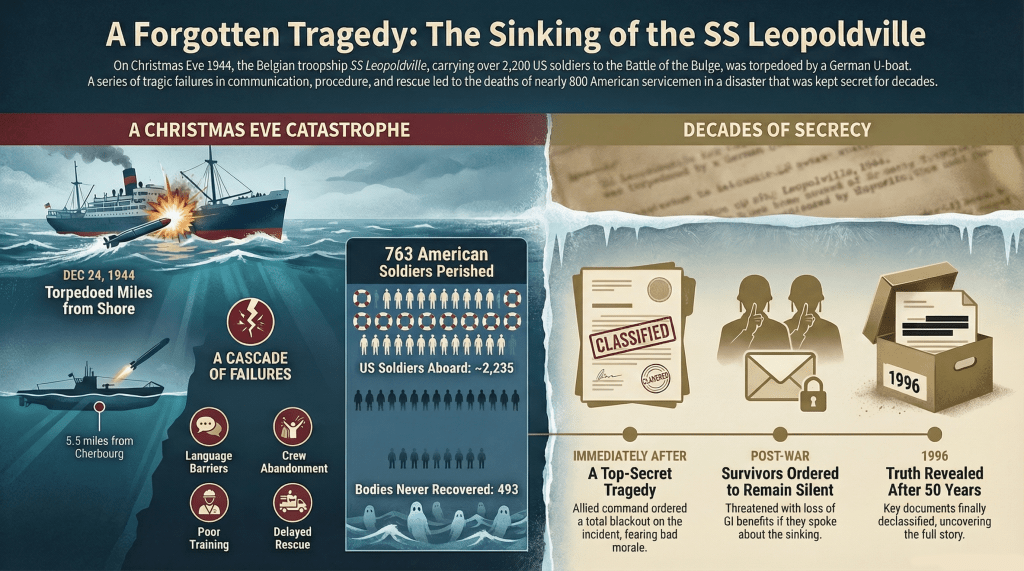
Waiting beneath the surface was U-486, a German Type VIIC submarine commanded by Oberleutnant Gerhard Meyer. She was equipped with a schnorchel, allowing her to operate submerged on diesel engines, reducing her visibility and complicating detection. Meyer spotted the convoy and waited. He did not need many chances. At 5:54 in the evening, he fired two torpedoes. One missed. One struck the Léopoldville on the starboard side aft, detonating near the number four hold.
The explosion was immediate and devastating. Steel tore open. Fire and water rushed into spaces where men had been sitting, sleeping, or joking moments earlier. Nearly three hundred soldiers were killed outright. Stairwells collapsed. Compartments labeled E 4, F 4, and G 4 flooded within seconds, trapping men below decks who never had a chance to reach open air. Survivors later recalled the sound of pounding from inside the hull, fists striking metal until the water rose and the noise stopped.
On deck, confusion reigned. The ship had not yet sunk, and many assumed she had struck a mine or suffered a mechanical failure. Some believed assistance would arrive quickly, that the situation was under control. Captain Limbor, fearing drift into a minefield, ordered the anchor dropped. From his perspective, it was a reasonable decision. From the perspective of survival, it turned the Léopoldville into a stationary target and eliminated the possibility of maneuver or rapid towing.
When Limbor gave the order to abandon ship, he did so in Flemish. His crew understood. The American soldiers did not. Lifeboats were lowered and filled by the Belgian crew, who had trained for this moment. Some American soldiers applauded, believing the boats were being prepared for them. It is a detail that feels unbearable precisely because it contains no malice. It is misunderstanding in its purest form.
Below decks, the medics of the 262nd Medical Department stayed with the wounded. They cut away uniforms, applied bandages in darkness and smoke, and tried to keep men calm as the ship listed further. Only a handful of those medics survived. They had been trained to remain with their patients, and they did exactly that.
The British destroyer Brilliant came alongside in a daring rescue attempt. The height difference between the two ships was enormous, with the destroyer riding thirty to forty feet below the troopship in heavy seas. There was no safe method of transfer. Soldiers were told to jump. Some landed on torpedo tubes and broke limbs. Others were crushed between hulls as the ships ground together in the swell. Brilliant managed to take aboard roughly five hundred men before being forced to pull away, overcrowded and in danger herself.
The broader rescue effort collapsed into what can only be described as bureaucratic farce. British ships and American shore stations in Cherbourg operated on different radio frequencies and could not read one another’s codes. Messages had to be relayed back to Portsmouth in England, then transmitted by telephone to France, costing nearly an hour. Visual signals blinked toward the harbor went unnoticed or misunderstood. Cherbourg was full of Allied ships, but it was Christmas Eve. Engines were cold. Crews were ashore. Shore stations were manned by skeleton staffs. Officers hesitated to interrupt senior commanders who were attending holiday gatherings. No one wanted to overreact. Everyone assumed someone else had the situation in hand.
At 8:40 p.m., the Léopoldville suffered two internal explosions and began to sink stern first. Around twelve hundred men were still aboard or in the water when she went under. The Channel temperature hovered around forty eight degrees. Hypothermia set in quickly. Many men wore life jackets incorrectly, having never been trained. When they hit the water, the jackets snapped upward, breaking necks. Survivors later recalled bodies floating face up, motionless, carried by currents that would have brought them to safety had rescue arrived sooner.
The final death toll has never been pinned down with absolute certainty. Estimates range from seven hundred sixty three to more than eight hundred American soldiers. Four hundred ninety three bodies were never recovered. Captain Limbor died with his ship, as did several crew members. The 66th Infantry Division was effectively shattered before it ever reached the front. Instead of reinforcing the Battle of the Bulge, survivors were reassigned to contain isolated German garrisons along the Atlantic coast at Lorient and Saint Nazaire, a grim consolation prize for men who had expected to fight one battle and found themselves surviving another.
What followed the sinking was not accountability, but silence. Allied command ordered an immediate news blackout. Survivors were instructed not to speak of the incident. Mail was censored. Some soldiers were warned that discussing the sinking could jeopardize their benefits. Families received telegrams stating that sons were missing in action, with no explanation of where or how. For many, hope lingered for years, fueled by the absence of a body and the vagueness of official language.
The war ended. Victory parades were held. New tragedies claimed public attention. The Léopoldville faded into obscurity, her story locked away in classified files. In the United States, those files remained sealed until 1959. In Britain, some were not released until 1996. When historians finally pieced the story together, they found no single villain, no dramatic act of betrayal, only a long chain of small failures that aligned with devastating precision.
The wreck itself lay undisturbed until 1984, when it was located by Clive Cussler and his team from the National Underwater and Marine Agency. Jurisdictional disputes followed, but the location was confirmed. For survivors and families, the discovery was both relief and reopening. Proof, at last, that the story had not been imagined or exaggerated. Proof that the silence had concealed something real.
One man, Allan Andrade, devoted years to tracking down survivors and families, restoring names to numbers and stories to silence. Projects such as Stories Behind the Stars documented individual losses, brothers who died together, soldiers whose last letters home spoke casually of Christmas plans that would never happen. Memorials were eventually erected at Fort Benning, in Titusville, in Weymouth, and on the Wall of the Missing at Normandy. They stand quietly, offering no explanation beyond names and dates.
The sinking of the Léopoldville matters because it exposes how modern systems fail. It shows how war kills not only through enemy action, but through confusion, complacency, and incompatible assumptions. Different languages. Different technologies. Different priorities. War on one side of the Channel. Holiday on the other. Together, they formed a structure that could not stand.
There is no neat moral to extract from this story, no comfortable lesson to apply. The men aboard the Léopoldville were not careless or foolish. They trusted a system that had carried thousands safely before them. That trust was not unreasonable. It was simply misplaced on one winter evening when everything that could go wrong did so quietly, without drama, and with devastating consequence.
For decades, the tragedy remained a shameful secret. Today, it stands as an honored memory, not because it offers redemption, but because it demands honesty. History does not always announce its failures with trumpets. Sometimes it whispers them through cold water and unanswered signals, and waits to see if anyone is willing to listen.

 DAVE DOES HISTORY
Leave a comment