
The winter encampment that Americans reflexively call “Valley Forge” has become a kind of historical shorthand, a single frozen tableau where virtue shivers nobly and emerges purified. That picture is comforting, and like most comforting pictures, it is incomplete. The army that staggered into Valley Forge in December 1777 had been forming, failing, adapting, and nearly coming apart since the summer of 1775. Valley Forge was not the beginning of the story, and it was not even the worst chapter. It was the reckoning.
One reason Valley Forge looms so large is that memory has a habit of compressing time. We talk as if the Continental Army was born fully formed in 1775 and then immediately endured its famous winter trial. In reality, the army was created in June 1775 as an emergency measure, a political compromise wrapped in a uniform. The winter that made Valley Forge famous did not arrive until the end of 1777. Between those dates lay a grinding education in logistics, authority, human limits, and the difference between patriotic enthusiasm and sustainable war. Valley Forge only makes sense when seen as the culmination of that education, not a sudden descent into misery from some earlier golden age.

What The Frock – The Musical
It also helps to understand that Valley Forge existed long before the soldiers did. In 1775, it was not a symbol. It was a working place. Where Valley Creek met the Schuylkill River, ironmasters had carved out a proto industrial landscape of forges, furnaces, mills, and charcoal pits. The hills that later sheltered log huts were already named Mount Joy and Mount Misery, a joke with more honesty than poetry. The forge itself was tied to the Potts family and to William Dewees, part of a Pennsylvania iron economy that had grown restive under British trade policy. Parliament’s Iron Act of 1750 encouraged the colonies to ship raw pig iron while forbidding them from producing finished goods that might compete with British manufacturers. Pennsylvania ironmasters did not always wait for permission. Valley Forge became one of those places where rules bent under the weight of practical necessity and quiet defiance.
By the time shots were fired at Lexington and Concord, Valley Forge was already serving the revolutionary cause. It produced tools, hardware, and munitions, and functioned as a supply node for Pennsylvania’s Committee of Safety. This made it valuable, and value in wartime draws attention. In September 1777, as British forces pushed inland toward Philadelphia, they sent a raid up the Schuylkill and destroyed the forge. The ironworks that had fed the rebellion were deliberately smashed before Washington ever ordered a single hut built there. That destruction mattered. When the army arrived months later, it did not arrive at a functioning industrial base. It arrived at the ashes of one.
Meanwhile, the army itself had been born in improvisation. In June 1775, the Second Continental Congress adopted the New England militia already surrounding Boston and rebranded it the Continental Army. It was an act of political necessity rather than military confidence. George Washington was appointed commander in chief in part because he was competent, and in part because he was a Virginian, which reassured southern delegates that this was a continental war and not a New England rebellion with better stationery.
Washington arrived in Cambridge to find what he later called “a commission’d mob.” Thirty eight regiments existed on paper, raised by different colonies, paid at different rates, and governed by different assumptions. Enlistments were short, often expiring at the end of the calendar year. Men came and went with the seasons and with their patience. Officers debated pay and precedence while privates lacked shoes. Powder was scarce, muskets were mismatched, and discipline was mostly a matter of personal persuasion. The siege of Boston in the winter of 1775 to 1776 was, in many ways, the army’s first winter encampment, though it is rarely remembered that way. The men suffered shortages then too, and learned early that enthusiasm did not conjure supplies out of frozen ground.
It was during that winter that Henry Knox dragged artillery from Fort Ticonderoga across snow and ice, a feat so improbable that it sounds like the kind of thing historians exaggerate. They do not need to. When those guns were placed on Dorchester Heights in March 1776, the British evacuation of Boston followed quickly. It was a victory, but it was also a warning. The army could succeed brilliantly when circumstances aligned and improvisation filled the gaps. It could also collapse just as easily when those gaps widened.
The campaigns that followed exposed those weaknesses repeatedly. By 1777, British strategy shifted toward capturing Philadelphia, the political heart of the rebellion. Washington tried to stop them and failed at Brandywine. He tried again at Germantown and failed again, though not without moments that suggested the army was learning. Philadelphia fell. Congress fled. The army retreated into the countryside, pursued not just by redcoats but by its own logistical ghosts.
The supply system collapsed under the strain. The Quartermaster and Commissary departments were riddled with mismanagement and outright corruption. Thomas Mifflin resigned as Quartermaster General in late 1777, leaving a system already near paralysis. Inflation devoured the value of Continental currency. Farmers who might have supported the cause in principle were not inclined to accept paper that bought less each week, especially when British gold was available just a few miles away. Washington warned Congress with increasing bluntness that the army must “Starve, dissolve, or disperse.” This was not rhetoric. It was arithmetic.
When Washington selected Valley Forge as the winter encampment in December 1777, he did so for sober reasons. The high ground offered defense. The site was close enough to watch the British in Philadelphia but far enough to avoid a sudden attack. It protected the interior of Pennsylvania. It was not chosen because it was comfortable or symbolic. It was chosen because there were no good options left.
The army that marched into Valley Forge numbered around twelve thousand, accompanied by hundreds of women and children who cooked, washed, mended, and followed because armies do not function on slogans alone. Washington ordered the construction of log huts, fourteen by sixteen feet, arranged along military avenues that imposed some semblance of order on the sprawl. Within weeks, a crude city rose from the mud. It was not elegant. It was functional, which is not the same thing.
The winter itself has been mythologized beyond recognition. It was not the coldest winter of the war. That distinction belongs to Morristown in 1779 to 1780. Valley Forge was wet. Roads dissolved into mud. Wagons sank to their axles. Transport failed not because men lacked courage, but because physics refused to cooperate. Food shortages were real, but starvation in the strict sense was rare. Disease was the true killer. Typhus, typhoid, and dysentery swept through the camp, taking men in the spring when supplies improved but weakened bodies gave out. Roughly two thousand soldiers died, most of them not in the dramatic snows of December but in the damp months that followed.
Albigence Waldo, a surgeon, left a line that still stings: “Poor food, hard lodging, cold weather, fatigue, nasty cloaths, nasty cookery. Why are we sent here to starve and freeze?” It is not polished prose. It is a man writing with numb fingers and very little patience for posterity. Washington, writing to George Clinton, struck a different note, praising “the incomparable patience and fidelity of the soldiery,” naked and starving as they were. Both were true. Endurance and misery are not opposites.
Valley Forge was also more diverse than the popular image suggests. African American soldiers served in integrated units like the First Rhode Island. Women played essential roles that rarely appear in heroic paintings. Oneida allies arrived with corn at a moment when it mattered, led by figures like Han Yerry and Polly Cooper. Their contribution prevented genuine starvation, and their presence complicates any simple narrative of a purely colonial struggle. History, like life, rarely fits on a single banner.
The transformation that followed did not happen by accident. In February 1778, Baron Friedrich Wilhelm von Steuben arrived, carrying letters of introduction that exaggerated his Prussian credentials with a wink Franklin would have appreciated. Von Steuben was not a Prussian general. He was a staff officer, but he was something more valuable to Washington. He was a professional who understood systems.
Von Steuben began with a model company, drilling a small group of men and then using them to train others. It was a practical solution to limited time and manpower. He simplified European drill to suit American realities, stripping away unnecessary complexity. He also understood Americans well enough to explain why discipline mattered. “You say to your soldier in Europe, ‘Do this’ and he doeth it,” he observed. “But here I am obliged to say, ‘This is the reason why you ought to do that,’ and then he does it.” It was not a complaint. It was an insight.
From this effort emerged the Regulations for the Order and Discipline of the Troops of the United States, the so called Blue Book. For the first time, the army had a standardized manual. Just as important, noncommissioned officers were recognized as the backbone of the force, the men who turned paper regulations into daily habit. Washington also pushed through an inoculation campaign against smallpox, a decision that saved lives quietly and without much ceremony, which is how most real victories occur.
Administrative reform followed. Nathanael Greene took over as Quartermaster General and rebuilt supply lines with a mix of competence and stubbornness. The army did not become comfortable. It became functional. That distinction mattered.
In May 1778, news of the French alliance reached Valley Forge. There were celebrations, parades, and cannon fire. It was a moment of relief, but also of validation. The struggle had been noticed. It had been judged worth backing. When the army marched out of Valley Forge in June, it did so as something new. At Monmouth later that month, it stood against British regulars in open battle. The fight was not decisive, but it proved that the training held under fire. That was enough.
The army that emerged from Valley Forge was not perfect. It was not fully supplied. It was still held together by fragile politics and thinner resources than its enemies enjoyed. But it was an army in the real sense, not just a cause with muskets. The spirit that animated the men in 1775 had finally been given a body capable of carrying it forward.
Valley Forge matters because it reveals how nations are actually made. Not through a single winter of noble suffering, but through years of trial, error, argument, compromise, and reform. The ironworks of 1775 and the log huts of 1777 were part of the same story. Resources without organization achieve little. Ideals without structure collapse under their own weight. By 1778, those lessons had been learned the hard way.
There is no tidy moral here, and that is as it should be. The men at Valley Forge did not know they were becoming a symbol. They were trying to survive, to improve, to make something work that had nearly failed. The fingerprints they left on the banister are uneven and sometimes uncomfortable to trace. That does not diminish them. It makes them human, and it makes the army they forged worth remembering, not as a myth frozen in snow, but as a living institution hammered into shape by necessity, discipline, and time.




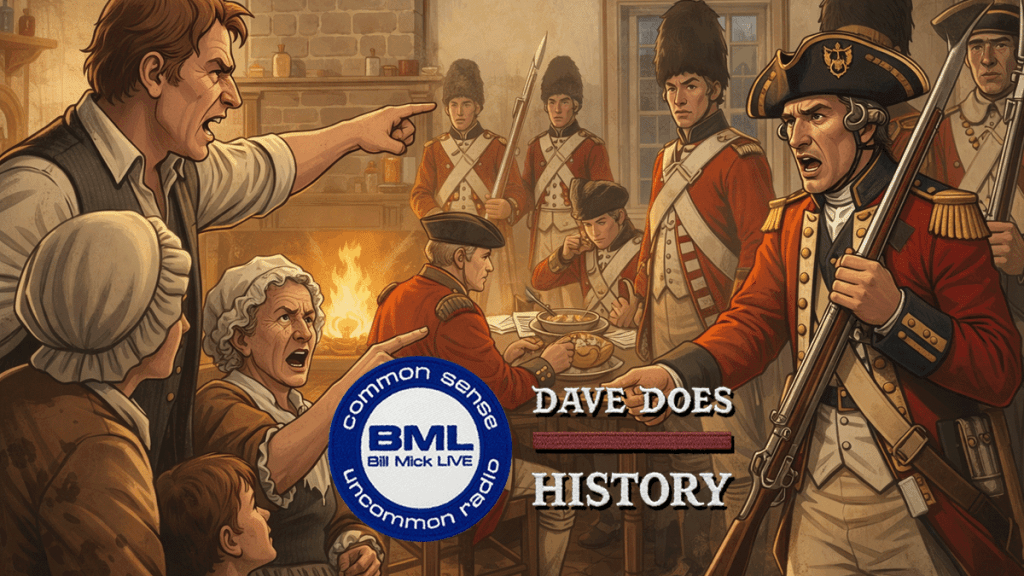
 DAVE DOES HISTORY
Leave a comment