
The story of the Battle of Great Bridge does not usually appear on the top shelf of American memory. It is tucked in the corner, somewhere behind the Boston tea that everyone pretends they would not have minded spilling, and before the grand parade of 1776 that has swallowed so many lesser known days whole. Yet if you walk the ground in what is now Chesapeake, Virginia, and you let the December air settle on your shoulders, you can feel the weight of its moment. The people who fought there knew perfectly well that nothing about their world was settled. The British Crown believed rebellion could still be stamped out with a firm display of force. The Virginians believed that the soil beneath their feet was already shifting beneath the weight of change, and the coming battle would prove who understood the map of their future more clearly.
Great Bridge took place on December 9, 1775, just outside Norfolk, a little more than nine miles from the center of a town that was, at the time, the most important port in colonial Virginia. It was the first significant battle of the Revolution fought in the colony and the first test of what Virginians could do if pressed into a corner. The Patriots were led by Colonel William Woodford, a steady officer with a sense of gravity about the stakes. The British and Loyalist forces were commanded by Captain Samuel Leslie, who had the unenviable task of holding together a mixed force of regulars, militia, and the newly raised Ethiopian Regiment. When the fighting was done, the British position in Virginia collapsed so completely that Lord Dunmore, the royal governor, could no longer claim authority on land. It was as if the old world had boarded a few fragile ships and pushed off into the tide, hoping the wind would carry it to a safer shore.
To understand how the Americans reached this strange moment, one must follow the path backward across a landscape that did not set out to become a battlefield. The Revolution did not appear one morning fully grown. It emerged the way weeds push through a stone walkway, slow and relentless and almost impossible to ignore. The Coercive Acts tightened London’s hand around the colonies, and Virginia answered by standing with Boston. The House of Burgesses protested, and Governor Dunmore responded in the time honored fashion of British officials who found colonial assemblies irritating. He dissolved them. The representatives simply regrouped as the Virginia Convention, and then another convention after that, and another in the spring of 1775. The movement toward self government gained momentum, although no one yet spoke openly about independence. Patrick Henry gave the kind of speech that people later claimed they understood at the time, although most listeners probably needed a moment to digest it. Liberty is a pleasant word. Death is a chilling one. Putting them together was either prophetic brilliance or reckless provocation, depending on who stood where.
The situation did not improve when Dunmore carried out one of the most clumsy decisions of his career. Acting on instructions from London, he ordered the removal of gunpowder from the Williamsburg magazine. The powder was taken by sailors in the dead of night on April 21, 1775. Word spread. Militia gathered. The colony teetered on the edge of open conflict. Dunmore then made the kind of threat that tells you more about a man’s fear than his authority. He announced that if anyone attempted to harm British officials, he would declare freedom for the colony’s slaves and reduce Williamsburg to ashes. It was a threat with more smoke than substance, although it revealed what he considered his most potent leverage. The crisis eased when Patrick Henry was compensated for the cost of the powder, but the trust between governor and governed did not repair itself. The gap between them widened like a worn beam in an old house. Everyone could hear the strain, even if no one wanted to admit that it meant the structure might soon fail.
By summer, Dunmore abandoned Williamsburg entirely and took refuge aboard British ships. A royal governor floating in a harbor is not an image of stable authority. He moved to Norfolk and tried to rebuild his standing from the waterline outward. Norfolk was a Loyalist stronghold, or at least enough of one to offer him a temporary base. From his ships, he ordered raids on plantations, seized supplies, and encouraged enslaved people to escape. Many did exactly that. Some sought freedom for reasons far deeper than political loyalty, and some joined Dunmore because his promise was the only one they had ever heard that included a path out of bondage.
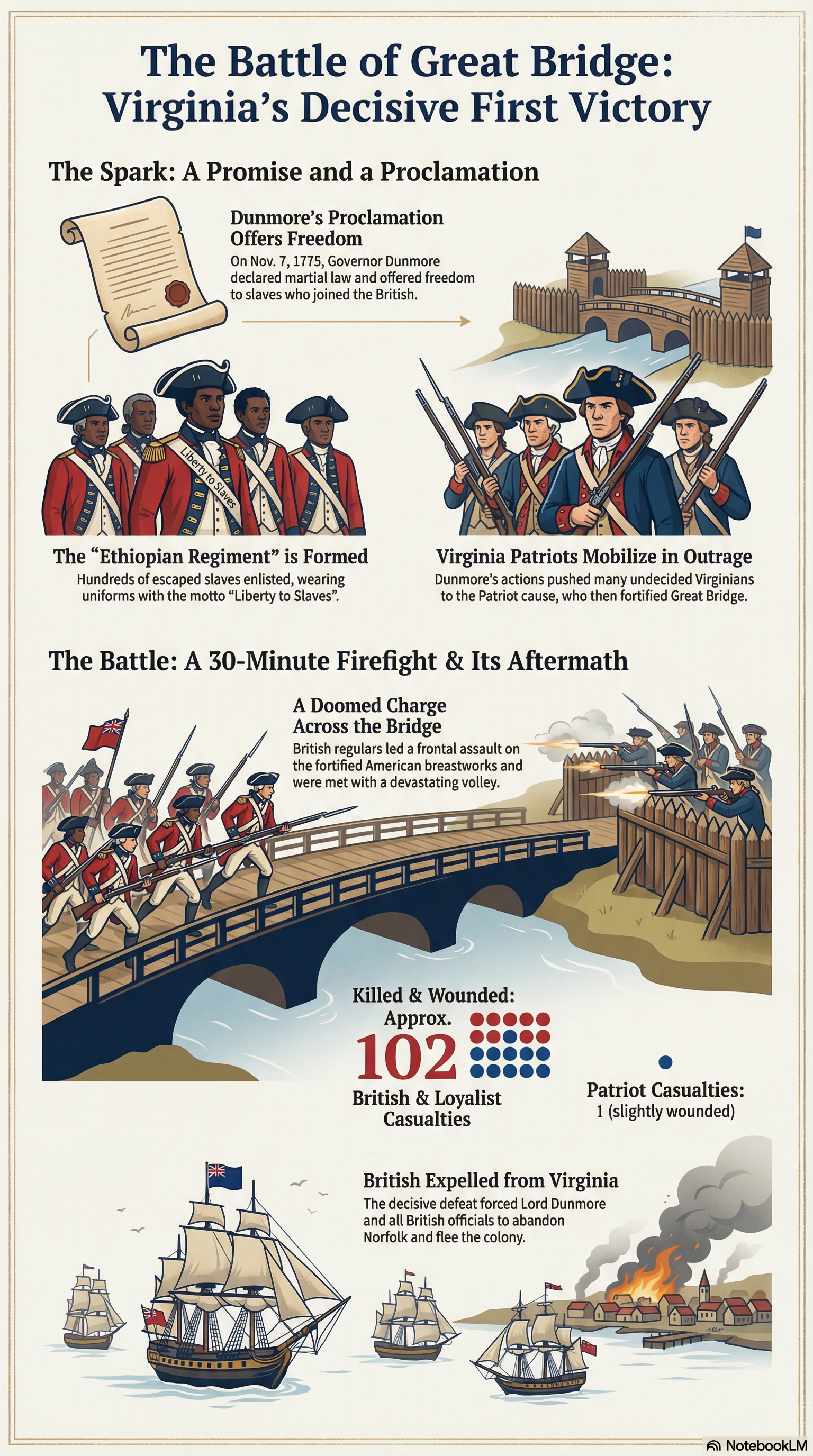
In November 1775, Dunmore issued a proclamation that placed Virginia under martial law and declared that indentured servants and slaves belonging to rebel masters would gain freedom if they took up arms for the Crown. The promise was a mixture of genuine intent, military necessity, and political miscalculation. It enraged Virginian plantation owners, pushed undecided moderates toward the Patriot cause, and created a new force in Dunmore’s service, the Ethiopian Regiment. The regiment grew quickly and wore uniforms bearing the motto Liberty to Slaves. It was a stark message in a colony that claimed to fight for liberty while defending a system that denied it to many of its own neighbors. History has never been tidy about such contradictions. The past rarely arranges its values in a neat row.

Dunmore’s force at Norfolk became a complicated assembly of British regulars, Loyalist militia, and escaped slaves seeking a fate better than the one they had fled. Two companies of the 14th Regiment of Foot anchored the professional side of the force. Dunmore also raised the Queen’s Own Loyal Regiment, composed of colonists still faithful to the Crown. With these troops he seized Kemp’s Landing in mid November. That small success convinced him that he might push inland and reassert authority with something resembling confidence.
Great Bridge, however, stood in the way. It was a narrow crossing over the Elizabeth River, surrounded by the Great Dismal Swamp, a name that gives no false promises. It was the only significant overland route connecting Norfolk with North Carolina. Whoever held the bridge controlled the road. Dunmore erected a fortification on the northern side, named Fort Murray. He removed planks from the bridge to make any Patriot advance difficult. It was the kind of move that looks clever on a map and becomes less so when the enemy refuses to cooperate.
The Virginia Committee of Safety ordered Colonel William Woodford to take the Second Virginia Regiment and confront Dunmore’s forces before they expanded their reach. Woodford marched south with a growing force that included riflemen from the Culpeper Minutemen. These men wore green hunting shirts and carried rifles capable of impressive accuracy. They looked more like frontiersmen than soldiers of a formal army, but appearances often deceive. In early December they reached the southern end of Great Bridge and built a semicircular breastwork. It was set close enough to the causeway to deliver concentrated fire and far enough back to avoid direct cannon fire. The ground was cold. Supplies were uneven. Some men lacked shoes or blankets. Yet more militia arrived daily, drawn either by duty, anger, or the restless certainty that the old order in Virginia was cracking.
Skirmishing took place in the swampy ground, and Dunmore grew impatient. He wanted to break the siege around Fort Murray and drive Woodford back before the Patriots became too entrenched. His initial plan involved a diversionary advance by the Ethiopian Regiment while the main force crossed the bridge. For reasons that would later ignite Dunmore’s frustration, the plan was not followed. Captain Leslie marched his forces from Norfolk on December 8 and prepared to attack without the diversion. British soldiers laid planks across the bridge in the night and moved two small cannons into position. By three in the morning they were ready.
The assaulting force formed in the early light. The column was led by Captain Charles Fordyce and Lieutenant John Batut, seasoned officers of the 14th Foot. Their men advanced six abreast along the narrow causeway. The water and swamp pressed in on both sides. The air held the stillness that precedes violence. Inside the American breastworks, Lieutenant Edward Travis instructed his men to hold their fire until the British drew close. Woodford wanted one sharp volley rather than scattered shots. The men waited. Waiting in battle is often worse than fighting. The imagination fills every second with possibilities both heroic and unbearable.
When the British line reached approximately fifty yards from the Patriot position, the Virginians opened fire. It was a single shattering volley. The effect was immediate. Fordyce was struck several times but continued forward. Batut was wounded. The regulars recoiled but did not break. Fordyce gathered himself and pushed again, leading a second charge up the causeway and into the teeth of the American guns. According to multiple accounts he fell within feet of the breastwork, pierced by fourteen shots. His determination was remarkable, although no amount of courage can survive that kind of fire.

The British line wavered and then retreated. The Culpeper riflemen took advantage of the moment and moved into positions that allowed them to target the British gunners. The British spiked their cannons and fell back to the fort. Those inside Fort Murray realized the position was untenable. The Patriot riflemen now commanded the ground. The entire battle lasted less than an hour, a short and violent punctuation in a story that stretched back through many months of miscalculation and mistrust.
The human stories within the battle reveal its complicated truth. Free African American soldier William Flora fought for the Virginia militia and played a decisive role by removing a bridge plank as the British advanced. He did so under fire and was said to be the last man to cross before the fighting began. His action delayed the British advance at precisely the moment they needed momentum. Meanwhile, members of the Ethiopian Regiment fought on the British side. Two of them, identified as James Anderson and a man known only as Caesar, were wounded and captured. Great Bridge marked the first time African Americans fought each other in open battle during the Revolution. That reality does not lend itself to neat lessons or comfortable summaries. Each man fought for the freedom he believed available to him. History rarely gives out identical maps to those traveling the same road.
British and Loyalist casualties were severe, estimated between sixty two and one hundred and two killed, wounded, or captured. The American casualties amounted to a single man wounded in the hand. It is tempting to turn these numbers into a simple story of talent versus incompetence, but the truth sits elsewhere. The British attacked across a narrow causeway into a fortified position held by determined men. The Patriots needed only to hold their ground. The British needed to cross a deadly span of fifty yards. The result, though dramatic, followed the cruel geometry of the battlefield.
After negotiating a brief truce to collect the wounded and dead, the British abandoned Fort Murray during the night. They withdrew to Norfolk, where Dunmore absorbed the news with volcanic frustration. He expected aggression to restore his authority. Instead, it revealed the limits of his command. Woodford marched into Norfolk days later, reinforced by North Carolina troops under Colonel Robert Howe. Dunmore and his Loyalists took refuge on ships in the harbor. From that point onward, the royal government operated from the water, which is not a comfortable place to conduct the business of ruling a colony.
Norfolk soon became a symbol of the unraveling British position. Patriot forces restricted supplies to the British ships, hoping hunger would do the work that musket fire had already begun. On New Years Day 1776, Dunmore ordered his ships to bombard the town. The British landed men who set fires, and the Patriots extended the destruction rather than allow Norfolk to serve again as a British base. By the end of the day, much of the town had been reduced to charred remains. It was a bitter conclusion for a place that had once hummed with colonial ambition. Woodford described the earlier fighting at Great Bridge as a second Bunker Hill affair in miniature. Norfolk became a grim continuation of that theme, a reminder that the Revolution did not always build as much as it destroyed.
Dunmore attempted to regroup on Gwynn’s Island and later at Portsmouth, but the military tide in Virginia had turned. General Charles Lee pushed him from his final positions. In August 1776, Dunmore sailed north to join British operations near New York. He never returned to Virginia. With his departure the last vestige of royal control vanished. The Virginia Convention was free to shape its own government and align the colony fully with the Continental cause. The battle at Great Bridge had removed the British foothold that had lingered in the Tidewater region. The gateway between Virginia and North Carolina opened to Patriot movement and supply. In a war where logistics often mattered as much as courage, this mattered intensely.
The victory carried more than military significance. It altered the political balance of the colony. Without Dunmore’s interference, Virginia could contribute men, supplies, and leadership to the Continental Army. Many later events in the war, including the eventual British return to the South, took place in a landscape shaped by the Patriots early control of Virginia. Great Bridge gave the colony a moment of triumph when morale needed support. It proved that trained British regulars could be defeated by militia positioned well and determined to hold their ground. It removed any illusion that the British could rely on loyal support across the colony. The people had chosen their side.

Today the site of the battle sits within the modern boundaries of Chesapeake, Virginia. The Albemarle and Chesapeake Canal cuts across ground that once echoed with musket fire. Route 168 Business, known as Battlefield Boulevard, runs along the general area of the causeway and bridge. The landscape has changed enough that a visitor must use imagination to see the events that unfolded there. Yet the place retains a quiet solemnity for those who pause long enough to feel it. Local citizens and historical groups have preserved the memory with care. The Great Bridge Battlefield and Waterways Historic Park now marks the area, and efforts continue to honor the story without smoothing away its rough edges.
Annual commemorations bring together descendants, historians, and those who simply believe that a nation ought to remember the moments that shaped its early days. The Sons of the American Revolution and the Daughters of the American Revolution participate in these events. The gatherings are not grand spectacles. They feel more like conversations between generations, quiet acknowledgments that the past does not fade unless we let it.
Reflecting on the Battle of Great Bridge invites a recognition of its layered meaning. The engagement was swift. The Patriots fired a devastating volley and the British fell back. One American was wounded. More than one hundred British and Loyalists fell in less than an hour. The outcome was not merely lopsided. It was a lesson in the importance of preparation, position, and purpose. The Patriots did not win because they were ideal soldiers. They won because they understood the ground beneath them and stood firm when the moment arrived.
The political consequences were enormous. With Dunmore gone and his authority hollowed out, Virginia became a fully self-governing Patriot colony at precisely the moment the Continental movement needed it most. Virginia provided troops, supplies, and leadership that shaped the course of the Revolution. The path from Great Bridge may wind through many later battles, but its imprint is unmistakable.
There is also the more difficult legacy to consider. Dunmore’s Proclamation promised freedom to enslaved people who joined the British. Many embraced that chance with desperation and hope. Yet their service did not end in the liberation they expected. Disease ravaged the Ethiopian Regiment, and British strategy never secured a strong hold in Virginia. Meanwhile, African Americans stood on both sides of the battle. William Flora’s courage reminds us that the Revolution contained stories that defy simple categorization. The war for independence did not resolve the meaning of liberty for everyone. The fact that men of African descent fired upon each other at Great Bridge is a reminder that history rarely aligns its symbols neatly. It presents us with tangled truths and expects us to trace them with patience.
In the end, the Battle of Great Bridge was a warning to the British that colonial resistance in the South was stronger and more capable than they believed. It revealed the hazards of underestimating a people who felt their rights were slipping from their grasp. It showed that militia, when properly positioned and motivated, could resist professional armies. It offered a confidence boost to the Patriots at a moment when the outcome of the Revolution was anything but certain. Woodford’s men proved that they could hold a line and alter the course of events beyond their small patch of frozen ground.
The story of Great Bridge may not glitter with the fame of larger battles, but it carries its own quiet radiance. It is the light that comes from understanding where the hinges of history actually sit, on mornings when ordinary men chose not to yield. It is also a reminder that victory in war often depends on moments that last less than an hour but echo across the decades. When you stand on that ground today, you may not hear musket fire, but you might hear something else. It could be the faint sound of people who believed that the world they knew was shifting, and who resolved to meet that shift with determination, imperfect courage, and the stubborn hope that they could shape the future that was coming toward them.
The Battle of Great Bridge invites us to listen to those echoes without forcing them into tidy conclusions. It reminds us that freedom is not a single moment or promise. It is a long and winding path shaped by choices made under pressure, by victories won in unexpected places, and by the courage of people who did not expect their names to live past the morning. In that way, Great Bridge belongs not only to the Revolution but to the larger human story of how ordinary ground becomes sacred when people decide that they will not yield it.



 DAVE DOES HISTORY
Leave a comment