
Josiah Bartlett is one of those names that shows up on the Declaration of Independence, gets a nod in a textbook, then quietly disappears behind louder, flashier founders. That is a shame. If you trace his life from a muddy frontier village in New Hampshire to the floor of the Continental Congress, then on to the governor’s chair and the sickbed of half his colony, you find a man who was constantly doing the hard, unglamorous work that keeps a revolution from collapsing in on itself.
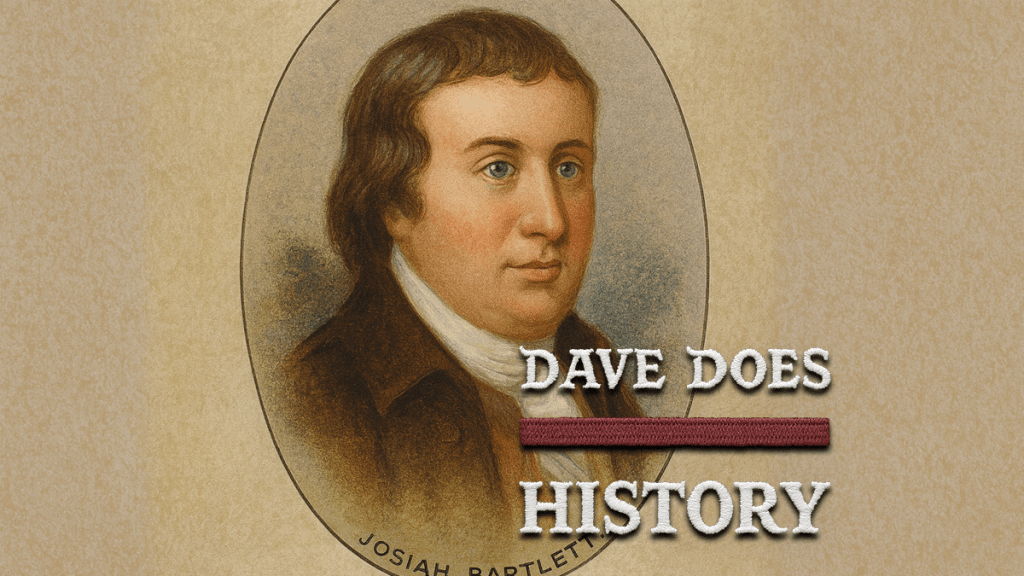
He was born on November 21, 1729 Old Style, which translates to December 2 in our calendar, in Amesbury, Massachusetts, the last child of Stephen Bartlett, a shoemaker, and Hannah Webster Bartlett. He did not come from a great house or an old family. He came from a shop where leather and debt were both very real. He got the basic local schooling, then was pushed further by a relative, Reverend John Webster, who drilled him in Greek and Latin and opened up a wider world of ideas than a village on the Merrimack usually offered.
At sixteen, instead of heading to Harvard like the more fashionable young men of Massachusetts, Bartlett went into medicine. He apprenticed under Dr. Nehemiah (or James) Ordway in Amesbury for about five years. Ordway was no scientific pioneer, but his shelves of books and the daily grind of treating sick neighbors gave young Josiah a practical foundation. By 1750, not yet twenty one, Bartlett did something bold. He packed a horse, thirty dollars, some medicines, and a set of surgeon’s instruments and rode north into the woods of New Hampshire to set up shop in Kingston, then a rough frontier settlement.
Kingston was not Boston. There were no elegant parlors or fashionable salons waiting for a young doctor. Bartlett arrived as the only physician for miles, and that isolation forced him to lean on his own judgment. He boarded with Reverend Joseph Seccombe, raiding the minister’s extensive library at night, working patients by day, reading medicine and natural philosophy whenever he could steal an hour. He bought a small farm, planted crops, and slowly became part of the fabric of the town. In 1754 he married his cousin Mary Bartlett of Newton. They would eventually have a large family, usually given as twelve children, with eight living to adulthood. This was not theory for him. When he spoke later about public duty and sacrifice, he was talking as a man who had a wife at home running a farm, managing servants, bearing and burying children while he rode off to tend strangers or vote on independence.
If Bartlett had done nothing but practice medicine, he still would have left a mark. Eighteenth century medicine was a bloodletting culture. Bleed the patient, blister the skin, dose them with emetics and harsh purges, stuff them in a hot room and hope the fever breaks before they do. Bartlett did not buy it. He had a stubborn habit of watching what actually worked, which put him on a collision course with fashionable theory.
In 1754 a vicious outbreak of “throat distemper,” probably diphtheria, tore through Kingston. Children dropped in terrifying numbers. The standard regimen produced corpses. Bartlett began experimenting. He tried various remedies and discovered that Peruvian bark, later understood as a source of quinine, eased the worst symptoms long enough for some patients to survive. He also found that “cooling” treatments worked better than locking patients in hot rooms. When he himself fell ill with a high fever, he ignored his own doctor, drank cold cider at intervals, and sweated his way back to health. He then did the unthinkable for his time. He applied that same cool regimen to his patients.
Neighbors noticed. In a town where dozens died, the people under Bartlett’s care survived at rates that could not be explained away as luck. He became known as the man who “treated the patient instead of the disease,” a physician who thought in terms of bodies, minds, and environments rather than blindly repeating the textbook recipe. He talked about diet, exercise, fresh air, and a settled mind as part of health, which sounds like something out of a modern wellness blog but was radical in the 1760s.
This was not just a gentle country doctor with a few clever tricks. Bartlett also thought about institutions. Late in life, as his political career peaked, he pushed for a formal medical profession in his state. In the early 1790s he helped secure legislation to charter the New Hampshire Medical Society and became its first president, presiding at its initial meeting while also serving as governor. Around the same time Dartmouth College conferred an honorary Doctor of Medicine on him, in the same ceremony where his son Ezra received the same degree. It was a neat symbol of what he had built: a family and a state stepping into a more modern, professional world because he would not leave medicine in the hands of guesswork and superstition.
While all of that was unfolding, politics came looking for Josiah Bartlett. In 1757 he became a town selectman, which was less about glory and more about roads, taxes, and trying to keep neighbors from killing each other over fences. In 1765 he entered the New Hampshire Provincial Assembly just as the Stamp Act crisis blew up. The royal governors, first Benning Wentworth and then his cousin John, tried the usual tactic. If a bright, popular man gave them trouble, they handed him an office in hopes it would tame him. Bartlett was made a justice of the peace and a militia colonel. It did not work. He opposed the Townshend Acts, drifted firmly into the Whig camp, and became one of those irritating provincials who kept pointing out that the colonies actually had rights.
By 1774, when committees of correspondence formed to coordinate resistance, Bartlett was on New Hampshire’s list, trading letters and intelligence with men like Samuel Adams. When Governor Wentworth dissolved the Assembly that year, Patriots in New Hampshire created an extra legal Provincial Assembly, and Bartlett was chosen its president. Loyalists in the region responded the way angry partisans often do. At some point his Kingston home burned under suspicious circumstances. Bartlett treated it as a message and an opportunity. He rebuilt the house on the same foundation, a not very subtle way of saying that he was not going anywhere. Wentworth retaliated by stripping him of his militia and judicial commissions in 1775. By then, Bartlett did not need royal paper to tell him who he was.
In the middle of this rising tension, the Continental Congress came into view. Bartlett declined election to the First Continental Congress in 1774, partly because his house had just burned and partly because he still had a town full of sick and frightened people to care for. By 1775, after Lexington and Concord, he could not stay away. He went to Philadelphia as one of New Hampshire’s delegates to the Second Continental Congress and soon found himself in an uncomfortable position. For a stretch in late 1775 and early 1776 he was essentially the only New Hampshire delegate present, which meant he landed on almost every major committee that needed a reliable workhorse. He served on committees of safety and secrecy, on munitions, on marine affairs, and on civil government. He was not a great orator. He was the man who read the documents, understood the details, and kept the machinery moving while others made the speeches.
That is how he ended up in the room when the colonies confronted the question they had been circling for a year. On July 2, 1776, when the Continental Congress took up Richard Henry Lee’s resolution that “these United Colonies are, and of right ought to be, free and independent States,” they called the roll from north to south. New Hampshire was the northernmost colony. That made Josiah Bartlett the first man in that chamber asked to vote his colony into independence or keep it bound to the Crown. He answered yes. Accounts from later generations say he answered so loudly he made the rafters shake. Whether the exact noise level is accurate or not, the political fact is clear. The first recorded voice for American independence in that final vote came from a small town doctor from Kingston.
When the engrossed parchment copy of the Declaration was ready on August 2, 1776, the delegates came forward to sign. The order again ran roughly from north to south. John Hancock had already placed his famous, oversized signature as presiding officer. The first state called was New Hampshire. Josiah Bartlett stepped up and signed, making him the second man on the page and New Hampshire’s sole signer in 1776. His colleague Matthew Thornton would not sign until the following November because of delays in his election and arrival. Bartlett later called the Declaration “the greatest state paper ever conceived by the mind of man,” and he treated his role in it with a mixture of gravity and quiet satisfaction rather than theatrics.
Congress still had to solve the problem of how these new states were going to live together. In June 1776, Bartlett was appointed to the committee to “prepare and digest” a plan of confederation. Within a month the committee produced a draft of what became the Articles of Confederation and Perpetual Union. It would take more than a year of wrangling for the document to pass Congress in November 1777, and months more for the states to sign. When the time came to vote on the final text, Bartlett again stood at the front. New Hampshire’s vote was called, and he cast the first recorded vote in favor of the Articles. When the formal signing rolled out in 1778, the delegates from New Hampshire were called first, and Josiah Bartlett’s name leads the list on the ratification instrument for his state.
That kind of work took a toll. Bartlett was not some tireless marble statue. By 1777 he was exhausted. After asking for relief, he returned home, just in time to be thrown into yet another crisis. British forces were moving down from Canada, and General John Stark was gathering New Hampshire men to meet them. Bartlett went north as a kind of hybrid envoy and surgeon. He coordinated supplies and tended the wounded after the Battle of Bennington in August 1777, then went to bat for Stark when political sniping threatened the general’s career. There was always another fire to put out, another quarrel to mediate, another regiment that needed powder or medicine.
Back in Kingston, Mary Bartlett kept the farm running. She oversaw planting, harvesting, servants, and the day to day work of survival with a house full of children and a war on her doorstep. Their surviving letters give a ground level view of the Revolution that does not match the heroic paintings. They write about crop failures, illness, and the constant strain of separation. Bartlett’s letters from Philadelphia include not only political news but also grim accounts of a city scarred by British occupation, with damaged buildings and stripped countryside.
By 1779 he was done with national office for the moment. His health was shaky, and New Hampshire needed judges. Despite having no formal legal training, he was appointed chief justice of the Court of Common Pleas, then elevated to the state’s Superior Court, the top bench in New Hampshire. Eventually he became chief justice of that court as well. Contemporary accounts, and later biographical sketches, praise his steadiness on the bench. He was not a brilliant legal theorist. He was a man who applied common sense, a working understanding of the law, and a lifetime’s habit of listening carefully to both sides. In a young state where old colonial elites were losing their grip, that kind of integrity mattered more than pedigree.
When the proposed federal Constitution emerged from Philadelphia, Bartlett once again stepped back into the wider arena. In 1788 he served as a delegate to the New Hampshire convention that considered ratification. He argued strongly in favor, helping to push his state into the yes column. When New Hampshire ratified on June 21, 1788, it became the crucial ninth state, the one that made the new Constitution legally effective between the ratifying states. The man who had been first to vote for independence and first to vote for the Articles now helped give birth to the new federal frame that would replace them.
The legislature elected him to the new United States Senate in 1789, and in a move that probably baffled ambitious men around him, he declined. He was nearing sixty, still carrying the scars of long years of overwork, and was already serving as the top judge in his state. Instead he stayed in New Hampshire and did something in many ways harder than national glory. He governed.
Beginning in 1790 he was elected chief executive of New Hampshire, a title that soon morphed from “president” to “governor” under the amended state constitution. In that role he did not chase grand theories. He tackled the boring but crucial work of making a state function. He worked with the legislature to review and codify existing laws, regulate currency, and set up special judges where the legal system needed more structure. He pushed for better roads, bridges, and canals. He tried to steady the finances of a small, debt ridden state that had just sweated its way through a long war. He backed farmers and small businesses because he understood firsthand that revolutions collapse if ordinary people cannot pay their bills and get their goods to market.
He also wore his physician’s hat even while in office. The chartering of the New Hampshire Medical Society in 1791, with Governor Bartlett elected its first president, is a perfect example. He saw that the same habits of order, recordkeeping, and shared standards that made a state work could also drag medicine out of superstition and into something like a profession. For a man who had started as a teenager in someone else’s back room, reading dog eared Latin treatises on fevers, that must have felt like closing a circle.
By 1794 his body had had enough. He resigned the governorship in January, writing that he wanted to retire “from the cares and fatigues of public business to the repose of a private life.” He went back to Kingston, to his farm, his orchards, and his family. He did not get many quiet years. He died on May 19, 1795, at sixty five, with paralysis given as the cause. Some of it was age. A great deal of it was the obvious cost of decades spent riding in all weather, sitting through endless debates, and carrying more responsibility than most of us would tolerate for a week.
His story did not end in that grave at Plains Cemetery in Kingston, where he lies beside Mary. Three of the Bartlett sons and seven grandsons went into medicine, creating a family medical dynasty in New England. Admirers described him as having a quick, penetrating mind, sound judgment, and a reserved dignity. Biographers like to point out that he rose not on the strength of a famous name, but by what one nineteenth century writer called “the probity of his character” and the “force of his genius.” That may sound a little purple, but underneath the rhetoric sits a simple truth. In a world where political advancement often depended on who your father was, Bartlett built his standing on patients he had saved and decisions he had handled honestly.
His religious journey is one more quiet sign of his independence. Raised in a Calvinist setting, he later shifted toward the more hopeful theology of the Universalists. The same mind that refused to accept standard medical dogma without evidence seems to have had trouble accepting a God who created most of humanity only to damn them. It is a reminder that eighteenth century New England was not just fire and brimstone sermons. It was also a place where thoughtful people were rethinking old creeds while they also rewrote charters and constitutions.
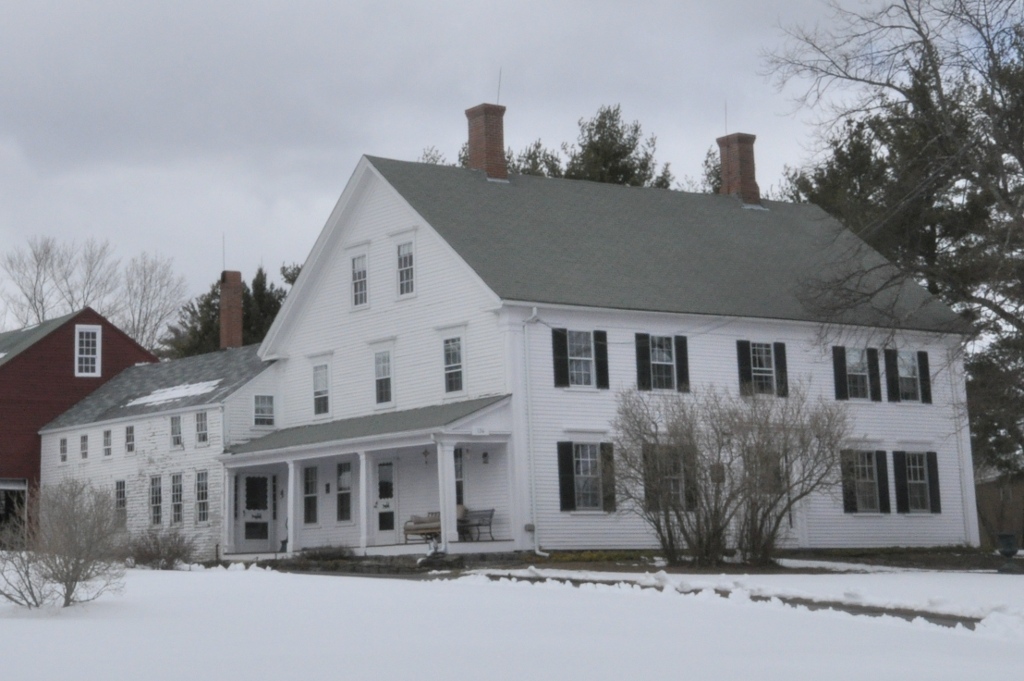
Public memory has done what it usually does. It has turned his name into a handful of symbols. The Josiah Bartlett House in Kingston, rebuilt after the suspicious fire of 1774, still stands as a National Historic Landmark, though it remains a private residence. In Amesbury, a bronze statue of Bartlett stands with a quill pen in one hand and a scroll inscribed with the word “Independence” in the other, unveiled on July 4, 1888 while the poet John Greenleaf Whittier supplied a commemorative poem. The town of Bartlett, New Hampshire, carries his name into the White Mountains, and his portrait, based on an original by John Trumbull, hangs in the State House in Concord.
His papers, including correspondence from his days in Congress, his time as judge, and his years as governor, are scattered through archival collections in New Hampshire. They show a man who worried about corn and beans, who wrote home about sick children, who fretted over militia supplies, and who was still tinkering with the details of state finance long after the fireworks of independence had faded.
To modern audiences, Bartlett lives a strange second life as a kind of spiritual ancestor of a fictional president. Aaron Sorkin’s television character Josiah “Jed” Bartlet on The West Wing was explicitly described as a descendant of the real Dr. Josiah Bartlett, and the show’s universe leans into that New Hampshire connection. Viewers who watched Martin Sheen stride through the West Wing with his Nobel Prize and quick Latin quips may not realize they are looking at a pop culture echo of a country doctor who once cast the first recorded vote for independence and then trudged back to Kingston to pull teeth and argue about bridges.
So what do we do with Josiah Bartlett, two and a half centuries on. At one level, he is a checklist of achievements. First to vote for independence. Second to sign the Declaration. First to vote for and sign the Articles of Confederation. Founder of a state medical society. Governor of New Hampshire in the early constitutional era. At another level, he is a reminder that revolutions and governments are held together by people who bring their day job into the political arena and refuse to separate practical skill from public duty.
His medical practice trained him to look at the evidence in front of him, not just the fashionable theory. His years in Congress taught him to do the committee work that makes lofty resolutions more than hot air. His time on the bench and in the governor’s office showed that he understood what it meant to translate revolutionary language into working law, sound currency, and functioning roads. He helped move New Hampshire from being a rebellious colony to being a reasonably stable state in a new federal union, and he did it without hunting for monuments or titles. Bartlett’s own epitaph captured it well. He was “not more illustrious for public services than for private virtues.” That is not the kind of line that gets you an action movie, but it is the kind of legacy that lets a country survive its own birth.
Bartlett Family Papers, 1710–1937. New Hampshire Historical Society. Concord, NH.
Mevers, Frank C., ed. The Papers of Josiah Bartlett. Vol. 17 of New Hampshire Records Series. Concord: State of New Hampshire, 1979.
New Hampshire Medical Society. “Dr. Josiah Bartlett.” Accessed 2025. https://www.nhms.org.
New Hampshire Provincial and State Papers. Concord: State of New Hampshire, various volumes.
Smithsonian National Portrait Gallery. “Josiah Bartlett, after John Trumbull.” Accessed 2025. https://npg.si.edu.
United States Congress. Biographical Directory of the United States Congress, 1774–Present. Entry for “Bartlett, Josiah (B000206).” Washington, DC. https://bioguide.congress.gov.
United States Continental Congress. Journals of the Continental Congress, 1774–1789. Edited by Worthington C. Ford and others. Washington, DC: Library of Congress, 1904–1937.
United States Department of the Interior. National Register of Historic Places Nomination: Josiah Bartlett House, Kingston, New Hampshire. Washington, DC, 1971.
Whittier, John Greenleaf. “Poem for the Dedication of the Bartlett Statue, Amesbury, Massachusetts, July 4, 1888.” Amesbury Historical Records.
Winton, Susan. Josiah Bartlett. Daughters of the Signers of the Declaration of Independence (DSDI). Accessed 2025. https://www.dsdi1776.com.


 DAVE DOES HISTORY
Leave a comment