
He was born Herman Webster Mudgett in Gilmanton, New Hampshire, in 1861, the son of a respectable Methodist family that would never guess what kind of history was taking shape under their roof. The boy grew into a man who would rename himself H. H. Holmes and would become a riddle that mixed talent with cold calculation. Americans know him as one of the earliest serial killers the country ever produced, but murder was only one strand of the twisted rope. He stole, he conned, he forged, he swindled. He told so many stories that truth learned to limp. The tally of victims has always been a guessing game, from the nine he admitted in varying moments to the scores that newspapers shouted about, and to the larger figures that storytellers love because they thrill. The honest accounting still escapes us. What does not escape us is that Holmes exploited a restless age of movement and novelty. He turned anonymity into camouflage. He used education as a tool. He used charm as a key. This story narrows to the Chicago years and the financial scheme that pulled his mask away. It follows the Pitezel fraud, the murders of children, the patient hunt that caught him, the trial that proved only a single homicide, and the hanging that left a sour aftertaste of legend. It ends with the odd little curse that people whispered about afterwards. It is a story about how an ambitious liar finally found the one truth that courts still tell with a rope.
Herman Mudgett learned early that quiet people can move unnoticed. Schoolmates remembered a solitary boy with a hard streak and an appetite for praise. He liked money, even when he had none. He liked appearing important, even when he had not earned it. He attended medical school, learned chemistry and anatomy, and gained a clinical eye for bodies that most people never look at for long. The line between curiosity and cruelty blurred. Rooming house gossip told of a dissected infant hidden under his bed. Whether that detail stands up or not, it fits the pattern that follows, and it tells you how witnesses judged his habits. He ran a vaccination scam that preyed on fear of smallpox. He had a gift for pretending to be official. He also had a gift for using people, which is a polite way to say he could be cruel to those closest to him. He married Clara Lovering in New Hampshire, accepted her help and her money, then abandoned her. She later spoke of physical abuse. She spoke of a man who could turn cold in a second. That coldness would become a furnace for schemes.
Chicago looked like a stage built for a man who thrived on confusion. The city was preparing for the World’s Columbian Exposition at the start of the 1890s. The fair promised new crowds, new commerce, and the kind of distraction criminals adore. Holmes arrived as a gentleman entrepreneur who sold drugs and remedies, then expanded into more ambitious plans. He raised a multi story building in the Englewood neighborhood, a structure that felt like a riddle box. The first floor held retail space for his pharmacy and other storefronts, while the upper floors housed rooms for rent. Fireproof, sound resistant, and confusing to navigate, the interior carried the kind of oddities that newspapermen later turned into folklore. Newspapers nicknamed it the Murder Castle once his crimes became public. That label was the work of sensational copy, but it captured a darker truth. Women who entered Holmes’s circle often vanished. Julia Conner, who had been married to a man named Ned Conner and later became Holmes’s mistress, disappeared, as did her young daughter Pearl. Emeline Cigrand, another young woman charmed by Holmes, vanished too. Minnie Williams came under his spell, and so did her sister Nannie. Minnie had money, a fact that always sharpened Holmes’s interest. In each of these cases, Holmes dangled flattery and promises, then folded the women into his web. Some rented rooms. Some helped in the office. Some believed he planned to marry them. The building became a prop. He controlled access. He controlled locked doors. He controlled secrets. Bodies were seldom recovered, which helped him tell new tales whenever suspicion stirred.
Holmes might have continued skating along the edge of rumor if not for a scheme that began with a simple idea and ended with a murder he could not explain away. In Philadelphia during September 1894, he and an associate named Benjamin Pitezel planned a straightforward fraud. Pitezel was a carpenter and a drinker, useful to Holmes because he could be manipulated, and useful to himself because he hoped for quick money. The plan called for Pitezel to fake his death so Fidelity Mutual Assurance Company would pay out a ten thousand dollar life insurance policy. The two men would split the money and laugh at the cleverness of it all. Simple plans and greedy partners rarely survive the leap from talk to action. Holmes decided that keeping Pitezel alive complicated matters. On September 2, 1894, at a house on 1316 Callowhill Street, Holmes used chloroform to render Pitezel helpless and then killed him. He staged the scene to look like an accidental explosion. Burns marked the body. Items were scattered to hint at a blast.
The explosion story did not survive the first skeptical look. Dr. William Scott, who examined the scene, noted the calm set of Pitezel’s face and the position of objects, including a pipe and chemical bottle fragments that seemed suspiciously close to the dead man for any true explosion. If a blast had thrown Pitezel, why were his possessions arranged as if someone had posed them for a photograph. Dr. Henry Leffman, who conducted the autopsy, confirmed what the hunches already suspected. Chloroform killed Pitezel. The fire that discolored the skin came after death. That meant the explosion was no accident. It was theater. Theater is a dangerous hobby when the audience includes a coroner.
The insurance company requires proof, and here is where the story turns from dark to black. Fidelity Mutual wanted a family member to identify the body. Holmes, always confident that his tongue could smooth any edge, persuaded Carrie Pitezel, Ben’s wife, that her husband remained alive and that the identification would be part of the act. He then traveled with their daughter Alice to Philadelphia for the grim task. She identified her father’s body on September 22. From that cruel moment forward, Holmes faced a new problem. He had a witness who could undo him if she ever learned the truth. He solved that problem in the way that defined his life. He arranged to separate the children from their mother and moved them around under false names while feeding Carrie a rotating tale of meetings and delays.
Howard, the youngest at ten, disappeared in Irvington, Indiana, on October 10. Alice, fourteen, and Nellie, twelve, vanished in Toronto on October 25. Holmes kept moving. He lodged with Carrie Pitezel and two of her children under one set of names. He traveled with the three doomed children under another set of names. He also traveled with his latest wife, Georgiana Yoke, under yet another. He enjoyed the juggling. He had always enjoyed it. He rented houses under false pretenses and paid cash. He bought stoves and trunks as if restlessness were a craft. That motion, and the fact that he had targeted children, brought in men who were not easily fooled by stories.
The Pinkerton National Detective Agency stepped in. Philadelphia assigned Detective Frank P. Geyer to the task of finding the missing children after Holmes had already been arrested on a lesser charge. Geyer was methodical. He retraced the odd trail through the Midwest and into Canada, asking about fake names, checking rental ledgers, interviewing landlords who remembered a quiet man with children. He kept traveling until the ground itself surrendered Holmes’s secrets. In Toronto, Geyer found the remains of Alice and Nellie. The girls had been killed and buried in a cellar. In Indianapolis, outside the city, a search produced the remains of Howard, including part of a jawbone that could still speak. The calm of Geyer’s work reads like an answer to the manic energy of Holmes’s flights.
Holmes had already been picked up in Boston on November 17, 1894, not for murder, but for an outstanding warrant related to a horse theft in Texas. Petty crime often drags a larger sin into daylight. He surrendered without much fuss, boasting privately that a smooth tongue and a long string of lies would free him. He liked to match wits with authority. He believed he could keep inventing new versions of himself faster than any court could pin him down.
Jails have a way of narrowing a man. Holmes landed in Moyamensing Prison in Philadelphia on November 20, 1894. Confinement did not reduce his appetite for performance. He talked and wrote, then contradicted himself, then wrote again. He confessed to a changing list of murders that reached twenty seven at moments and fell lower at others. He published an autobiography, Holmes’ Own Story, that reads like a vanity project cosplaying as contrition. When Geyer’s discoveries about the children became public, Holmes invented a fresh defense. He named a mysterious figure called Edward Hatch as the real killer, a ghost blamed by a man who could not stand to see himself clearly.
The formal trial covered only one homicide, the murder of Benjamin Pitezel. It opened on October 28, 1895, and felt more like a test of patience than a whodunit. The defense team included William A. Shoemaker and Samuel Rotan. Holmes, never content to be silent, sought permission to act as his own counsel as well. He enjoyed the image of himself as a brilliant defendant, keen enough to command a courtroom. The judge simplified the matter by limiting the scope. The murders of the Pitezel children were ruled irrelevant to the Philadelphia charge, since they took place in Indiana and Canada. That legal boundary line frustrated the prosecution, which wanted the jury to see a continuous pattern. The jury would hear only the story that began on Callowhill Street.
The prosecution still had enough. Georgiana Yoke took the stand against the man she believed was legally her husband, though the marriage was void because Holmes had never divorced his first wife, Clara. Her manner and testimony gave the jury a clear view of his use of aliases and his habit of deceit. Carrie Pitezel told the story of the insurance plan and of Holmes taking her children. Her voice brought the crime back to human scale. The medical testimony closed the circle. Dr. Henry Leffman, the same physician who had studied the body a year earlier, laid out the science. Chloroform killed Pitezel. Death came before the fire. That simple chain of cause and effect snapped the final threads of Holmes’s last workable story that Pitezel had killed himself.
Jurors took three hours to complete their work. On November 3, 1895, they returned a single word that mattered. Guilty. The judge pronounced the sentence on November 30. Holmes would hang. For a man who loved control, the sentence must have felt like the first plain declaration that his voice no longer mattered. He would be confined, then walked up steps, then dropped.
Waiting men find religion. Holmes announced a conversion to Catholicism while in prison. He kept to good habits, or tried to appear that way. On the morning of May 7, 1896, he ate a hearty breakfast. The gallows had a set choreography. He denied all crimes except two failed abortions that he labeled criminal operations, a parting shot at honesty that told more about his taste for self serving detail than it did about the dead. Hundreds witnessed the hanging. A botched execution has a macabre fame. Some spectators later said his fingers and limbs continued to twitch for nearly fifteen minutes after the drop. The doctors said the neck broke. Choose which set of witnesses you trust. In any case, a quiet fell on the name that had been a storm.
Holmes had lived with corpses. He had ordered them and disguised them. He had used the medical knowledge of bodies the way a highwayman uses a pistol. Yet he had a real fear of postmortem indignity. He asked for special burial arrangements that would preserve his remains from any curious hands. The authorities granted him that small control. His body went into a coffin that had been partly filled with cement. More concrete was poured on top. The heavy casket went into the ground at Holy Cross Cemetery in Yeadon, Pennsylvania, ten feet down. There the concrete set like a hard final answer.
No criminal ever dies alone in the public mind. Stories linger. Motives harden into myths. The Holmes case bred a little legend that people liked to call a curse. Bits of bad luck clustered around those who had been near the case. The doctor who had taken part in the autopsy, Dr. William K. Mattern, died of blood poisoning. The jury foreman, Linford Biles, died by electrocution in an accident that people filed under strange fate. The prison superintendent, Howard Perkins, took his own life. Father Henry McPake, who had ministered to Holmes, died violently. One investigator’s office burned, yet a framed photograph of Holmes survived without a singe. These details sound made for carnival talk. They act like a mirror that lets the public avoid looking too steadily at the ordinary reasons people die. Still, the cluster has persisted in the telling, because generations love to round a story off with an omen.
There is a simpler explanation for the force of the curse tale. The Holmes story does not give anyone a comfortable ending. The Chicago building burned in 1895 and was later torn down, so the city cannot even point at a museum of horrors and collect a little money off the memory. The famous number of victims can never be nailed to a courtroom wall. He was convicted for one killing, even though he had almost certainly murdered many more. For those who crave definitive justice, that feels like a ledger with blurred ink. The curse gives people emotional symmetry. It lets them imagine that the world contains a hidden accountant who balances accounts invisibly when the courts cannot.
Historians linger over Holmes because he straddles two currents. He used the professional polish of the nineteenth century to hide a medieval appetite. He studied medicine in an era when dissection and chemical analysis were gaining rigor, yet he practiced crime the way a stage magician practices misdirection. He loved the cover of hotels and boarding houses because people moved in and out without being noticed. He built a confusing building because confusion has a pressure all its own. He cultivated gullible partners because crime feeds on ego. He wrote his own book because he believed in his brand.
Sorting fact from fiction is not easy. He lied constantly. Newspapers inflated. Witnesses observed through fog and were not immune to gossip. Even today, the word Murder Castle blinds readers to the more prosaic truth that Holmes killed for money and opportunity and control. The structure helped him, but it was not a haunted house with gas pipes, torture chambers, and trapdoors working like clockwork in the way some later accounts describe. The more you study him, the more you see a con man who seized chances and erased those who threatened to expose him. That profile is uglier and less romantic than the ghoulish myths, which is exactly why it deserves to be told plainly.
The Pitezel case provides that plain view. It shows a killer who saw a partner’s life as a useful prop. It shows a fraud grown into murder the way mold grows in a cupboard, quietly at first and then all at once. It shows what happens when a criminal loses patience with plans and seeks the easy fix. The forensic work, modest and careful, feels almost heroic because it values order over spectacle. Dr. Leffman’s testimony sweeps aside drama with the clarity of basic chemistry. The court that could try only one murder still found enough evidence to convict. The jury did not need the curse or a high body count to do its job. It needed proof that a man had been killed by another man. That proof sat right there in a bottle and a burn pattern.
The story also reminds us that law has borders and that those borders can frustrate justice. The judge in Philadelphia was correct to limit the evidence to the homicide that occurred in his jurisdiction. Trials should be precise. Precision can feel unsatisfying when you sense a larger pattern that cannot be presented. That tension fed the public appetite to make Holmes more monstrous, and in that appetite you can hear the hum of future true crime entertainment. The facts are strong enough without embroidery. A father died for an insurance policy. Three children died to protect a lie. Those deaths do not need extra adjectives.
Holmes’s last acts, including the conversion and the final breakfast, show a man trying to choreograph his own exit. Denying every crime but two botched abortions was an attempt to keep the narrative in his hands for one more moment. It did not work. The rope wrote the last sentence. The burial under concrete added a hard period. Now the name lives in the museum of American crime, and every generation takes it out to stare. Some see a demon. Some see a genius of evil. A colder reading sees an unusually adaptable con artist who learned that people believe pleasant lies more readily than they sift unpleasant facts. He exploited women by promising futures that would never arrive. He exploited a drunken partner by promising a windfall. He exploited geography by skipping from Chicago to Denver to St. Louis to Philadelphia to Boston and back. He exploited the moment by posing as a businessman during the greatest fair of the age. None of that requires legend. It requires a steady eye and a refusal to be charmed.
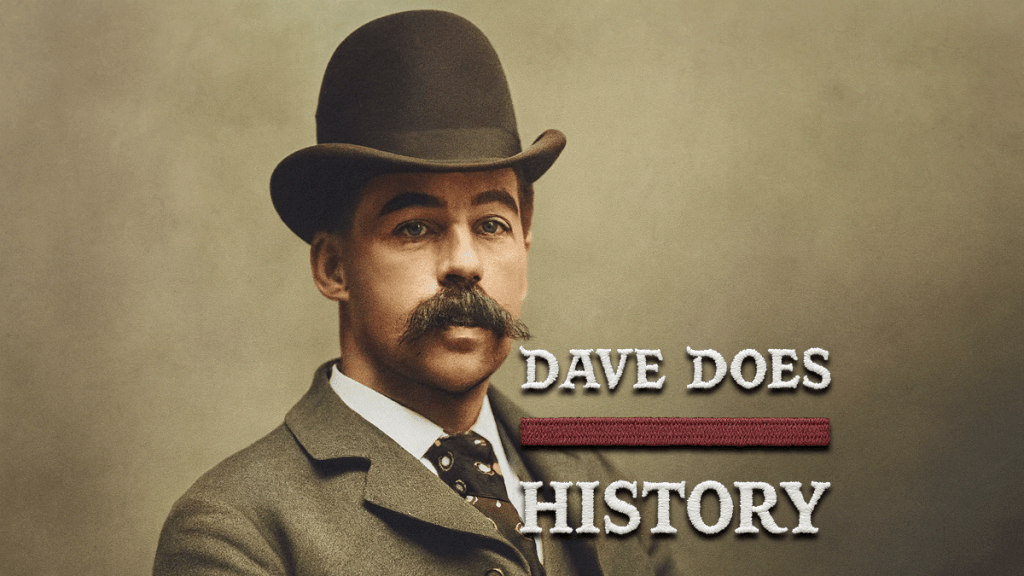
The image of Holmes in a bowler hat with a stiff, smug pose has become a kind of logo. It suggests competence and even a dapper coolness that advertisers might steal for a vintage poster. It says nothing about a child’s jawbone found by a detective who kept walking until he found what he needed. If there is a lesson worth keeping, it sits with Frank Geyer more than with H. H. Holmes. Geyer took lodger lists and receipts and turned them into a path. He did not invent twists. He followed them until they stopped. The moral weight of this story rests on that kind of work.
Holmes remains an infamous early American serial killer, yet his story has always been larger than murder counts. He was also a forger, a thief, a fraud, and a man who used social trust as a tool. The paradox of his conviction still stings. He was legally punished for one killing, the murder of Benjamin Pitezel, while history strongly suspects him of many more, especially those tied to the strange Chicago building that papers called the Murder Castle. The difficulty for researchers lies in the fog he created on purpose and the headlines that followed with glee. He aggrandized himself with confessions that bent to the market. The press draped his crimes in lurid fabric. Buried beneath that noise are solid facts about a single corpse and three children. Those facts are enough. They point to a man who killed to clean up his schemes.
The temptation with a figure like Holmes is always to ask for a grand conclusion. One exists only in a narrow form. Lies can buy time, but they cannot buy a future. Fraud can build a fortune, but it cannot hold it. Murder can silence a witness, but it can also wake the one witness that never lies, the body itself. H. H. Holmes built a labyrinth in Chicago. He built bigger labyrinths in people’s minds. The law found a straight path through one of them and led him to a scaffold. That is not a perfect ending. It is a human one. It leaves us with questions about other victims, about the true layout of that building, about how many people walked in and never walked out. It leaves us with an old photograph of a man who bet that the world would never see through him. Eventually the world did.
The small legends that cling to him will continue. People will repeat the curse stories and nod at the coincidences. They will point to preserved photographs after fires and speak with delighted shivers. A better memorial would be to remember the names of those who died and to honor the blunt clarity of the coroner who read a burn pattern and the chemist who smelled chloroform and the detective who followed a landlord’s memory to a cellar door. Those people did not believe the fairy tales that Holmes told. They showed that truth, though slower and less glamorous, still arrives. In a century that loves myth more than it admits, that is the only lesson that holds.




 DAVE DOES HISTORY
Leave a comment