
It was one of those moments in history when the nation’s pulse quickened, when politics felt less like policy and more like destiny. The year was 1960, and America stood at the threshold of a new decade, restless from recession, confident in its prosperity, but haunted by the long shadow of the Cold War. Out of that tension rose two men who would define a generation’s choice between continuity and change: John Fitzgerald Kennedy and Richard Milhous Nixon.
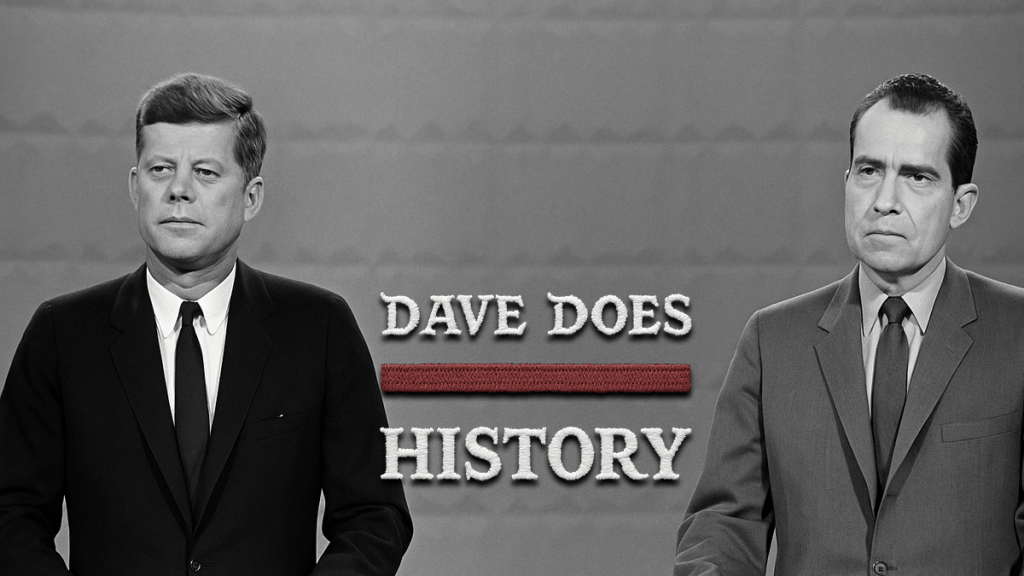
Kennedy, the youthful senator from Massachusetts, embodied the vigor of a new America. Nixon, the sitting vice president and veteran of eight years under Dwight Eisenhower, stood for experience and stability. Between them stretched an invisible line that divided a country ready to step forward from one uncertain whether it could afford to. On November 8, 1960, the nation made its choice, but barely. The outcome was so close it might as well have been decided by the flicker of a television screen.
This was the first election in which all fifty states took part, with Alaska and Hawaii casting their inaugural ballots. It was the last in which the citizens of Washington, D.C., could not vote. And it was the first in which the 22nd Amendment barred a popular president from running again, forcing Eisenhower to hand off the Republican torch. When the votes were counted, Kennedy had become the youngest elected president in American history, at just 43 years old. His victory was a whisper more than a shout, but it was enough to change the nation.
The race had been close—so close that Kennedy’s presidency would always carry the faint scent of controversy. The country had just endured a mild recession, and that hurt the Republicans. But the Democrats also held an enormous numerical advantage in registered voters, a fact that no amount of Eisenhower nostalgia could overcome. Nixon carried the aura of a loyal lieutenant to a beloved general, but Kennedy had something rarer: momentum. His Catholic faith, once considered a political burden, gave him a base of support that matched Nixon’s among Protestants, canceling out old prejudices in a new arithmetic of ambition.
At both parties’ conventions that summer, the contrast was clear. For the Republicans, the nomination process was more of a coronation than a contest. Eisenhower’s second-in-command had spent eight years in the vice presidency, visiting fifty-four countries and standing in for the president at home and abroad. His only serious challenge came briefly from New York Governor Nelson Rockefeller, who toyed with the idea of running before realizing the party was firmly in Nixon’s camp. By July, Nixon was the undisputed nominee, with Henry Cabot Lodge Jr., the patrician U.N. ambassador, as his running mate.
The Democrats, on the other hand, had a fight on their hands. Their field was crowded with old hands and rising stars: Lyndon B. Johnson, Stuart Symington, Hubert Humphrey, Wayne Morse, George Smathers, and twice-defeated Adlai Stevenson. But it was Kennedy, the young senator with the Harvard accent and Hollywood looks, who seized control of the race through the oldest political proving ground in America—the primaries.
He faced his toughest challenge in Wisconsin, where he squared off against Hubert Humphrey. Kennedy’s victory there was impressive but incomplete; critics claimed it came from Catholic-heavy districts. So Kennedy doubled down in West Virginia, a state that was overwhelmingly Protestant. He debated Humphrey on live television before a skeptical audience, promising competence over creed. The result was decisive: Kennedy won more than 60 percent of the vote. That single triumph destroyed the argument that a Catholic could not win in America and catapulted him to the front of the pack.
When the Democrats gathered in Los Angeles that July, Johnson and Stevenson tried to play the role of reluctant saviors, entering the race at the last minute. It didn’t work. Kennedy took the nomination on the first ballot. Then, in a shrewd and controversial move, he offered the vice presidency to Johnson, the powerful Senate Majority Leader from Texas. His brother Robert opposed it bitterly, but John stood firm. He knew he needed the South, and Johnson was the key to unlocking it. The uneasy alliance between the young senator and the Texas titan would shape the future in ways neither could have imagined.
As the general election began, both sides knew they were fighting not only for votes but for the soul of a new decade. The themes of the campaign reflected the anxieties of an age balanced between confidence and fear. The Cold War dominated everything. The Soviets had launched Sputnik three years earlier, and Fidel Castro had taken Cuba that very year. Kennedy hammered away at the idea that America was slipping behind, warning of a “missile gap” and calling on the nation to “get moving again.” Nixon countered with a promise of steady leadership, vowing to continue the peace and prosperity of the Eisenhower years.
Experience versus youth became the election’s central metaphor. Nixon cast himself as the seasoned hand, ready to steer the ship of state through turbulent waters. Kennedy, in turn, framed his inexperience as a virtue, representing freshness and boldness where bureaucracy had grown stale. “Who’s seasoned through and through,” his supporters sang, “but not so dog-gone seasoned that he won’t try something new.”
Beneath the grand rhetoric, deeper tensions simmered. Civil rights, once a regional issue, had become a national moral reckoning. When Martin Luther King Jr. was arrested in Atlanta during the campaign, Kennedy took a personal risk. He called Coretta Scott King to express sympathy, and his brother Robert called the judge to press for King’s release. That act, small in appearance but monumental in impact, helped shift the Black vote toward the Democrats in several key states. In an election decided by less than two-tenths of a percent, such moments mattered.
Then there was religion. Kennedy’s Catholicism hung over the campaign like a specter from another century. Anti-Catholic pamphlets circulated widely, warning that the Pope would soon rule from Washington. Protestants fretted that a Catholic president would take orders from Rome. Kennedy knew he had to confront the issue head-on. On September 12, 1960, before a gathering of Protestant ministers in Houston, he declared his independence of both church and hierarchy. “I believe in an America,” he said, “where the separation of church and state is absolute.” He promised that his conscience, not his catechism, would guide his presidency. The speech turned suspicion into grudging respect, though some Catholics felt he had distanced himself too far from his own faith. Still, it worked. The religious issue faded enough for the campaign to move on.
The Republican strategy stumbled when President Eisenhower, in an unguarded moment, dealt Nixon a serious blow. Asked at a press conference to name one major idea Nixon had contributed to his administration, Eisenhower quipped, “If you give me a week, I might think of one.” It was meant as a joke, but Nixon’s opponents pounced. The vice president suddenly looked like a man who had spent eight years standing in the president’s shadow, not sharing his light.
Kennedy’s speeches, meanwhile, grew sharper. He visited Warm Springs, Georgia, invoking Franklin Roosevelt’s legacy and calling for national health care reform. Republicans dismissed it as “socialized medicine,” but the symbolism of Kennedy aligning himself with FDR resonated deeply. The two men shared a patrician background and a flair for optimism, and in 1960, optimism was a political weapon.
Late in the campaign, foreign policy flared again when Nixon accused Kennedy of weakness over the islands of Quemoy and Matsu off the coast of Communist China. Kennedy had suggested they were indefensible. Nixon said that kind of thinking invited aggression. The issue never quite took hold, but it signaled the growing importance of global perception in domestic politics.
Then came the debates. For the first time in American history, presidential candidates faced each other on television before a nationwide audience. The first debate, on September 26, drew an astonishing 66 million viewers, more than half the country. What they saw changed politics forever.
Kennedy arrived tanned, rested, and ready. He wore a dark suit that contrasted neatly with the gray studio backdrop, looked directly into the camera, and spoke with calm confidence. Nixon, recovering from a knee injury and exhausted from campaigning, wore a light gray suit that blended into the background. He refused makeup, sweated under the lights, and appeared ill at ease. On radio, listeners thought Nixon had won. On television, Kennedy was the clear victor. The difference was visual, not verbal. The age of the image had begun.
In the later debates, Nixon recovered his footing, performing well in discussions on foreign policy and domestic programs. The third debate even used a split-screen setup, connecting the two candidates from separate cities, Kennedy in New York, Nixon in Los Angeles. But the damage had been done. Kennedy’s composed, youthful image became the lasting impression. By the time the debates ended, the momentum was his.
When Election Day arrived, the nation divided almost evenly. Kennedy carried 22 states; Nixon carried 26. Yet Kennedy’s states were more populous, giving him 303 electoral votes to Nixon’s 219. The popular vote margin was razor thin—just 112,827 votes out of nearly 69 million cast. Kennedy’s coalition was an old Democratic mosaic: Catholics, African Americans, labor unions, and big-city machines. Nixon won Protestants, the suburbs, and most of the West.
But it wasn’t that simple. In the Deep South, old cracks were widening. In Alabama and Mississippi, several Democratic electors refused to support Kennedy, instead casting their ballots for Virginia Senator Harry Byrd, a segregationist. A faithless elector in Oklahoma did the same. Byrd, who hadn’t even run, ended up with 15 electoral votes. In Hawaii, the state was initially called for Nixon, but a recount flipped the result to Kennedy by just 115 votes.
Almost immediately, rumors of fraud began to swirl. Illinois and Texas were the centers of suspicion. In Chicago, Mayor Richard Daley’s political machine was accused of padding the rolls with the names of the dead and the relocated. In Texas, critics claimed that Johnson’s allies had “found” just enough votes in key precincts to secure victory. If Nixon had taken both states, he would have won the presidency. The temptation to fight was enormous.
But Nixon refused. He knew the country could not afford a drawn-out recount while the Soviet Union watched from abroad. “Our country cannot afford the agony of a constitutional crisis,” he told his supporters. It was an act of restraint that would later seem almost saintly compared to the bitterness of modern politics. His decision, though, haunted him. Eight years later, when he ran again, the ghosts of 1960 still followed him to every podium.
When Kennedy took the oath of office on January 20, 1961, the snow was falling, and the nation stood hushed. His inaugural address, with its famous challenge—“Ask not what your country can do for you—ask what you can do for your country”—captured the spirit of the New Frontier. The phrase had first appeared in his acceptance speech at the Democratic convention, where he spoke of a new generation of Americans “born in this century, tempered by war, disciplined by a hard and bitter peace.” It was more than a campaign slogan. It was a declaration that the United States would not retreat from history but run headlong into it.
The election of 1960 marked more than a change in administration. It marked a transformation in how Americans saw their leaders. The debates had shown that television could decide elections, and the camera had chosen Kennedy. Politics would never again be purely about policy papers or stump speeches. Image, charisma, and the art of presentation had become inseparable from power.
In the aftermath, journalists tried to make sense of what had happened. The most influential among them was Theodore H. White, whose book The Making of the President 1960 turned campaign reporting into something literary, even heroic. White’s work won the Pulitzer Prize and changed political journalism forever, transforming it from a record of events into a story about character and destiny.
Looking back, the 1960 election stands as one of those rare hinge moments in history when everything—technology, culture, and ambition—aligned to open a new era. It was the last gasp of the old party machines, the first true television campaign, and the spark that lit the fires of the 1960s. From that narrow victory came both triumph and tragedy, from Camelot to Dallas, from the New Frontier to the moon.
In the end, the contest between Kennedy and Nixon was not just about who would sit in the Oval Office. It was about what kind of nation America would become. Kennedy’s America promised movement, vision, and youth. Nixon’s promised steadiness and strength. The country chose movement—barely—and history followed.

 DAVE DOES HISTORY
Leave a comment