
John Philip Sousa was the sound of a confident America striding into the twentieth century. Born in Washington, D.C., on November 6, 1854, he was the son of a Portuguese-Spanish father, João António de Sousa, and a German-Bavarian mother, Maria Elisabeth Trinkhaus. His heritage was as eclectic as the country that would claim him as its musical voice. The title “March King” was no idle nickname. Sousa composed more than 130 marches, 15 operettas, suites, and countless other works that defined American patriotism in brass and percussion. Yet he was more than a composer of rousing tunes. He was a purist in an age that was turning toward mechanical reproduction and commercialization. His career straddled two worlds—the disciplined formality of nineteenth-century musicianship and the restless modernity of the mechanical age—and he never stopped warning that art might lose its soul to convenience.
Sousa’s childhood was steeped in music. His father played trombone in the United States Marine Band, known as “The President’s Own.” By the age of seven, John Philip was studying violin and piano. He possessed perfect pitch, a gift that his teachers quickly recognized. His first instructor, John Esputa Sr., dismissed him for lack of discipline, but Esputa’s son took the boy under his wing and taught him theory, composition, and multiple instruments. Sousa absorbed everything, becoming proficient on strings, woodwinds, and brass alike. His musical curiosity was boundless, but so too was his youthful restlessness. When, at thirteen, he threatened to run away to join a circus band, his father intervened decisively by enlisting him as an apprentice musician in the Marine Corps in 1868. The boy’s fate was sealed in music, though not in the circus.
In the Marine Band, Sousa learned not only the mechanics of performance but the structure of command. He studied composition under George Felix Benkert, mastering theory and orchestration while observing the final years of Francis Scala’s tenure as bandleader. Scala had elevated the Marine Band to national prominence, and Sousa learned from his example that precision, discipline, and vision were as vital to music as melody. During his off-hours, he played violin in Washington’s theaters and orchestras, gaining a reputation for skill and reliability.
In 1875, he left the Marines and sought new horizons. Philadelphia became his proving ground. There, he worked as a conductor, arranger, and composer, honing the skills that would soon make him famous. He played under visiting conductor Jacques Offenbach, whose theatrical flair and rhythmic precision influenced Sousa’s later operettas. He also conducted productions of Gilbert and Sullivan’s works, notably his own arrangement of H.M.S. Pinafore, an early sign that he was as comfortable on the stage as on the parade ground. Those years were an apprenticeship in showmanship, a quality that would serve him well when he became the face of American music.
In 1880, Sousa rejoined the Marines, this time as leader of the Marine Band. At twenty-five, he was the youngest and first American-born conductor of “The President’s Own.” For twelve years he transformed the ensemble. He discarded outdated pieces that had stagnated the repertoire and replaced them with transcriptions of Wagner, Grieg, and Tchaikovsky. His insistence on exacting standards and modern arrangements turned the Marine Band into a model of musical excellence. Presidents from Rutherford B. Hayes to Benjamin Harrison relied on him for state occasions, inaugurations, and official ceremonies. He was both a public servant and a national entertainer.
Sousa’s relationship with presidents produced some memorable commissions. For Chester A. Arthur, he composed the Presidential Polonaise in 1886, and for the Marine Corps itself, Semper Fidelis in 1888—a march so stirring that it remains the Corps’ official anthem. His Gladiator March (1886) was his first great popular success, followed by The Washington Post (1889), which became synonymous with American optimism. Ironically, Sousa sold the publishing rights to his early marches for a mere thirty-five dollars each, a mistake that would later make him wary of business dealings in the age of “canned” music.
In 1892, Sousa left the Marine Corps to form his own civilian ensemble, the Sousa Band. It was a bold step into entrepreneurship and showmanship. Managed by David Blakely, the band became a touring sensation, performing more than 15,000 concerts across the United States and around the world. The Sousa Band played at the Paris World Exposition, Royal Albert Hall in London, and every major American city. Audiences were astonished by the precision and vigor of the performances. Sousa had turned the concert band into a national institution.
When the United States entered World War I in 1917, Sousa returned to service as a lieutenant in the Naval Reserve. He was sixty-two years old but still a man of immense energy. At the Great Lakes Naval Station in Illinois, he led a massive band composed of sailors and recruits, using music to boost morale and raise funds. True to form, he donated all but one dollar of his naval salary each month to the Sailors’ and Marines’ Relief Fund. He was later promoted to lieutenant commander, a rank he proudly retained. After the war, he returned to touring, conducting the Sousa Band until his death in 1932.
Sousa’s musical catalog is staggering. His 130 marches alone form the backbone of American ceremonial music. His style balanced rhythmic precision with melodic uplift, the perfect marriage of discipline and joy. Among his masterpieces, The Stars and Stripes Forever, composed at sea on Christmas Day 1896, stands tallest. Designated by Congress in 1987 as the National March of the United States, it captures everything Sousa represented—pride, unity, and exuberance. The piccolo solo remains one of the most recognizable moments in American music. The Liberty Bell (1893), though originally intended for an operetta, became another classic, later immortalized as the theme for Monty Python’s Flying Circus. His U.S. Field Artillery March (1917) evolved into “The Army Goes Rolling Along,” the official song of the U.S. Army. Even his lesser-known pieces, like Minnesota March or The Thunderer, reveal a mind attuned to the spirit of pageantry and order.
His output extended beyond marches. Sousa wrote operettas such as Désirée (1883), El Capitan (1896), and The Charlatan (1898), as well as orchestral suites like Looking Upward (1902). His concerts often featured overtures by Arthur Sullivan, whose influence he admired. He believed music should uplift and entertain, not confound or alienate. Melody was his creed, and he championed it against the encroachments of modernism and technology alike.
That conviction led to one of his most famous crusades: the fight against “canned music.” In an age when the phonograph and player piano were transforming culture, Sousa became the most outspoken critic of mechanical reproduction. He testified before Congress in 1906, declaring that “talking machines are going to ruin the artistic development of music in this country.” He foresaw, with prophetic unease, a society where people no longer sang or played together but instead listened passively to recordings. He warned that such habits would atrophy the public’s sense of participation in music. In one of his more colorful predictions, he claimed that the human vocal cord might one day “be eliminated by evolution, as was the tail of man when he came from the ape.”
Sousa’s disdain for recordings was rooted partly in philosophy and partly in economics. He believed that real music required inspiration, something divine that could not be captured by machinery. In a 1930 letter, he wrote that the measure of music lay in its beauty, not in its technical construction. Yet there was also a practical concern: composers received no royalties for mechanically reproduced works. Alongside Victor Herbert, Sousa lobbied Congress to reform copyright law, culminating in the Copyright Act of 1909. The act granted composers royalties – two cents per copy – for reproductions of their work, establishing a principle that remains the foundation of modern music rights.
Despite his rhetoric, Sousa’s name became entwined with the very industry he distrusted. The Sousa Band made many recordings, but he almost never conducted them himself. Arthur Pryor, Henry Higgins, and others handled the sessions while Sousa remained aloof. In thirty-five years, he personally conducted only five recording sessions, producing eight performances. For decades, he dismissed the phonograph as soulless imitation. Then, in 1925, he heard the Orthophonic Victrola and was astonished. “This is the first time I have ever heard music with any soul to it produced by a mechanical talking machine,” he admitted. Even the March King could evolve. By 1929, he had allowed radio broadcasts of his performances, though he remained skeptical of the medium’s impact on musicianship.
Sousa’s talents extended far beyond the baton. He was a prolific writer and inventor. His novella The Fifth String (1902) told of a violinist whose instrument’s fifth string granted both mastery and doom. Pipetown Sandy (1905) captured his fondness for humor and Americana, while The Transit of Venus (1920) reflected his curiosity about science and the cosmos. He even wrote a practical Manual for Trumpet and Drum, ensuring that the foundations of band music would be passed to future generations.
Away from the concert hall, Sousa was a champion trapshooter. He organized the first national trapshooting association, the forerunner of today’s Amateur Trapshooting Association, and is enshrined in the Trapshooting Hall of Fame. He once said the sound of a successful shot was “the sweetest music to me.” A dedicated Freemason, he was initiated in 1881 and later composed the Nobles of the Mystic Shrine March for the Shriners, which remains one of his most spirited works.
Sousa also lent his name and insight to an instrument that would define the marching band: the sousaphone. Dissatisfied with the helicon’s limited projection, he approached instrument maker J. W. Pepper in 1893 to design a brass instrument that could send its sound upward and over the band. The result was the sousaphone, later perfected by C. G. Conn in 1898. The instrument’s grand, enveloping tone became synonymous with the parade itself.
John Philip Sousa died on March 6, 1932, at seventy-seven, in Reading, Pennsylvania. The day before, he had conducted a rehearsal of The Stars and Stripes Forever with the Ringgold Band. It was his last act—a man who had spent his life directing sound and motion guiding one more band through the music that defined him. He was buried in Washington’s Congressional Cemetery, and every year on his birthday, the Marine Band plays Semper Fidelis at his gravesite.
Recognition followed in waves. King Edward VII awarded him the Royal Victorian Medal in 1901, and France honored him with the Order of Academic Palms. In 1976, he was inducted into the Hall of Fame for Great Americans, and in 1987, Congress named The Stars and Stripes Forever the National March of the United States. A crater on Mercury bears his name, as does the Liberty ship SS John Philip Sousa. The bell from that ship now rings at Marine Band performances of The Liberty Bell March, a fitting echo from a vessel that once carried his name across the seas.
The John Philip Sousa Foundation, established in 1981, continues his legacy, granting awards for musicianship, dependability, loyalty, and cooperation—the very virtues Sousa embodied. The Library of Congress holds more than 9,000 items in the John Philip Sousa Collection, from handwritten scores to personal letters. His legacy endures not only through the music but through generations of musicians who march, play, and strive for his standard of excellence.
Sousa’s life was a paradox of patriotism and protest, melody and skepticism. He gave America its musical heartbeat while warning that the pulse could falter if machines replaced musicians. He was both prophet and patriot, standing at the crossroads of tradition and innovation. Nearly a century after his death, his marches still fill stadiums, parades, and hearts. The brass rings, the drums thunder, and the piccolos soar, carrying forward the voice of a man who believed that true art comes from discipline, inspiration, and the human spirit.




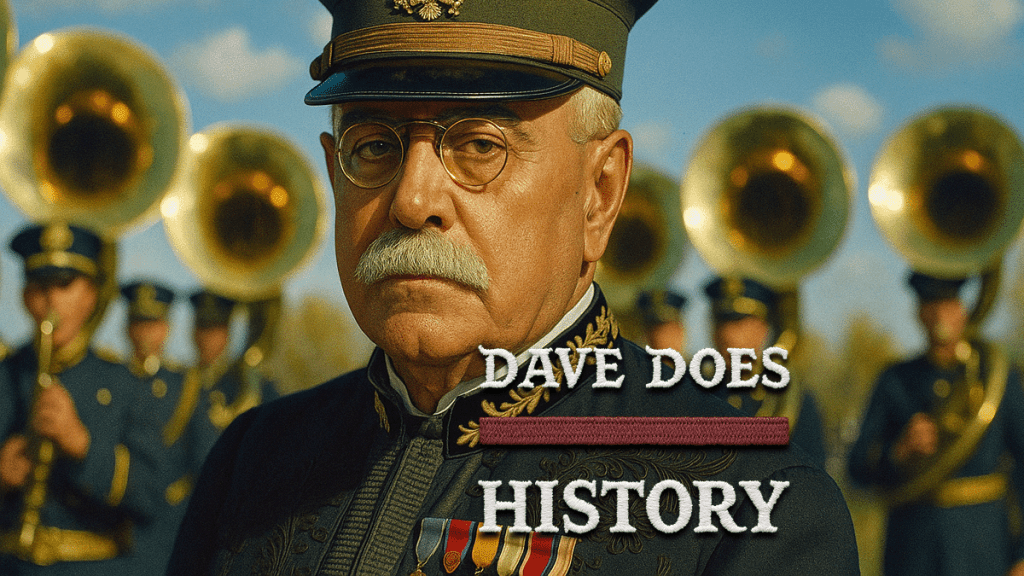
 DAVE DOES HISTORY
Leave a comment