
The scene was ordinary enough for a Friday evening in Tokyo Station. Trains hissed in the steam of their own exhaust, porters scurried along the platforms, and clerks in western suits hurried home through the Marunouchi exit. It was November 4, 1921, a time when the new Japan, outwardly modern and progressive, still carried the spirit of the old samurai beneath its Western clothing. Among the travelers that night was Hara Takashi, known as Kei Hara, Prime Minister of Japan and the first commoner to rise to that post. He was en route to Kyoto for a party conference, an unremarkable trip for a man who had built his political life on party discipline and negotiation. He never reached the train. From the crowd emerged a railway switchman named Nakaoka Kon’ichi, carrying a kitchen knife and a grudge. He lunged forward, stabbing the Prime Minister in the chest. Hara collapsed to the platform and died before medical help arrived. The crowd froze in stunned silence. Japan’s first experiment with responsible party government died with him.
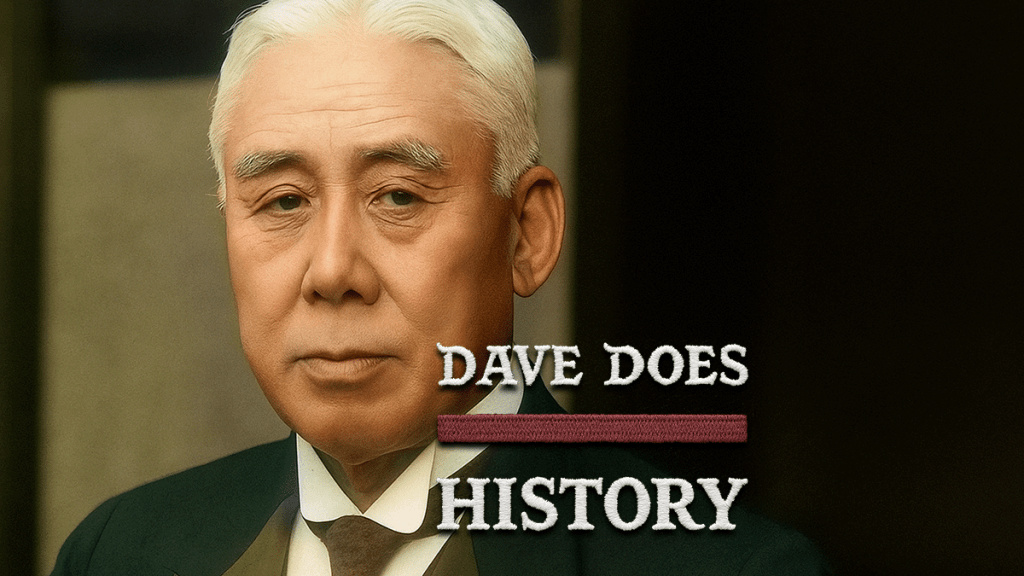
The news spread like lightning through the capital. The newspapers that had once mocked Hara’s caution now carried headlines in mourning type. The country’s first true party government, barely three years old, was suddenly headless. For Japan’s constitutional monarchy, still finding its footing in the Taishō era, the event was not simply a political crime but a national trauma. The assassination of Hara Takashi signaled that Japan’s democracy, fragile and newborn, was already being devoured by forces that would later consume the entire nation.
Hara Takashi’s rise was improbable in a nation still dominated by samurai legacies and oligarchic clans. Born in 1856 in the Morioka domain, a northern backwater that had been defeated in the Boshin War, he came from neither wealth nor privilege. He was educated at a French Catholic seminary and then at a law school, but his calling turned out to be the written word. He began as a journalist, working for papers like the Hochi and Daito, where he learned the value of persuasion and the power of public opinion. He was pragmatic rather than idealistic, a man who preferred persuasion to confrontation. He did not join the anti-government movement or align himself with the victorious Satsuma and Choshu cliques that had built the Meiji state. Instead, he cultivated personal ties with the pragmatic reformers Kaoru Inoue and Munemitsu Mutsu, men who saw politics as an art of compromise rather than purity. This strategy would define Hara’s career, for better and worse.
In 1900, when Itō Hirobumi founded the Rikken Seiyukai, the Association of Friends of Constitutional Government, Hara joined as chief secretary. He was not the party’s most charismatic speaker, but he was its shrewdest manager. He had a talent for collecting political funds, for reconciling factions, and for enforcing discipline within a notoriously fractious party. When he became Seiyukai president in 1914, he had transformed himself from an outsider into the undisputed boss of Japan’s leading political machine. Four years later, amid the social upheaval of the Rice Riots of 1918, his chance came. The genro, the elder statesmen who had long dominated the government, found themselves unable to ignore the growing demand for representative rule. They appointed Hara Takashi as Prime Minister. For the first time in Japan’s history, the government would be led not by a peer, a general, or a prince, but by a commoner and a career politician.
When Hara took office, the public’s expectations were immense. His cabinet, composed entirely of Seiyukai members except for the legally required military ministers, was hailed as the first true “party cabinet” in Japan’s history. It was a watershed moment for the constitutional system, an experiment in parliamentary governance within a monarchy that still bowed to the Emperor. Hara styled himself as a realist, one who believed in gradual reform. He pursued economic expansion, educational improvement, and colonial development, particularly in Korea. His critics called him autocratic, accusing him of running the government like a private company and tolerating corruption in his party’s ranks. But he believed that party government had to prove its ability to govern effectively, even if it meant making uncomfortable compromises.
To understand Hara’s era, one must understand Taishō Democracy, the brief but vibrant period between 1905 and 1932 when Japan flirted with representative politics and social reform. It was a time when the Imperial Diet gained influence, labor movements began to form, and newspapers became instruments of political debate. But it was also a time of tension. The military still claimed its independent “Right of Supreme Command” under the Meiji Constitution, beyond the reach of civilian authority. Hara’s government sought to expand party control over policy while balancing the competing interests of the army, the navy, the court, and the genro. His bargain with the conservative field marshal Yamagata Aritomo was typical of his approach. In exchange for Yamagata’s tolerance of his cabinet, Hara promised to support large defense appropriations. It kept the peace, but only temporarily.
One of the great crises of his administration was the Siberian Intervention. Japan, along with other Allied powers, sent troops to Siberia during the Russian Civil War. The cabinet approved it reluctantly, but once the military machine was in motion, it slipped beyond civilian control. The General Staff expanded the operation far beyond its intended scope, invoking its constitutional autonomy. Public resentment grew as the expedition drained the treasury and yielded nothing but casualties and embarrassment. It was a grim lesson in the limits of party power under the Meiji Constitution.
At home, the economy wavered under the weight of postwar inflation. Wages stagnated while prices rose, eroding public trust in the government. The Seiyukai, triumphant after its 1920 electoral victory, soon found itself mired in corruption scandals. Bribery, nepotism, and political favoritism flourished. Critics accused Hara of tolerating these abuses as the price of maintaining unity within his party. The same skill that had built the Seiyukai’s strength now became the source of its moral decay.
As Hara’s popularity declined, so did his safety. He became the target of anonymous threats and vitriolic newspaper attacks. The right-wing press denounced him for his supposed softness toward Korea and his refusal to interfere in the engagement of Crown Prince Hirohito to Princess Yoshiko, a match opposed by ultranationalists who deemed her lineage impure. Hara stood firm on principle, insisting that the government had no authority in Imperial Court affairs. For this he was labeled arrogant and unpatriotic. The death threats grew more specific, and in February 1921 he wrote his will. His friends urged him to increase his security, but Hara, true to his reserved nature, declined. He had never worn a sword or carried a weapon. He once remarked that a politician who fears assassination should not enter politics. On November 4, that stoicism cost him his life.
At 7:25 that evening, Hara arrived at Tokyo Station accompanied by several aides. He was to take the night train to Kyoto for a Seiyukai conference. The station was crowded with commuters and officials seeing off colleagues. Near the Marunouchi South Exit, Nakaoka Kon’ichi, a 27-year-old railway switchman, stepped out from the throng. Without warning, he drew a kitchen knife and drove it into the Prime Minister’s right chest. The blade pierced the lung and heart. Hara collapsed instantly. His attendants tried to lift him, but it was too late. He died within minutes, his last words unrecorded. The assassin offered no resistance and was immediately arrested. When questioned, Nakaoka declared that he had acted out of fury over the “narrow partisan interests of the Seiyukai.” He claimed that politicians like Hara had betrayed the Emperor and the people.
In truth, Nakaoka was a man adrift in the turbulence of a changing society. Japan’s rapid industrialization had produced new classes, new grievances, and new ideologies. Nakaoka had been influenced by right-wing supervisors who despised Hara’s party politics as corrupt and unpatriotic. He was not a revolutionary, but a reactionary, clinging to the old notion that political virtue lay in the strong hand, not in the patient compromise of parliamentary government. His act, though shocking, resonated with a growing number of disaffected nationalists who believed that Japan’s modern system was eroding its moral fiber.
The assassination plunged Tokyo into chaos. Crowds gathered outside the Seiyukai headquarters and the Prime Minister’s residence. The cabinet resigned the following day, November 5. The newspapers, stunned, declared it a tragedy for constitutional government. The assassin was tried and sentenced to death, but his sentence was later commuted to life imprisonment, and he was released after only thirteen years. The leniency reflected a cultural sympathy for his “sincere motive” and would prove disastrous. It set a precedent that political murder, if cloaked in patriotic intent, could be forgiven. In the decade to follow, this indulgence would invite more blood.
Hara’s successor was Takahashi Korekiyo, a respected economist and elder statesman. He vowed to continue Hara’s policies, but the Seiyukai fractured almost immediately. The party’s factions, once held together by Hara’s authority, broke into rival cliques. Within a year, the cabinet collapsed. The experiment in party government, so promising in 1918, was now visibly unraveling.
Hara’s death marked three distinct losses for Japan’s political future. First was the loss of control over the military. Hara had sought to define the balance between civilian and military authority. Though his compromises often drew criticism, his assassination ended the last realistic chance to legislate civilian supremacy. The generals, already mistrustful of politicians, took the lesson that the army’s destiny lay outside the reach of party politics. The next decade would see that principle entrenched, culminating in the military’s near-complete autonomy by the early 1930s.
The second loss was that of party reform. Hara had intended to transform the Seiyukai from a political machine into a responsible governing institution, promoting public welfare and administrative transparency. His death left the party rudderless. Corruption worsened, public confidence collapsed, and the notion of party government itself came to be associated with greed and incompetence. This erosion of faith in civilian politics became fertile ground for the rise of the military and the right-wing movements that claimed to embody moral purity.
The third and most intangible loss was that of moral authority. Hara might have become, in time, an elder statesman to the young Emperor Hirohito, who ascended the throne in 1926. His counsel could have provided the moderate, constitutional guidance the new Emperor needed. Instead, Hirohito was left with the aging genro Saionji Kinmochi as his only civilian adviser, and the vacuum was quickly filled by military men and bureaucrats. The Emperor’s later missteps, including his acquiescence to the Manchurian Incident of 1931, can be traced in part to this absence of balanced advice.
The pattern that began with Hara’s assassination repeated itself with grim regularity. In 1930, Prime Minister Hamaguchi Osachi was shot at Tokyo Station by a right-wing nationalist enraged by the London Naval Treaty. He lingered for months before dying of his wounds. In 1932, Prime Minister Inukai Tsuyoshi was gunned down by naval officers in the May Fifteen Incident. His killers shouted, “If only you had understood our feelings!” before surrendering. Each act eroded the norms of civilian rule. By 1932, the experiment of Taishō Democracy was effectively over. The government fell under the domination of “national unity” cabinets led by bureaucrats and military officers. Political violence had replaced debate as the instrument of change.
In hindsight, historians like Shimizu Yuichiro have described Hara’s age as one of “confrontational democracy.” It was a system in which politics was not yet a dialog but a contest of wills, conducted by men who believed that authority came from passion rather than persuasion. Hara was caught in this transition. To the bureaucrats of the old Meiji order, he was too liberal, too willing to empower the Diet. To the common people, he was too conservative, too comfortable with the elite. He stood on a bridge between two worlds, trying to balance progress and order, and fell into the abyss between them.
Violence in that era carried a certain moral weight. The public did not always approve of assassination, but they understood it as a form of protest, a desperate expression of frustration in a society where political discourse was limited. The newspapers that condemned Hara’s murder in print often published letters justifying it in the next column. The culture had not yet learned to separate passion from violence. Hara’s death was not just a personal tragedy, but a reflection of the failure to establish a political culture grounded in debate rather than destruction.
Hara himself had understood this danger. He once remarked that Japan was not yet ready for universal suffrage because people did not yet understand the responsibility that came with political freedom. He feared that without education and civic maturity, democracy would become mob rule. He believed that true democracy required citizens who could listen as well as speak. His goal was to build a society governed by reasoned dialog rather than emotion. In that sense, he was a century ahead of his time.
In modern Japan, the memory of Hara’s assassination still resonates. The murder of former Prime Minister Abe Shinzo in 2022 invited inevitable comparisons. Both men were strong-willed leaders who commanded powerful factions and inspired fierce opposition. Both were criticized for their heavy-handed political styles. Yet the difference in public reaction reveals how much Japan has changed. Abe’s assassination was met with universal shock and condemnation. There was no sympathy for his killer, no justification offered in patriotic terms. The society that once tolerated political violence as an act of faith had evolved into one that values order and discourse above all. Shimizu Yuichiro calls this the “age of dialog,” a society governed by law and persuasion rather than confrontation.
The lesson, however, remains unfinished. Democracy is not a destination but a discipline. Hara’s generation failed to nurture it fully, and Japan paid the price in war and devastation. The postwar era, under the American-imposed Constitution, created the legal framework for democracy, but the deeper challenge, the moral one, endures. Hara’s hope for a political culture of listening remains as vital today as it was a century ago. Modern democracy still struggles with polarization, demagoguery, and public cynicism. The tools have changed, but the need for reasoned dialog is as urgent as ever.
When Hara’s funeral was held in Tokyo, thousands of mourners lined the streets. The cortège moved slowly under the gray November sky. Many wept openly, not only for the man but for the hope he represented. Observers later wrote that his death marked “the beginning of the road to sundown” for Japanese diplomacy and party politics. They were not wrong. Without Hara’s stabilizing presence, the fragile balance between the Emperor, the military, and the people collapsed. The Meiji Constitution, elegant on paper, depended entirely on the virtue of its actors. When virtue failed, the system failed with it.
In the decades that followed, Japan abandoned party government for militarism, and constitutionalism for conquest. The nation that Hara had tried to guide through persuasion became a state guided by the sword. It took another generation, and a catastrophic war, for Japan to rediscover the principles he had championed. Hara Takashi’s life and death stand as both a warning and a prophecy. He proved that democracy cannot survive without discipline, patience, and the courage to compromise. His murder proved what happens when those virtues are lost.
History rarely grants second chances. Japan’s first experiment with party-led constitutional government ended in blood on the platform of Tokyo Station. Yet the idea that Hara carried, the belief that a common man could govern a great nation through reason and consent, endures as one of the most remarkable and tragic chapters in the story of modern Japan. The train he never boarded that night still stands, in memory, as a symbol of a journey interrupted—a journey toward democracy that would not resume for another quarter century. And when it did, it began again with the same fragile hope Hara Takashi once embodied: that words, not weapons, should guide the destiny of nations.




 DAVE DOES HISTORY
Leave a comment