
John Willis Menard was not a man of half measures. He was a poet who spoke in the language of justice, a journalist who wrote for the conscience of a nation, and a politician who refused to let his color silence him in the halls of power. His life stretched across some of the most tumultuous decades in American history, a life that reflected both the rise of freedom and the persistence of prejudice. Menard holds a unique distinction in the nation’s story: the first African American ever elected to the United States House of Representatives. Yet Congress refused to seat him. His election, his speech before Congress, and his subsequent work as a civil rights advocate, journalist, and intellectual represent one of the purest expressions of the Reconstruction spirit—a vision of America that promised equality but faltered in the execution. His journey from Illinois to Louisiana, then to Florida and finally back to Washington, reveals not only a man of unbreakable resolve but also an early thinker in Black internationalism, who saw the struggle for freedom as global. In our own time, Menard’s image has finally found its rightful home in the Library of Congress and the National Museum of African American History and Culture, and Congress itself has acknowledged that he was wrongfully denied his seat. It took more than a century for the United States to say what Menard already knew in 1869: that the right to representation should not be bound by race.
John Willis Menard was born on April 3, 1838, in Kaskaskia, Illinois, a town that had once served as the capital of the state but was already fading by the time of his birth. He was the son of French Creole parents and raised in a free Black family at a time when most African Americans in the country were still enslaved. Menard’s youth in Illinois placed him within a rare circle of free people of color who had access to education and political thought. He attended Iberia College in Ohio, one of the few integrated schools of higher learning in the United States. The college was a hotbed of abolitionist sentiment, where Menard absorbed not only lessons in literature and philosophy but the moral fire of freedom. Among his classmates was James Monroe Trotter, who would later serve as one of the first Black officers in the Union Army.
Even before the Civil War, Menard’s voice was already rising. In 1860, he published An Address to the Free Colored People of Illinois, an impassioned appeal for unity, education, and moral uplift among African Americans. The pamphlet circulated widely in abolitionist circles, setting him apart as a young intellectual of promise. When the war came, Menard moved to Washington, D.C., where he entered federal service and broke new ground by becoming the first African American to serve as a clerk in the U.S. Department of the Interior. At a time when even Northern bureaucracies were deeply segregated, his appointment was both symbolic and substantial—a sign that the world was changing, however slowly.
His most unusual commission came in 1863 when President Abraham Lincoln authorized him to investigate British Honduras, modern-day Belize, as a possible site for African American colonization. Lincoln, uncertain that emancipation alone would secure racial harmony, entertained the idea of voluntary Black migration abroad. Menard’s mission was to assess the viability of this plan. He found the land fertile and promising but the infrastructure woefully inadequate. His report reflected the paradox that haunted many Black intellectuals of the era: the tension between building a new life abroad or staying to reform the old one at home. Menard himself seemed torn. He admired the idea of a New World colony where African Americans could govern themselves, but he also recognized that the future of his people remained tied to the fate of the United States. His return to Washington marked the beginning of his commitment to change the country from within.
When the war ended and Reconstruction began, Menard moved south to New Orleans, Louisiana, one of the most politically active cities in the postwar nation. It was a city where free men of color had long maintained a vibrant community, but where tensions between races and classes ran deep. Menard quickly involved himself in Republican politics, the party of Lincoln and emancipation. He received patronage appointments as inspector of customs and later as commissioner of streets, positions that gave him both income and influence. He also turned to journalism, editing newspapers such as The Radical Standard and the New Orleans Standard. His editorials championed civil rights and equal suffrage, warning that the promises of Reconstruction would mean nothing unless Black Americans defended them through political participation.
In 1868, Menard’s opportunity came. The Republican Party nominated him for Louisiana’s Second Congressional District, a seat left vacant by the death of Congressman James Mann. Menard campaigned vigorously, appealing to newly enfranchised Black voters and progressive white allies. On November 3, 1868, he won decisively with more than sixty-four percent of the vote, becoming the first African American elected to Congress. It was a moment of triumph not only for Menard but for millions of freedmen who saw in him a living symbol of political equality. But triumph was short-lived. His opponent, Caleb S. Hunt, contested the results, claiming fraud and intimidation at the polls.
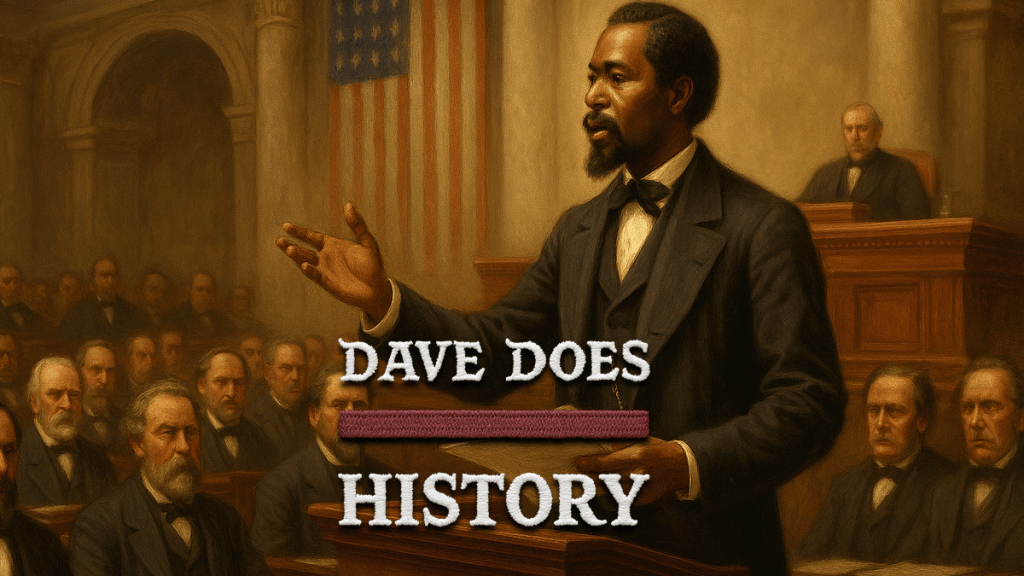
Menard traveled to Washington to present his credentials and demand recognition of his victory. The House Committee on Elections reviewed the case but could not reach agreement. In February 1869, the issue came before the full House. For the first time in the history of the Republic, an African American stood to address the chamber. On that day, John Willis Menard’s words filled the hall that had so long excluded men of his race. He spoke calmly but firmly, defending the rights of the nearly nine thousand voters who had chosen him. He insisted that his claim was based on law and merit, not color. He noted that Hunt had failed to file proper notice of contest and that the real fraud lay in the systematic intimidation of Black voters in the parishes of Orleans and Jefferson. Menard told the House that if those votes had been fairly counted, his majority would exceed three thousand.
Despite the clarity of his argument, the House refused to seat him. By a vote of 130 to 57, both candidates were denied the position. Menard, however, was paid the salary he would have earned, a hollow gesture for a man who had fought to represent his people, not enrich himself. The decision reflected the fragile state of Reconstruction—a moment when white lawmakers still flinched at the full meaning of equality. Yet his speech before Congress marked a turning point. Menard had spoken in the chamber, and history could not unhear him.
After his political defeat in Louisiana, Menard did not retreat. He turned south once again, this time to Florida, arriving in 1871 at the age of thirty-three. There he found a state in transition, its newly freed Black population struggling for political power against entrenched resistance. Menard’s education and eloquence quickly earned him recognition. In 1873, he was appointed to fill a vacant seat in the Florida House of Representatives, serving until 1875. He later held a series of civil service positions, including justice of the peace in Duval County, collector of revenues, and clerk in the Jacksonville post office. His commitment to public service was unwavering, even as Reconstruction began to collapse under the weight of white violence and political compromise.
It was in Florida that Menard’s voice as a journalist and thinker reached its full strength. He edited The Sun and later established the Key West News, a bilingual paper reflecting the island’s multicultural population of African Americans, white laborers, and Cuban immigrants. In Menard’s view, freedom was not a local or national matter but an international struggle. He saw in Key West a glimpse of the world he hoped to build—one in which racial and ethnic boundaries blurred under the common pursuit of liberty. His papers published articles in both English and Spanish, connecting the struggles of freedmen in the South with the revolutions in Cuba and Central America. In 1883, he founded the Florida News, which he later renamed the Southern Leader. The paper took a bold stand against the rising tide of racial segregation, urging a non-violent but unyielding resistance.
Menard’s talents were not limited to politics and journalism. He was also a poet of considerable depth. His collection Lays in Summer Lands, published in 1879, revealed a literary mind that balanced romantic imagery with sharp political insight. His poems touched on subjects from love and faith to race and liberty. Some of his earlier works had already appeared in the Christian Recorder during the Civil War years, showing that even as he worked in government offices, his pen was never idle.
As Reconstruction gave way to the harsh realities of the post-Reconstruction South, Menard’s political strategy evolved. He had grown weary of the Republican Party’s complacency and of white leaders who used Black votes without delivering justice. He began to advocate coalition politics, supporting candidates of any party who advanced the interests of African Americans. In 1876, he opposed Republican Governor Marcellus Stearns and backed Democrat George T. Drew, arguing that cooperation, not partisanship, was the path to progress. His pragmatism drew criticism from more radical voices but reflected the desperate realities of the era.
Menard’s moderate philosophy eventually clashed with the militant approach of T. Thomas Fortune, editor of the New York Age and founder of the Afro-American League. Fortune argued that equality could never be granted—it had to be demanded. Menard and his son-in-law, Thomas V. Gibbs, rejected this approach, warning that agitation could lead to racial violence and civil unrest. They believed time, education, and moral advancement would achieve what confrontation could not. History would prove both men partly right and partly wrong, but Menard’s insistence on dignity and discipline remained true to his character.
The Southern Leader continued publication until 1888, when a yellow-fever epidemic devastated the region. Menard, financially drained and in declining health, left Florida for Washington, D.C., the city where his public life had begun. There he found modest employment as a clerk in the Census Bureau. Yet even in his final years, he remained active. In 1890, he launched the National American, a monthly magazine aimed at African American readers across the nation. He had mellowed in some views and hardened in others. Now he praised the Afro-American League and called for federal land in the West to be allocated for Black settlers fleeing Southern oppression. His last letters reveal a man still restless, still reaching for solutions to the American dilemma. He died on October 8, 1893, at the age of fifty-four, and was buried in Washington, far from the fields of Kaskaskia where his story began.
Menard’s legacy is defined by the word “first.” He was the first African American elected to Congress and the first to address the House floor. His election predated the seating of Hiram Revels, who became the first African American actually to serve in Congress the following year. Menard’s contested victory foreshadowed the long pattern of suppression and challenge that would define Black political life for generations. His calm yet forceful speech before Congress remains one of the great moments of Reconstruction—a declaration that citizenship and competence were not bound by color.
Beyond politics, Menard’s life underscores the power of the Black press in shaping the nation’s conscience. His newspapers were more than sources of information; they were schools of citizenship. They offered a space for African Americans to define themselves, to debate strategy, and to resist the steady erosion of rights. His poetry added another dimension, revealing a man who found beauty even in struggle. The reissue of Lays in Summer Lands in 2002 renewed appreciation for his literary gifts and his ability to capture the moral complexity of his age.
In the twenty-first century, recognition has finally caught up with his accomplishments. In 2004, Illinois Governor Rod Blagojevich declared February 25 as John Willis Menard Day, honoring the native son whose influence stretched far beyond his birthplace. In 2018, historians discovered the only known photograph of Menard in the Emily Howland album, an artifact jointly acquired by the Library of Congress and the Smithsonian’s National Museum of African American History and Culture. This collaboration ensured that Menard’s face, once lost to time, would remain part of the public record, visible to future generations.
The acknowledgment reached its proper home in 2023 when the House of Representatives passed Resolution 817. The resolution formally recognized Menard, along with James Lewis, Pinckney B.S. Pinchback, and Josiah Thomas Walls, as duly elected members during Reconstruction who were wrongfully denied their seats. It called for their names to be displayed permanently in the Capitol and for an oil painting honoring them to hang in the connecting corridor of the House. It was an act of belated justice, a confession from the institution that once silenced him.
John Willis Menard’s life was not one of comfort but of conviction. From the colonial debates of British Honduras to the bright chaos of Reconstruction politics, from his pen in the newsroom to his voice in Congress, he carried the torch of equality with grace and intellect. He lived to see neither full freedom nor lasting peace for his people, yet his example endures as proof that moral courage can outlast political defeat. The young clerk who served Lincoln, the candidate who defied Congress, the poet who saw beyond his age—all were facets of the same man. His story is not just about being first; it is about insisting that the promise of America apply to all Americans. In that insistence lies his true and enduring victory.



 DAVE DOES HISTORY
Leave a comment