
It rained for days before the battle. Cold, relentless, miserable rain. The kind that seeps into everything, from the seams of armor to the marrow of bones. And on the morning of October 25, 1415, Saint Crispin’s Day, it turned a quiet field near a little French village called Azincourt into a swamp. That was the stage for one of the most lopsided, unlikely victories in all of English history. A few thousand exhausted, half-starved Englishmen against what seemed like the entire nobility of France. And against all sense, all strategy, and all arithmetic, the English won.
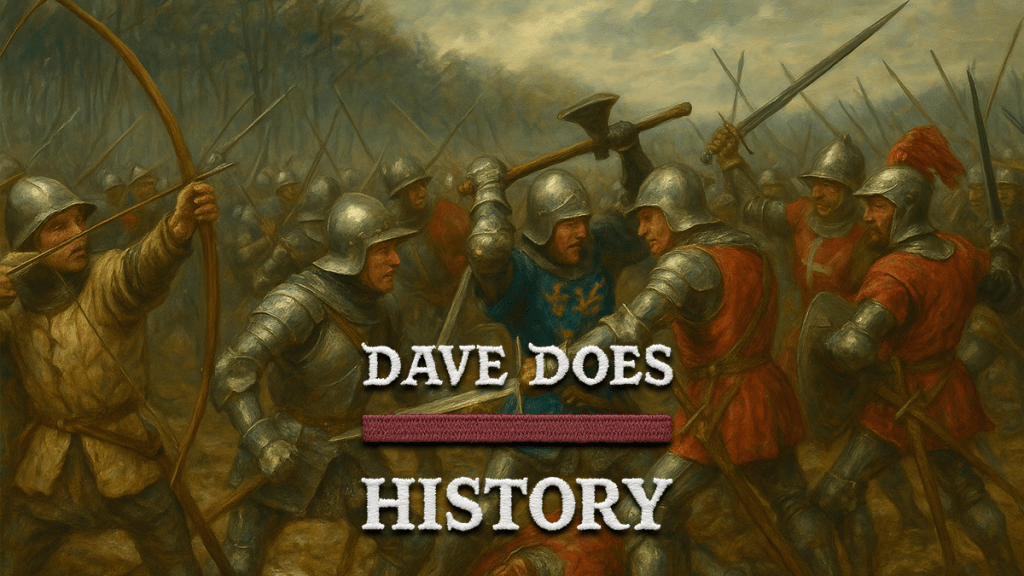
They didn’t just win. They shattered a world order. Agincourt was supposed to be a formality, a show of chivalric might. Instead, it became the day the armored knight died in the mud.
To understand how they got there, you have to start with Henry V. Young, pious, stern as oak, and convinced that God Himself had chosen him to be King not just of England, but of France. His claim traced back through his great-grandfather Edward III, who had started the whole bloody Hundred Years’ War in the first place. For Henry, this wasn’t just about power. It was about legitimacy. The French crown was his birthright, or so he said, and he would have it either through parchment or through battle.
When Henry sent envoys to negotiate in 1414, he came armed with a list of demands long enough to choke a herald. He wanted Normandy, Anjou, and Aquitaine returned to English control. He wanted a king’s ransom for the release of John II of France, dead for half a century. He wanted a dowry so immense it would take generations to pay. And, of course, he wanted the French throne. The French, amused and insulted, offered him a patch of land and half the gold he asked for. That was enough. Negotiations ended, swords unsheathed, and England began to build ships.
Henry’s campaign began that August, when a fleet of more than a thousand vessels carried his army across the Channel. He had a force of about twelve thousand when he landed near Harfleur. A respectable army by any standard, but one that soon bled away under the double assault of French resistance and dysentery. The siege of Harfleur dragged on far longer than planned. By the time the French garrison surrendered in late September, the English were hollow-eyed and reeking of sickness. Hundreds died before ever drawing a sword. Henry left a garrison behind and led the rest, fewer than ten thousand now, northward toward Calais. He told his men it was to show strength. In truth, it was to show the French he could march across their country unopposed.
But the French were not sitting idle. They had gathered a host so large that even chroniclers struggled to count it. Some said twelve thousand, others twenty-five. Monstrelet, who never met a number he didn’t exaggerate, claimed a hundred and fifty thousand. Whatever the truth, it dwarfed Henry’s little column. Worse, they knew where he was going. Every ford and bridge along the Somme was watched. The English wandered for days, hungry, cold, and hounded. When they finally crossed near Voyenne, it felt like deliverance. They were free of the river but not of the enemy.
By October 24, both armies faced each other across that narrow, ploughed strip of land outside Azincourt. The French were confident. They had nobles from every corner of the realm. Dukes, counts, barons, all glittering in polished steel and fine cloth. Their banners filled the morning mist like a festival procession. To them, this was not war. It was justice, punishment for a foreign upstart who dared call himself their king. The English were ragged, mud-streaked, and spent. Some hadn’t eaten properly in days. But they had something the French lacked. They had Henry.
Henry V was not a man to lead from behind. He was methodical, deeply religious, and as hard as the iron plates that covered him. He made his men confess before the battle and then told them, as chroniclers later put it, that God would decide who truly had the right to France. He wasn’t fighting for loot or for titles. He was fighting for what he believed was law. The French, meanwhile, were squabbling over who got to be in the front rank. Glory meant ransom, and ransom meant gold. Everyone wanted to be the first to strike. No one wanted to take orders.
The field itself was about seven hundred yards wide, bracketed by the woods of Tramecourt on one side and Azincourt on the other. It was a killing funnel, though neither side saw it that way at first. Henry placed his dismounted men-at-arms in the center and flanked them with his longbowmen, English and Welsh alike. Each archer drove a sharpened wooden stake into the mud at an angle, a wall of thorns against any charging horse. They had learned the trick from stories of Nicopolis, where impaled cavalry had fallen like wheat before the scythe.
Across the field, the French lined up in three great divisions. The vanguard, packed with the finest lords of France, was so deep that men in the back could barely see daylight. Behind them stood another mass of men-at-arms, with a rearguard waiting to finish the work. The archers and crossbowmen, the ones who might have countered the English longbow, were shoved to the sides or the rear. Nobles didn’t like standing behind commoners. Their cavalry waited on the flanks, ready to sweep around and crush the English archers. On paper, it was unstoppable.
Morning came. Mist clung low, the ground already squelching under boots. For hours, nothing happened. The French waited for stragglers, for the sun to rise higher, for someone to make the first move. The English waited because they had to. Every minute the French delayed gave their stomachs more time to growl and their arms more time to cramp. Finally, Henry decided to end the waiting. He ordered his army forward. Quietly at first, then with the rhythmic pounding of boots in mud, the English advanced just far enough to get within bow range. They halted, replanted their stakes, and raised their bows.
The first volley was like thunder. Thousands of arrows cut the air in a single wave, a sound like tearing cloth magnified by terror. The French cavalry charged, but the field was too narrow and the stakes too sharp. Horses reared, slipped, and crashed into one another. The arrows struck the unarmored flanks of the animals, sending them into wild panic. Riders tumbled, trampled, and were swallowed by the muck. The charge disintegrated in minutes.
The French men-at-arms lumbered forward next. They sank almost immediately. Their armor, so glorious in tournaments, turned traitor in the mud. Some fell to their knees and couldn’t rise again. Others pressed on, but the sheer weight of the men behind them turned the advance into a slow, suffocating crush. The English arrows rained down in relentless rhythm. Every few seconds, a shaft found a joint, a visor slit, a weak seam. The front ranks fell, the ranks behind tripped over them, and the whole mass became a heaving, breathless wall of metal and flesh.
When the arrows finally ceased, the archers dropped their bows and waded in with whatever weapons they had left. Knives, axes, hammers. They hacked and stabbed and pulled men down by their visors, killing them where they lay. The English men-at-arms joined them, fighting side by side with the bowmen they had once scorned as peasants. King Henry himself was in the thick of it, wielding a war hammer and rallying men wherever the line threatened to buckle. He was struck hard enough to dent his helmet while defending his wounded brother, the Duke of Gloucester. It didn’t matter. The French were finished.
By noon, the vanguard was gone. The second French line, seeing the slaughter ahead, hesitated. Some charged anyway and met the same fate. Others tried to retreat but found their own men blocking the way. Panic spread faster than any arrow. The field became a graveyard.
Then came the strange, dark aftermath. Somewhere behind the English lines, a band of French raiders, probably local peasants and opportunists, attacked the baggage train. They looted, burned, and caused chaos. Henry, still in the fog of battle, believed the French were regrouping. His army was spent, outnumbered even by its own captives. In a grim calculation, he ordered the unthinkable. The prisoners were to be killed. Every one except the highest nobles worth ransoming.
English knights balked. Killing prisoners was an affront to chivalry. Henry didn’t care. He commanded the archers to do it instead. The screams of dying nobles carried across the field once more. Some chroniclers later tried to soften it, claiming it was justified, that it was war. Others called it what it was, a massacre born of fear. Henry would later say it was the fault of those who attacked the baggage train. Whatever the excuse, the killing was done.
When the counting began, the scale of the victory was almost unbelievable. Six thousand French dead, maybe more. Three dukes, nine counts, the Constable and Admiral of France, and hundreds of knights. The nobility of France had been gutted in a single morning. English losses barely reached six hundred. Among them was the Duke of York, who died surrounded by his men. Henry ordered prayers said for both armies, then gave thanks to God and named the battle after the nearest castle, Agincourt.
Word of the victory raced across Europe. To the English, it was proof of divine favor. To the French, it was humiliation. Chroniclers called it a miracle, a punishment for pride. The French monarchy reeled, its ranks of leadership cut in half. The feud between the Armagnacs and Burgundians deepened, tearing the country apart from within. Henry pressed his advantage, sweeping through Normandy and forcing the Treaty of Troyes five years later. That treaty made him heir and regent of France, sealing the union with his marriage to Catherine of Valois. For a brief, shining moment, it looked as though one crown might indeed rule both realms. But fate, as always, had other plans.
Henry died in 1422 at the age of thirty-five, likely of dysentery, the same curse that had dogged him since Harfleur. His infant son inherited both kingdoms, though he would never truly hold either. The war dragged on, and within a decade, Joan of Arc and Charles VII had undone everything Henry achieved. But Agincourt remained untouched. Its legend only grew.
What made it endure wasn’t just the scale of the victory. It was what it represented. The end of an age. Agincourt proved that courage, discipline, and a few thousand common men with bows could shatter the might of feudal chivalry. It wasn’t knights who won that day. It was the yeomen, the farmers, the men who had trained in muddy fields back home, who could loose six arrows a minute and hit a knight in the eye slit. They were the future of war, whether the nobles liked it or not.
Terrain played its part too. Henry turned the field itself into a weapon. The narrow strip between the woods nullified French numbers, and the mud destroyed their mobility. In another place, on another day, the outcome might have been very different. But history doesn’t run on what-ifs. It runs on the choices of men in moments like that morning. Henry’s choice to stand and fight, to trust his archers, to advance first. Those decisions made legends.
Centuries later, the story would find new life on the stage. Shakespeare gave Henry the words every Englishman remembers: “We few, we happy few, we band of brothers.” It was a line that turned a muddy slaughter into poetry. Laurence Olivier would later film it as wartime propaganda, a rallying cry against the Nazis. Kenneth Branagh’s version decades later stripped away the varnish, showing a king haunted by what he had done, but still unbreakable in purpose. Each retelling says as much about the teller as the told.
But even stripped of poetry, the facts alone hold power. The longbow, simple and deadly, was the rifle of its age. The English army, built on discipline and faith, fought like a single living thing. And the French, trapped by pride and terrain, learned too late that courage without control is suicide.
Today, the site of Agincourt is quiet farmland. There is a small museum there, unassuming, standing where thousands once fought and fell. Visitors walk the same ground and find it hard to imagine the chaos that once filled it. Yet if you stand still long enough, you can almost hear it, the snap of bowstrings, the crash of armor, the rain falling heavy on the mud. And maybe, just maybe, the echo of a young king’s voice, carried by wind and legend alike.
Henry V’s victory did not last forever. But then, nothing ever does. Empires fade, crowns rust, and songs turn into whispers. What remains is the story. The tale of a king who believed he was chosen, of common men who fought for him, and of a field that swallowed an army whole. The Battle of Agincourt was not just won with arrows or faith. It was won by endurance, by sheer human will, and by the mud itself.
That is the truth of it. The French had everything but humility. The English had nothing but hunger and prayer. And when the arrows flew, it was the latter that carried the day.

 DAVE DOES HISTORY
Leave a comment