
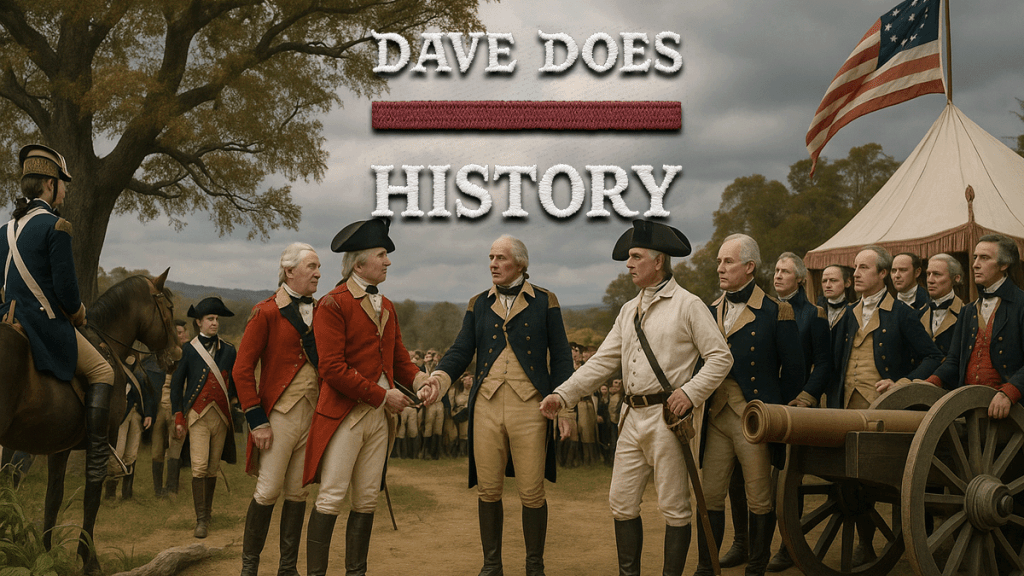
On a raw October morning in 1777, a British general in fresh scarlet cloth stepped out from the shelter of a tent and walked toward an American officer in a plain blue frock. John Burgoyne held out the hilt of his sword, spoke a practiced line about the fortunes of war, and found his blade promptly returned by Horatio Gates. The gesture mattered. It said to the watching armies that the fighting was not personal, though the costs had been. It also announced something larger to the world. The rebellion in North America had not been brushed aside. On the contrary, a British field army had just been captured in the upper Hudson valley, and that single fact would reorder strategy, politics, and diplomacy from London to Paris.
Saratoga lives in American memory as the moment when a citizen army proved it could beat redcoats and their German auxiliaries in open fight. It sent recruits back into the ranks after a dispiriting year. It also rebalanced the story that people abroad were telling about the war. The world’s premier military power had stumbled, and the colonists who had been dismissed as a mob armed with slogans had shown staying power, discipline, and a talent for exploiting an adversary’s mistakes. That last point is the sober core of Saratoga. The American victory came from grit and growing professionalism, yes, but it also came from a British plan that was both audacious and badly wired.
The grand design looked tidy on a London map. Cut New England from the rest of the colonies by seizing Albany and the water route that links the St. Lawrence to the Hudson. Let Burgoyne push down from Canada with the main body while Barry St. Leger comes in along the Mohawk as a western claw. Have General Howe march up from New York City to close the trap. New England, the supposed hotbed of the rebellion, would sit isolated behind a British river line while the Crown pacified the middle and southern colonies in manageable pieces.
The flaws were baked into the plan at birth. There was no single American-style commander in chief to harmonize all British movements. Lord George Germain, managing the war from Whitehall, approved two different priorities at once. Burgoyne would have his northern march. Howe would also have his separate campaign to capture Philadelphia. Orders to cooperate were vague, late, and ultimately irrelevant once Howe had sailed south by sea. Burgoyne did not know that his hoped-for partner would be off chasing Washington in Pennsylvania. He kept moving, confident that relief would appear at Albany like a character who never enters the stage.
At first the invasion sparkled. On July 6 Burgoyne took Fort Ticonderoga without a costly assault after British engineers hauled guns up Sugar Loaf, the knob Americans called Mount Defiance, and made the position untenable. Arthur St. Clair withdrew the garrison to save it. The British press crowed. The American Congress fumed and shuffled commanders. But empty laurels did not feed horses. From that moment the march south turned into drudgery. Philip Schuyler, still in charge of the Northern Department for a few crucial weeks, ordered roads choked with felled trees and bridges wrecked. Streams were dammed to flood low ground. Livestock and grain disappeared ahead of the invaders. It took three weeks to grind twenty-three miles. Wagons broke. Tempers frayed. Supplies shrank to brittle rations.
Then the outer claws of the British scheme snapped off. St. Leger’s mixed column in the Mohawk Valley stalled before Fort Stanwix after the savage fight at Oriskany shredded his Indigenous support. He turned back. Burgoyne, desperate for provisions, pushed a German detachment toward the American stores around Bennington. John Stark’s New England militia swarmed them on August 16 and flattened the effort. Nearly a thousand men and the hope of fresh animals and carts vanished in a single day. Meanwhile, a gruesome episode caught the public imagination. The murder of Jane McCrea by British allied warriors, and Burgoyne’s halting response, swelled the American militia and drove off many of his Native allies. The army that had relied on skilled scouts in the woods now moved blind while Daniel Morgan’s riflemen prowled the edges.
By late August the American command changed hands. Congress replaced Schuyler with Horatio Gates, a tidy staff officer with a talent for counting heads and letting good subordinates fight. Tadeusz Kościuszko, the Polish engineer whose eye for ground was sharp as a hawk’s, fortified a ridge at Bemis Heights that dominated the river road. Burgoyne could not bypass it. If he tried a direct shove, he would be shredded by guns emplaced on commanding knolls. If he tried the interior, he would be snared among ravines and trees, under the sights of men who knew every fold of the leaf mold.
So he tried to feel for the American left with a three-column push on September 19. The clearing called Freeman’s Farm became a killing ground. Morgan’s riflemen struck first. Reinforcements fed in piecemeal from both sides. The fighting seesawed from fence line to thicket to field. At dusk the British held the ground, which let Burgoyne print the word victory. The butcher’s bill told the truer story. He had burned through around six hundred irreplaceable soldiers to gain nothing that mattered. The Americans lost far fewer and watched their ranks swell daily as militia arrived and confidence rose. The day also soured relations within the American headquarters. Gates’s official report did not credit Benedict Arnold’s hard fighting on the left. The two men quarreled. Gates clipped Arnold’s authority. Both decisions would echo.
Three weeks of cold rain and short rations followed. Burgoyne still hoped for a gesture from the south. None came. On October 7 he sent a 1,700 man reconnaissance to test the same American flank. Morgan, Enoch Poor, and Ebenezer Learned met it fast and hard, rolled up both edges, and turned a probe into a rout. Simon Fraser, the gallant brigadier who had steadied the right, took a mortal wound while rallying his men. At the crisis, Benedict Arnold ignored his status, vaulted into the saddle, and rode into the fight. Soldiers who had sworn at him an hour earlier followed him now. He led the storming of the Breymann Redoubt on the German line, his leg smashed again in the final rush. The British losses were severe, nearly nine hundred men to about one hundred and fifty Americans. The ratio was ruinous. The army that had marched out of Canada with bands playing now bled in a shrinking camp ringed by bayonets.
Retreat was the only choice. Burgoyne pulled back behind the Great Redoubt and groped north through mud and cold toward Saratoga. The roads were clogged, the weather foul, and the Americans pressing in. After two miserable days the redcoats and their German comrades found themselves corralled at the village we now call Schuylerville. American strength climbed toward twenty thousand. On October 13 Burgoyne’s council voted to open talks. Far south along the river, British forces took Forts Clinton and Montgomery, a belated success that could not change anything upstream. Burgoyne never received the dispatches in time anyway.
Negotiators finally produced what Burgoyne insisted on calling a convention rather than a capitulation. The terms granted his army free passage home on condition that it would not serve again in North America during the present contest. On October 17 the armies acted out the ceremony. British and German troops grounded arms near the ruins of old Fort Hardy. Burgoyne, polished and proud, crossed Fish Creek with his staff to meet Gates, who had chosen a simple blue coat rather than a dress uniform. The two men exchanged words and formal courtesies. Burgoyne’s sword changed hands, then changed back. The Americans maintained order and silence. There were no jeers as defeated men filed past. There was no triumphal parade. There was only relief, and the understanding that something epochal had happened.
Congress looked at the paperwork and reached for a red pencil. The delegates doubted that Britain would honor the deal in good faith. Men ferried back to England could be replaced by fresh garrisons from elsewhere, and formal ratification would mean recognizing the United States as a legal equal. Congress demanded explicit ratification from London and suspended the convention when it did not arrive. Burgoyne’s men became prisoners of war by another name. Officers were exchanged in due time. The rank and file trudged east to Cambridge, Massachusetts, and crowded into makeshift barracks in a raw winter. The British government balked at paying their keep. Some of the army shifted to Rutland for management’s sake. In late 1778 the bulk of the prisoners were forced south on a seven hundred mile march to Albemarle Barracks near Charlottesville, Virginia. Gardens, small trades, and barter kept them alive. Desertion ate at the numbers every month. By mid 1780 only about twenty six hundred remained under guard. Later, the British portion moved again to Maryland and then Pennsylvania while the Germans were sent to Lancaster. In 1781, officers were split from their men and sent to Connecticut, another cut in the thread that held the army together. When Cornwallis surrendered at Yorktown, the machinery of prisoner exchange finally began to move with purpose. The last survivors of the Convention Army, perhaps a sixth of the original total, were released in the spring of 1783. Many who had slipped away found new lives in America. Some even shouldered muskets for the cause that had captured them. The war has a way of bending intentions.
The most important consequences of Saratoga were not lived out in icy huts along the Hudson or in the red mud of Virginia. They played out in Paris. Benjamin Franklin and his colleagues carried the news to the Comte de Vergennes on December 4. An entire British army had surrendered in the interior of North America. The Americans had staying power. France had been sending help in the shadows. Now the king could see a plausible investment. On February 6, 1778, the United States and France signed a treaty of alliance. Each promised not to make peace without the other. The object was candid and bold, the protection of the liberty and independence of the United States. Money, munitions, professional soldiers, and above all a fleet began to flow in the open. Spain entered the war the next year as France’s ally. Britain had to spread ships and regiments across oceans to defend the home islands, Canada, and the sugar islands that were the jewels of the empire. Lord North’s government staggered. A colonial police action had become a global war, and the ledger no longer favored London.
The legacy of the campaign took on its own rituals and landmarks. Congress called for a national day of Thanksgiving that December, the first official observance of a holiday by that name. The ground where Burgoyne marched and bled is today preserved as Saratoga National Historical Park. Monuments on that ridge keep hard memories. One obelisk lists the American commanders on four sides and leaves an empty alcove where Benedict Arnold’s statue should stand. The odd little Boot Monument honors the shattered leg that carried him into the Breymann Redoubt and pointedly does not name the man. It is an honest compromise for a complicated figure in a complicated war.
It is easy to romanticize Saratoga as a simple tale of plucky farmers who whipped the British and went home to harvest. The truth is more adult. The Americans fought in formed lines with Continental officers who had learned their trade the hard way. The British and their German partners fought with courage in ugly terrain and for a plan that had never been properly synchronized by the ministers who sent them. Gates managed numbers and ground well. Arnold, for all his flaws, turned a battle by sheer will. Morgan’s riflemen showed how irregular skill could serve regular operations. Kościuszko’s earthworks taught a lesson that would echo all the way to Yorktown. Congress made a call on the convention that looks harsh even now. Yet the political risk bought time, and time let diplomacy ripen in Paris. A statesman does not always get to be kind.
Call it the fulcrum of the war. Before Saratoga, American independence looked like a long bet that might not pay. After Saratoga, kings and cabinets treated that bet as a sound investment. The surrender on October 17, 1777, was not the end of the fighting. It was the moment the end became possible. The field at Bemis Heights and the road to Schuylerville taught a practical lesson that still holds. Strategy without clear command fails. Logistics can strangle a fine army. Intelligence is worth more than parade polish. And when a free people find the ground that favors them, dig in, and refuse to yield, even an empire must change its plans.




 DAVE DOES HISTORY
Leave a comment