
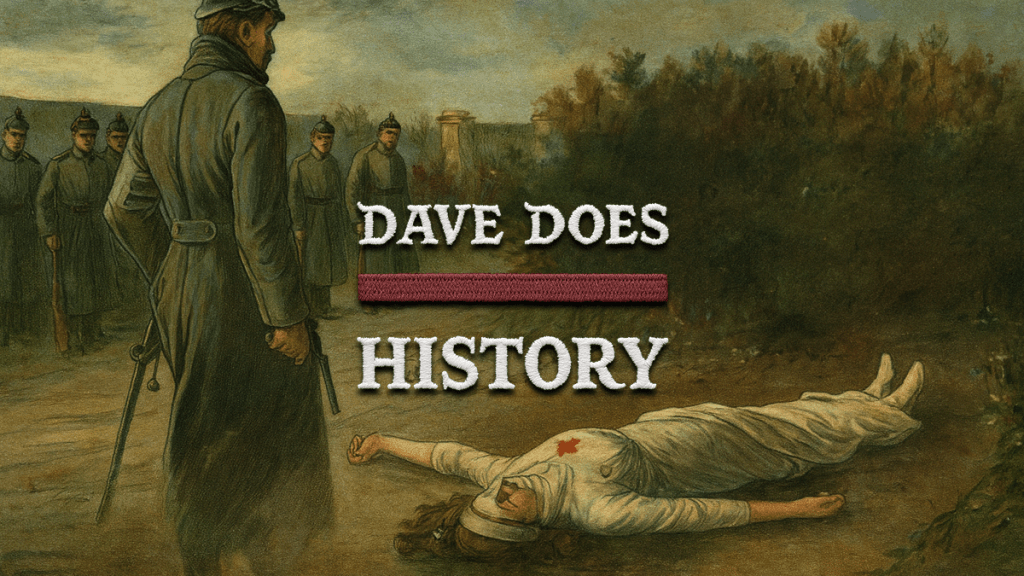
Edith Cavell’s story begins in the dim chill of a Brussels morning, October 12, 1915. As dawn broke over the Tir National shooting range, a 49-year-old nurse stood before a German firing squad. She was calm, composed, and ready. Within minutes, a volley of rifle fire would echo across the Belgian capital, and the world would soon know her name. To the Germans, she was a criminal who had broken military law in wartime. To nearly everyone else, she became something far larger—a martyr, a moral compass in a world gone mad, a symbol of the humanity that war so easily devours.
The Great War had reached one of its most brutal plateaus. Belgium, trampled under the boots of the German army, lay crushed and occupied. Civilians lived under strict military law, and the German administration tolerated little dissent. Amid this setting stood Edith Cavell, a British nurse whose life had been devoted to healing. Yet that devotion would soon bring her into direct conflict with the same occupation authority she tried to humanize. When her death was announced, the outrage was immediate and universal. Newspapers from London to New York screamed headlines condemning “German barbarism.” Churches rang their bells for her, politicians thundered speeches in Parliament, and mothers pointed to her photograph and told their sons, “This is why you fight.” Her death, both tragic and transformative, became one of the most powerful propaganda tools of the war.
But propaganda aside, the story of Edith Cavell was one of a woman who believed deeply that mercy should never bow to fear. Her actions sprang not from political fervor but from faith, conviction, and the relentless duty of care that defined her life. Her death, though legally justified under military law, was morally indefensible to much of the world. It revealed the collision between two worldviews—the rigid machinery of total war and the boundless compassion of a single soul who refused to obey its limits.
Edith Louisa Cavell was born on December 4, 1865, in the quiet village of Swardeston, Norfolk, the eldest of four children of Reverend Frederick Cavell. Her upbringing was steeped in the modest virtues of a vicar’s household—discipline, service, and faith. From an early age she was known for her gentleness, her quick wit, and her sense of purpose. She worked for a time as a governess, including several years in Brussels, where she developed a fondness for the Belgian people. Her life changed course when she returned home to nurse her ailing father through illness. The experience awakened a calling she could not ignore.
At thirty, she began nursing training at the London Hospital under Eva Luckes, one of the great reformers of modern nursing. Cavell’s early service was rigorous and relentless. In 1897, still in training, she was dispatched to help combat a deadly typhoid outbreak in Maidstone, earning the Maidstone Typhoid Medal for her service. Her compassion was matched by an exacting professionalism, and her career advanced swiftly through posts at St. Pancras Infirmary, St. Leonard’s in Shoreditch, and Manchester and Salford.
In 1907, the Belgian surgeon Dr. Antoine Depage recruited her to Brussels as matron of a new secular nursing school, L’École Belge d’Infirmières Diplômées. Until then, nursing in Belgium had largely been confined to religious orders. Cavell helped professionalize it, introducing training programs, modern hygiene, and discipline that elevated the reputation of nurses throughout the country. She founded Belgium’s first nursing journal and inspired a generation of young women to see nursing as both a calling and a profession.
When the summer of 1914 brought war to Europe, Cavell was visiting her widowed mother in Norfolk. The British government advised its nationals to remain home, but Cavell saw things differently. “My duty is with my nurses,” she told her family, and returned at once to Brussels. When the Germans occupied the city, her institute was turned into a Red Cross hospital treating soldiers of all nations. Cavell insisted that every wounded man, friend or foe, be treated equally. “Each man is a father, husband, or son,” she said. “As nurses you must take no part in the quarrel. Our work is for humanity. The profession of nursing knows no frontiers.”
That principle—simple, direct, and deeply Christian—became the center of her life and, ironically, the reason for her death. In late 1914, as wounded Allied soldiers were cut off behind German lines, sympathetic Belgians began organizing escape routes to the neutral Netherlands. Cavell’s clinic, known for its discretion, became one of the key safe houses. Working with Prince Réginald de Croÿ and others, she sheltered British and French soldiers and helped them reach the border. She arranged civilian guides, provided food and forged papers, and even financed their journeys. Her operation saved about two hundred men in total, an extraordinary figure for an amateur network. In one of her letters she wrote, “Don’t send any more men—but we must save them. If one were caught and shot it would be our fault.”
The risk was immense. German occupation authorities considered aiding enemy soldiers a capital offense. For months Cavell’s network operated in secrecy, but betrayal came in the summer of 1915. A collaborator named Georges Gaston Quien revealed details of the organization to the Germans. On August 5, Cavell was arrested and taken to Saint-Gilles Prison. She was interrogated repeatedly over ten weeks, the last two spent in solitary confinement. Calm and straightforward, she made no attempt to deny her role. She told investigators she had helped about sixty British and fifteen French soldiers, along with a hundred or so Belgian and French civilians of military age. She even mentioned receiving letters from those who had safely reached England—an admission that confirmed, in German eyes, the completion of her crime.
Under German law, her offense was “war treason,” not espionage. Paragraph 90 of the German Penal Code defined it as aiding the enemy’s military forces. Paragraph 58 of the Military Code prescribed death for anyone who completed such an act during wartime. By helping soldiers return to active duty, Cavell had indeed conveyed “troops to the enemy.” The Geneva Convention’s protection for medical personnel was voided when their medical facilities were used to commit “acts injurious to the enemy.” To German military justice, the case was straightforward.
Her trial began on October 7, 1915, before a court-martial of seven judges. Cavell was one of thirty-five defendants. Her lawyer, Sadi Kirschen, was not permitted to consult her before the proceedings. The prosecution presented her signed depositions as evidence; her own words sealed her fate. Witnesses described her as calm and dignified, replying clearly and without fear. When asked why she had helped enemy soldiers, she said simply that she believed she was saving them from being shot. “I have tried to do my duty to my country,” she added. The prosecutor demanded the death penalty.
German authorities maintained that gender could not excuse such a crime. Alfred Zimmermann, Undersecretary of Foreign Affairs, later said, “It was a pity that Miss Cavell had to be executed, but it was necessary. Consider what would happen to a state, particularly in war, if it left crimes aimed at the safety of its armies to go unpunished because they were committed by women.” The German command also believed a harsh example was needed to deter other civilians from aiding fugitives.
News of the verdict reached the American and Spanish legations on October 11. Brand Whitlock, the U.S. Minister to Belgium, was gravely ill, but his secretary Hugh Gibson and legal adviser Gaston de Leval joined the Spanish Minister, the Marques of Villalobar, in a desperate midnight appeal to Baron von der Lancken. They begged for clemency or at least a delay. Gibson warned that the execution of a woman nurse would be regarded as an atrocity equal to the burning of Louvain or the sinking of the Lusitania. The diplomats reminded the Germans that they had promised to notify them before the sentence was carried out, which they had not done. They argued that her crime was already completed, that her life posed no threat to the German army, and that mercy would serve German interests far better than blood.
Von der Lancken deferred to the Military Governor, General von Sauberzweig, who refused all appeals. “The sentence is imperative,” he said coldly. At dawn on October 12, the order was carried out.
The night before, Reverend H. Stirling Gahan, the Anglican chaplain in Brussels, was permitted to visit Cavell in her cell. He found her serene, even thankful. “I am thankful to have had these ten weeks of quiet to get ready,” she told him. “I expected my sentence and I believe it was just.” She confessed her faith, received Holy Communion, and spoke of her peace. “I have seen death so often,” she said, “it is not strange or fearful to me.” Before he left, she gave him the words that would immortalize her. “Standing as I do in view of God and eternity, I realize that patriotism is not enough. I must have no hatred or bitterness towards anyone.”
At seven o’clock the next morning, she and her fellow prisoner Philippe Baucq were led to the Tir National. Witnesses differ on the details, but most agree she faced the firing squad without a blindfold, composed and silent. The German chaplain, Pastor Paul Le Seur, later recorded her final words to him: “Ask Father Gahan to tell my loved ones that my soul, as I believe, is safe, and that I am glad to die for my country.” Moments later, the rifles fired. A German army doctor, Gottfried Benn, certified her death. By order of the Spanish minister, Belgian women were permitted to bury her body near Saint-Gilles Prison that same day.
When news broke, it shocked the world. The British Foreign Office, which had chosen not to intervene for fear of worsening her situation, was stunned by the result. The story of her execution raced across cables and headlines. In Britain, outrage turned to resolve. Posters appeared overnight bearing her image and the words “Murdered by the Germans.” Recruitment offices reported surging enlistments, with nearly twice as many men joining the colors in the eight weeks after her death. The War Propaganda Bureau at Wellington House seized upon her story as proof of German brutality. She was portrayed as an innocent nurse, a noncombatant victim of militarism run wild.
In the United States, still neutral at the time, her death hardened public opinion against Germany. Newspapers called her “the martyr nurse of Brussels.” Church leaders invoked her in sermons, and women’s groups organized memorial services. To a war-weary world, her calm courage and forgiveness stood in striking contrast to the mechanized cruelty of the conflict.
The Germans, realizing the scale of the backlash, tried to justify their decision as a matter of military necessity. They pointed out that Cavell’s actions directly endangered German soldiers, and that international law provided no immunity for civilians who aided the enemy. But the damage was done. To millions, she had become a saintly figure, her execution a moral dividing line between civilization and barbarism.
When the war ended, her story did not fade. In May 1919, her remains were returned to Britain aboard HMS Rowena. The coffin traveled from Dover to London in a railway van that became known as the Cavell Van. She was given a state funeral at Westminster Abbey on May 15, an honor shared by few civilians. Her coffin then returned to her native Norfolk, where she was reburied at Life’s Green beside Norwich Cathedral. Thousands lined the route, casting flowers as the procession passed.
Her memory was carved in stone and bronze. In 1920, sculptor George Frampton’s statue of her was unveiled near Trafalgar Square. Its inscription bears her words: “Patriotism is not enough. I must have no hatred or bitterness towards anyone.” Across Britain and the Empire, hospitals, schools, and mountain peaks were named for her. Mount Edith Cavell in Alberta, Canada, became a monument in stone. A joint memorial with Marie Depage, wife of her Belgian colleague, rose in Brussels. In Norwich, her hometown, a quiet garden near the cathedral still bears her name.
Even in death, her influence continued to ripple through history. During the Second World War, Belgian nurse Andrée de Jongh, founder of the Comète escape line, credited Cavell’s example for inspiring her. The cultural tributes multiplied: films, plays, songs, and even the naming of a French child who would one day become famous—Édith Piaf, whose parents named her in honor of the British nurse martyred in Brussels.
The Church of England added her to its Calendar of Saints, commemorating her each October 12. In Norwich Cathedral, new paintings were commissioned on the centenary of her death, and musical works such as “Eventide: In Memoriam Edith Cavell” were performed in her honor. In 2019, the centenary of her repatriation was marked with ceremonies in both Britain and Belgium, reaffirming that her legacy had not dimmed after a century.
What makes Edith Cavell endure is not only her courage but her clarity. She was no ideologue, no politician, no soldier. She was a nurse who believed that saving a life was always right, even if it meant breaking a law. Her death forces us to confront the uneasy balance between duty to one’s nation and duty to one’s conscience. The German officers who condemned her were not sadists; they were men obeying the rigid logic of wartime law. Cavell, by contrast, obeyed the quiet law written on her heart. That collision produced not only her death but one of the defining moral moments of the twentieth century.
In purely strategic terms, her execution backfired. It galvanized recruitment, turned neutral opinion against Germany, and gave the Allies a martyr of perfect moral symmetry—a healer slain by those she had once nursed. But beyond the propaganda, her death touched something deeper. It reminded the world that even in total war, humanity could still speak with a single voice through a single person.
She once told her nurses, “Each man is a father, husband or son.” Those words outlived the war and outlived the politics. In them lies the heart of her legacy. She saw the enemy not as a faceless uniform but as a man who might be loved by someone else.
Standing in her cell that final night, she spoke words that have been carved on monuments and echoed in sermons for over a century. “Patriotism is not enough.” The phrase was no rejection of love of country, but a reminder that patriotism alone cannot justify cruelty. It was an appeal to a higher loyalty—to compassion, forgiveness, and the sacred worth of every human life.
In the end, her execution revealed both the limits of law and the boundlessness of conscience. She died believing her soul was safe and her duty done. A century later, her example continues to challenge anyone who serves in the name of humanity. In a world that still divides itself by flags and front lines, Edith Cavell’s calm voice from that Brussels prison reminds us that mercy remains the truest form of courage.




 DAVE DOES HISTORY
Leave a comment