
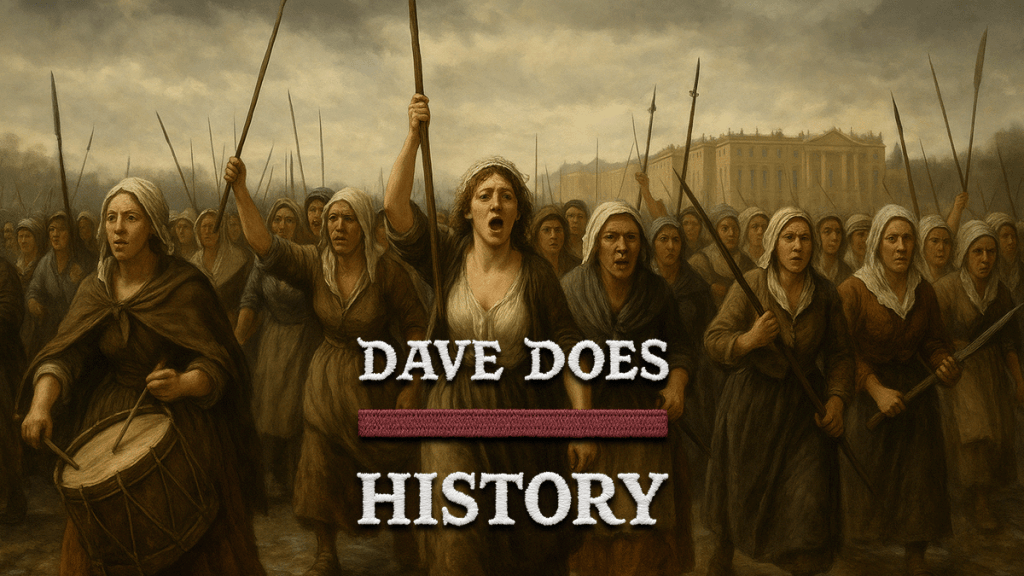
The air in Paris that morning was thick with rain and resentment. The markets were restless, the bread stalls nearly bare, and the voices of hungry women rose in frustration that had been building for months. Somewhere near the Halles, a young woman began to beat a drum. The sound drew others, first a few, then hundreds, then thousands, until the streets themselves seemed to move. They carried pikes, cleavers, and kitchen knives. They shouted for bread, for justice, for their King to answer them. It was October 5, 1789, and France was about to learn what happens when hunger and hope collide.
Historians have given the event several names: the Women’s March on Versailles, the Black March, the October Days. Whatever the title, it stands as one of the defining moments of the French Revolution. Less than three months had passed since the storming of the Bastille, yet the spirit that took that fortress now turned its eyes toward the palace of the King himself. The march began as a protest against the price of bread and ended as a political revolution that changed the geography of power. By dragging Louis XVI and his family from Versailles to Paris, the marchers forced monarchy into the shadow of popular sovereignty. It was the day the people came to claim their King.
The Revolution had begun in Paris, but by the autumn of 1789, its heartbeat was uneven. The common people were starving, their lives held hostage by a grain economy that had been collapsing for years. For the lower ranks of the Third Estate, hunger was not a metaphor. Bread was the measure of life, and when its price doubled, despair turned to fury. In a normal year, a Parisian workman might spend half his income on bread. That summer, he needed almost every sou he earned just to keep his family alive. Poor harvests, profiteering merchants, and the deregulation of grain markets had combined to make food scarce and ruinously expensive. Memories of earlier unrest, like the Flour War of 1775, came back to life. Whispers of a so-called “Pacte de Famine,” an aristocratic conspiracy to starve the poor, spread through the alleys and taverns. It did not matter whether the rumor was true. What mattered was that people believed it.
Meanwhile, at Versailles, the court dined well. The King and his ministers were surrounded by the trappings of old privilege, insulated from the misery that filled the capital. The National Assembly sat in the same town, drafting a new order for France, but progress was grinding to a halt. Louis XVI resisted the August Decrees that had abolished feudal privilege and the Declaration of the Rights of Man and of the Citizen, which had proclaimed equality before the law. Even after being granted a suspensive veto on September 11, he hinted that he might use it to block the very measures that had given the Revolution its moral core. To many in Paris, the King seemed less the father of his people than a man scheming to regain his lost power.
The last insult came on October 1, when the King’s Bodyguard held a lavish banquet for the newly arrived Flanders Regiment. Versailles was already a symbol of excess, but that night the display became unforgivable. There were toasts to the royal family, but none to the nation. Courtiers handed out white cockades, the symbol of the Bourbons, and eyewitnesses claimed that tricolor cockades—the emblem of the Revolution—were trampled underfoot. Whether that detail was exaggerated hardly mattered. Parisian newspapers called it an orgy of loyalist debauchery, and writers like Marat and Desmoulins fanned the outrage into open fury. It was not only about bread anymore. It was about dignity, equality, and insult.
The spark found its fuel on the morning of October 5, in the Faubourg Saint-Antoine, where the smell of wet straw and hunger hung heavy. It began with one woman and her drum. Others joined her, many from the markets, all from lives lived close to the bone. They shouted for bread and for the Mayor to open the grain stores. As they marched toward the Hôtel de Ville, church bells began to ring, calling more to join them. By the time they reached City Hall, there were thousands, perhaps ten thousand. Inside, the city’s officials hesitated, but hesitation had no place in a crowd that had nothing left to lose. They forced their way in, ransacking rooms, seizing muskets, powder, and two small cannons.
Amid the chaos stepped Stanislas-Marie Maillard, a former clerk and one of the heroes of the Bastille. Recognized and respected, he was pushed to the front. He promised order, or at least direction, and gave the crowd its cry: “To Versailles!” His leadership kept the mob from burning the building, even as he joined their march. They poured out of Paris like a river of anger, armed with pikes, sabers, and kitchen tools. The road to Versailles was fifteen miles of mud and rain, but hunger marches farther than armies.
As the women trudged through the countryside, word reached Lafayette, commander of the National Guard. His men were gathering in the Place de Grève, restless and ready to join. Lafayette knew the danger. If he refused, they might kill him or desert; if he agreed, he risked inflaming rebellion. But his soldiers, many of them veterans of July 14, had already decided. They would go. Reluctantly, Lafayette took command and followed the women toward Versailles, leading fifteen thousand Guardsmen and several thousand civilians more.
By the time the marchers arrived, soaked and exhausted, the sun had already set. Versailles was caught between disbelief and panic. The National Assembly opened its doors to the first wave, hoping to calm the situation. Deputies watched as the women filled the benches, dripping rainwater onto the polished floors, clutching their weapons, their skirts clinging with mud. It was not the scene of political decorum that the Assembly had envisioned. When they were asked what they wanted, the answer came plainly: bread. Maillard spoke for them, demanding grain and the dismissal of the Flanders Regiment.
The President of the Assembly, Jean-Joseph Mounier, promised to take their petition to the King. He selected six women to accompany him, one of them Pierrette Chabry, chosen for her polite manner. Inside the palace, Louis XVI received them with what appeared to be sincerity. He gave his word that grain would be distributed and even wrote a note confirming it. For some, that was enough. A small group returned to Paris carrying the King’s promise, but most stayed. They had seen too much deceit to take the word of a monarch at face value. Rumors flew that the Queen would undo his concessions before dawn.
That evening, around six o’clock, the King announced that he would accept the August Decrees and the Declaration of Rights without condition. It was a sweeping concession, a bow to revolutionary momentum, and perhaps an attempt to save himself. But it came too late to calm the storm.
Lafayette arrived with his National Guard late that night. He met with the King and reportedly declared, “I have come to die at the feet of Your Majesty.” He then arranged his troops around the palace, trying to maintain an uneasy peace. The night passed in anxiety. Inside, the court whispered of flight; outside, the crowd whispered of vengeance. The Commune’s commissioners came again to the King, urging him to move to Paris. He refused, saying, “A fugitive king is no king at all,” and postponed his decision until morning.
Morning brought blood. Around five or six o’clock, a group of protesters, mostly men, found an unguarded gate in the marble courtyard. They surged into the palace, crying for the Queen. The guards fought back, but two were killed, one while sounding the alarm. Marie Antoinette barely escaped through a back corridor, barefoot and terrified, into the King’s chambers. For a moment, the Revolution stood face to face with the monarchy it had unseated. Then the National Guard, under the young officer Lazare Hoche, intervened, clearing the corridors and rescuing the royal family. The heads of the slain guards were placed on pikes and paraded outside as proof that the people had triumphed over their oppressors.
Lafayette, who had slept little, rushed back to the palace. He brought the King to the balcony, facing the sea of Parisians below. The crowd demanded that the King go to Paris. Louis hesitated, then nodded. Shouts of “Vive le Roi!” answered him. When the Queen appeared, the mood shifted again. Some shouted for her death, others jeered. Lafayette, sensing danger, knelt before her and kissed her hand. For a brief instant, the gesture disarmed the mob. They cheered, “Vive la Reine!” The monarchy had survived another dawn, but it was now a monarchy on borrowed time.
At one o’clock that afternoon, the King relented completely. “My friends,” he said, “I shall go to Paris with my wife and my children.” The crowd erupted in jubilation. The royal procession that followed was like no other in French history. Over sixty thousand people joined, moving slowly toward Paris under the gray sky. National Guardsmen carried loaves of bread on their bayonets, wagons of grain rolled beside them, and in the center rode the King, Queen, and their children in the royal carriage. Around them marched women singing that they were bringing “the baker, the baker’s wife, and the baker’s boy” to the city. Behind them, carried high, were the severed heads of the palace guards. It was a carnival of triumph and terror, a living symbol of what the Revolution had become.
The journey took nine hours. When they reached Paris, Mayor Bailly welcomed the royal family and installed them in the Tuileries Palace, abandoned by the monarchy for more than a century. Versailles, once the heart of divine kingship, was left empty. The King’s title changed, no longer “King of France and Navarre,” but “Louis XVI, King of the French.” The National Assembly followed within two weeks, taking up residence in the Salle du Manège near the Tuileries. The shift was more than symbolic. It ended the physical separation between the rulers and the ruled. Power was now within reach of the streets.
The political consequences were immediate and irreversible. Louis XVI was effectively a prisoner. The October Days guaranteed the ratification of the August Decrees and made any return to absolute monarchy impossible. The moderate faction known as the monarchiens, dismayed by the violence and the forced relocation, collapsed. Mounier himself fled France within days. The aristocracy, humiliated and stripped of privilege, began to organize resistance from abroad, lending new life to the idea of the “aristocratic conspiracy” that had haunted the popular imagination since the bread riots began. What had been rumor now became policy, and that fear would later feed the Reign of Terror.
Historians have long debated the meaning of the Women’s March on Versailles. To some, it represents the purest expression of popular sovereignty, the moment when ordinary people seized control of their destiny. To others, it marks the beginning of mob rule, the dangerous precedent that passion could dictate policy. Both views are true. Georges Lefebvre argued that the Old Regime did not fall to words or decrees but to force. The Revolution, in his view, became irreversible only when the people took direct action. That day in October, they did exactly that.
The prominence of women in the event cannot be overstated. The poissardes—the market women who formed the march’s vanguard—became heroines of the Revolution. They were celebrated as “Mothers of the Nation,” honored for their courage, and even granted seats in the galleries of the Assembly. Their actions demonstrated that citizenship was no longer confined to men or nobles. The march was both a demand for bread and a declaration of presence. It proved that the Revolution belonged to the people, not to philosophers or politicians alone.
The leadership of figures like Maillard and Lafayette provided structure, but the energy came from below. Robespierre, then a young deputy, earned his first public acclaim by supporting the women and defending their grievances in the Assembly. His solidarity with them would later help shape his image as the incorruptible voice of the people.
As with all revolutions, conspiracy theories soon followed. The Orléanist hypothesis claimed that Louis Philippe II, Duke of Orléans, had secretly financed the march to undermine his cousin the King. Some in the crowd even hailed him as “King Orléans.” Yet most serious historians find little evidence that he directed events. His role was opportunistic, not orchestral. The true motive force lay in hunger and the conviction that the monarchy had betrayed its people.
In the years that followed, the consequences of that October march unfolded with grim logic. By moving to Paris, the King had placed himself within the grasp of every rumor, every riot, every political whim. His power dwindled month by month until, in 1791, he tried to flee to Varennes, only to be captured and returned in disgrace. From that moment, his downfall was inevitable. By 1793, the guillotine finished what the march had begun.
Yet for all its violence and contradiction, the Women’s March on Versailles remains one of the most extraordinary popular movements in history. It began with a loaf of bread and ended by redrawing the map of French politics. It revealed the power of ordinary people to alter the course of nations. The poissardes and their ragged procession did not think in terms of ideology or theory. They thought in terms of hunger, insult, and justice. In doing so, they made the Revolution real.
When the rain fell on the morning of October 5, few imagined that a crowd of starving women would topple a monarchy’s confidence and change the shape of modern Europe. Yet that is exactly what happened. The palace at Versailles, once a monument to royal glory, became a relic of a vanished order. The King was no longer untouchable. The people had found their voice, and once found, it would not be silenced. The march on Versailles was not just about bread. It was about belonging, the unspoken demand that government serve those who live under it. And on that long, wet road between the Halles of Paris and the marble halls of the palace, France began to learn what that truly meant.



 DAVE DOES HISTORY
Leave a comment