
On the morning of September 25, 1911, Toulon harbor lay hushed under a pale Mediterranean dawn. The naval base stirred with its usual rhythm. Buglers roused men from their hammocks, petty officers barked orders for the day’s drills, and stokers fed coal into boilers for the ships that would soon get underway. But this morning carried an extra weight. At the far end of the arsenal, preparations were underway for the funerals of several sailors from the cruiser Gloire, killed in a magazine fire just two weeks earlier. The pall of grief still clung to the fleet, but no one suspected that an even greater tragedy was about to unfold before their eyes.
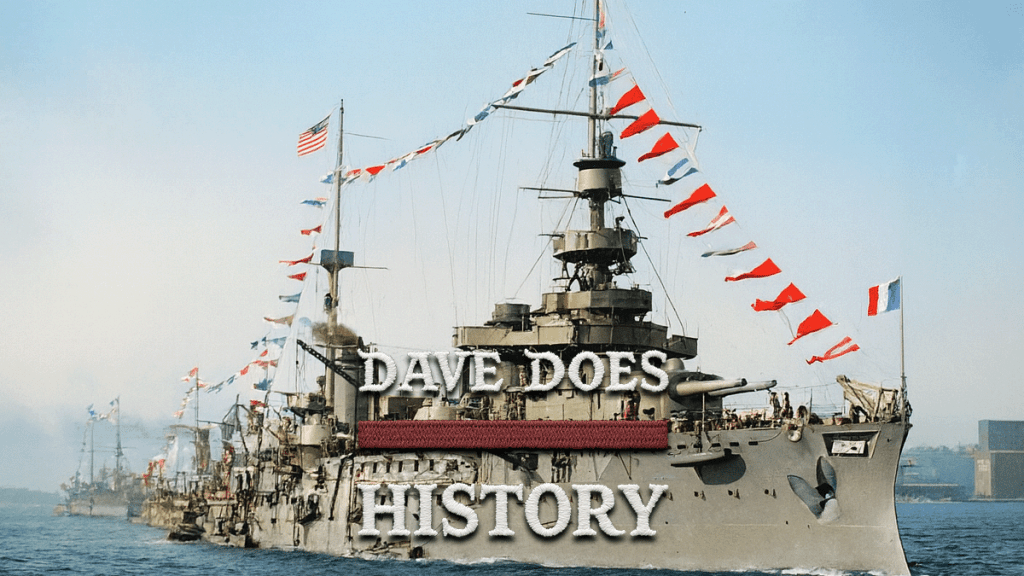
At 5:35 a.m., aboard the battleship Liberté, a muffled thud rolled across the anchorage. Smoke began curling up from the forward deckhouse. Sailors on neighboring ships paused, peering toward the gray bulk of the 15,000 ton battleship, unsure if it was a boiler mishap or an accident in one of the forward magazines. Then came a sharper blast. Flame leapt skyward, and men were seen rushing desperately along the decks. Almost instantly, launches and cutters were lowered from nearby warships as volunteers tried to reach their comrades. They rowed toward the burning ship even as fragments of steel clattered into the water around them.
For nearly twenty minutes the blaze seemed to rage but not consume. There were even hopeful reports that the fire might be checked. But at 5:53 a.m., a blast tore the harbor apart. The Liberté vanished in a sheet of flame and smoke. Her bow was obliterated, the ship itself heaved into the air as if it were no more than driftwood, and the shockwave rattled windows miles away. A thirty seven ton armor plate flew two hundred meters and smashed into the battleship République, while the sea itself boiled with falling debris. In seconds, hundreds of men were dead or dying, their bodies mangled in ways the sea had never before inflicted. The Liberté disaster was the culmination of years of warnings ignored, the product of unstable propellant and naval inertia. It would become the French Navy’s deadliest peacetime disaster, a grim symbol of how modern technology could betray those who trusted it.
When the Liberté slid down the ways at Lorient in 1905, she represented the French Navy’s attempt to keep pace with rivals in the era before the dreadnought. Modeled on Britain’s King Edward VII class, she carried four 12 inch guns in twin turrets fore and aft, supplemented by a heavier than usual secondary battery of ten 7.6 inch guns in turrets along her sides. She displaced 14,900 tons, was protected by a 280 millimeter armored belt, and could steam at 18 knots. Yet by the time she was commissioned in 1908, she was already outdated. HMS Dreadnought, launched in 1906, had rendered every pre dreadnought battleship obsolete. Liberté thus joined a fleet already overtaken by events, an expensive symbol of ambition rapidly turned relic.
But her true danger lay not in her armor scheme or her gunnery arrangements. It lay hidden below decks, in the powder magazines. There rested hundreds of charges of Poudre B, France’s smokeless propellant. Invented in the 1880s, it was at first hailed as a triumph. Unlike traditional gunpowder, it produced little smoke, allowing gunners to aim without blinding themselves, and it packed far greater energy. By 1911, every French warship relied on it. Officially, Poudre B was declared safe. But within the fleet, sailors whispered a different story. Chemically unstable, it slowly decomposed over time, especially in hot, poorly ventilated magazines. As it aged, it exuded acidic vapors that corroded brass fittings and, in the worst cases, ignited spontaneously. Each battleship and cruiser carried within its steel hull the seeds of its own destruction.
The French Navy already had ample warnings. In February 1907, a torpedo boat was blown to pieces by powder ignition. Just weeks later, the battleship Iéna exploded at Toulon, killing 120 men. The inquiry blamed unstable Poudre B, but the navy’s response was muted, partly out of fear of political embarrassment. In 1908, the gunnery school ship Couronne suffered a similar fate, followed by smaller fires and accidents in other ships. On September 10, 1911, just two weeks before Liberté, the cruiser Gloire lost several men when her powder ignited. Each disaster should have forced action. Instead, each was treated as an isolated mishap. The French Navy continued to insist that its powder stocks were safe. Meanwhile, every sailor in Toulon knew the truth. Their ships were floating bombs.
The timeline of the disaster is painfully precise. At 5:35 a.m., sailors aboard the République and Démocratie noticed smoke seeping from Liberté’s forward turret. A dull explosion followed, and flames licked upward. Almost immediately, calls for help were raised. Boats were launched from every ship within sight. Officers on the République and Marseillaise shouted orders as their men rowed toward the burning vessel. Within minutes, poisonous fumes filled Liberté’s lower decks. Senior Engineer Lestin attempted to reach the valves to flood the forward magazines, but the system was fatally designed. The controls were located directly beneath the very magazines in flames. He never returned. Survivors later testified that the heat was unbearable, the air thick with acrid gas, and that men collapsed where they stood.
By 5:45, fragments of exploding charges were being hurled across the harbor. A huge flash set the signal flags ablaze. And then came the deceptive lull. Some thought the worst was over, that the flames might be contained. At 5:53 a.m., the Liberté ceased to exist. The forward half of the ship was annihilated in a single colossal detonation. An armor plate weighing thirty seven tons was hurled across the harbor and embedded itself in the side of République. Fragments rained down on Saint Louis, Marseillaise, and Léon Gambetta, killing and wounding men who had come to help. The blast was heard thirty miles away.
The casualty figures were staggering. Two hundred twenty six men were confirmed dead, three hundred twenty eight wounded. Some sources suggested the toll approached 286. On other ships, rescuers paid dearly. Fifteen killed on Marseillaise, nine on Saint Louis, six on Léon Gambetta. The medical services at Toulon were overwhelmed. Hospitals designed for peacetime training accidents were suddenly faced with industrial scale carnage. The Red Cross was called in, reversing the Navy’s earlier refusal of civilian aid after the Iéna disaster. The nature of the injuries horrified all who saw them. These were not the clean deaths of men swept overboard or drowned in combat. They were mangled, burned, and torn apart by blast. Sailors were found with limbs missing, skulls shattered, bodies reduced to fragments. An officer on the République recalled being struck by something wet. He looked down and realized it was part of another man’s brain. A bugler was found dead on deck, still clutching his instrument, as if frozen in the instant before he could sound the alarm.
In the aftermath, Toulon harbor resembled a slaughterhouse. Instead of men swallowed by the sea, bodies floated amid the wreckage. For weeks, steamboats patrolled day and night, hauling in corpses or fragments washed ashore. Many had to be cut free from the twisted steel of the wreck. The identification process took place at Saint Mandrier hospital, where family members and officers filed past rows of remains. But the violence of the blast made recognition nearly impossible. Many bodies were burned beyond recognition or reduced to parts. Only 68 percent of the dead could be identified. Seventy two men were declared missing, their remains never conclusively found.
On October 4, France staged a national funeral. President Armand Fallières and cabinet ministers attended. Coffins, each draped in the tricolor, were borne through the streets in a somber procession. Survivors and families marched at the head, the navy carefully preserving command hierarchy even in mourning. Those who could not be identified were buried in a mass grave at Lagoubran cemetery. The scale of grief softened political and religious tensions. Unlike after the Iéna disaster, when church and state clashed over funeral rites, this time both Catholic clergy and Republican officials participated together. The mourning united a divided France, if only briefly.
The Navy convened an inquiry within hours. At first, sabotage was whispered. France in 1911 was still haunted by fears of spies and anarchists. But investigators quickly dismissed foul play. The official verdict was that excessive heat had accelerated the decomposition of Poudre B, triggering ignition. Regulations had been followed, no crewman was blamed. Instead, the powder itself was declared the culprit. Yet the report avoided deeper responsibility. Why, after Iéna, Couronne, and Gloire, had unstable stocks remained aboard ships. Why had the flooding systems been designed so fatally. The reforms were modest but overdue. Propellant older than four years was ordered destroyed. Misfired charges could no longer be returned to magazines. Powder magazines were given better ventilation. Yet the fundamental instability of Poudre B remained.
The wreck of Liberté was too shattered to be quickly removed. It lay in Toulon harbor as a rusting tomb, hindering navigation and serving as a grim reminder. Salvage operations were delayed by the outbreak of World War I and only completed in 1925, when the remains were finally raised and broken up. The navy sought to recast the story. Destroyers were named for Engineer Lestin and Sub lieutenant Gabolde, men who had died heroically trying to save their ship. Heroism, not negligence, became the official memory. But to sailors, the lesson was obvious. Their lives had been gambled against bad powder.
The destruction of the Liberté was the inevitable climax of years of negligence. Poudre B had already claimed ships and lives, and yet it remained in the magazines. The sailors paid the price. The deaths were gruesome, industrial, a preview of the mechanized slaughter the world would soon see in the trenches of France and Belgium. What happened at Toulon was more than an accident. It was a warning, about the arrogance of institutions, the dangers of unexamined technology, and the cost of ignoring what everyone already knew. The explosion of the Liberté showed that innovation without caution can be catastrophic. The sound of that blast echoed far beyond Toulon. It marked the end of the age when navies could pretend their technology was invincible. It foreshadowed a war where shells and gas and high explosives would tear men apart just as surely as they had in the forward magazines of a French battleship on a September morning.



 DAVE DOES HISTORY
Leave a comment