
When we speak of liberty, we often toss the word around as though it were a simple thing, something handed down like an heirloom we never had to earn. But liberty has always come with a price, and more than that, with a principle that must be jealously guarded. That principle is representation. Without it, law becomes no different than the lash of a whip, and government becomes nothing more than organized force. The colonists understood this better than we sometimes do today, because they lived the experience of being ruled without a voice.

The story does not begin in Philadelphia in 1776. It stretches back centuries, to a meadow at Runnymede in 1215, when King John, cornered by his own barons, agreed that even a king could not take money without “common counsel.” That was the seed. Over the generations it grew, through Parliament’s rise, through the Petition of Right, and in 1689 through the English Bill of Rights, which declared that levying money “without grant of Parliament” was illegal. Those were Englishmen defending their freedom, and the American colonists considered themselves heirs to that same legacy.
But across the Irish Sea, William Molyneux gave the idea sharper teeth. In 1698 he argued that Ireland could not be bound by laws passed in a parliament where the Irish had no seats. Consent, he wrote, was the only thing that gave law its force. Otherwise, it violated liberty and property. His book was burned in London, but his words spread like wildfire among men who would later lead an American rebellion. They saw in Molyneux’s arguments the same injustice they themselves faced.
Fast forward to Virginia, 1765. Patrick Henry rose in the House of Burgesses and thundered that taxation without representation would reduce free men to slaves. His Virginia Resolves declared that only Virginians, through their own assembly, had the right to tax themselves. Anything else was tyranny. John Dickinson took the thought further in his Letters from a Farmer in Pennsylvania, warning that even suspending a legislature was as dangerous as marching troops into a town. To strip away an assembly, he said, was a dreadful stroke at liberty.
By the time Jefferson sat down with quill in hand, these ideas were not new, but deeply rooted. The Third Grievance of the Declaration of Independence gave them voice: that the King had refused laws unless colonists surrendered their right to representation. That was the breaking point. Taxes were never the whole issue. The real fight was about consent. The right to have a voice in the laws that bound them. And the colonists were ready to risk everything to defend it.
The roots reach back to 1215 and the Magna Carta, that medieval document sealed by King John at Runnymede under duress from rebellious barons. For most Englishmen at the time, the Magna Carta meant very little in practice. But for history, it planted the first seed. Buried among its many clauses was a principle that would echo down the centuries. It declared that certain taxes and payments for the Crown’s benefit could not simply be levied at will. They required what the document called “common counsel.” It was hardly democracy. It meant that the king had to consult his nobles before reaching too deeply into their pockets. Yet even in this feudal arrangement, the spark of an idea had been struck: taxation required some form of collective approval. Without it, the act was arbitrary and unlawful. Later generations would seize on that precedent, holding it up as evidence that even monarchs must govern with consent.
By the late seventeenth century, this seed had grown into something much more substantial. The Glorious Revolution of 1688 toppled James II, and with it came a reordering of English constitutional life. The English Bill of Rights of 1689 spelled out a new settlement between ruler and ruled. It declared that levying money for the Crown “without grant of Parliament” was illegal. It further condemned the suspension of laws “without consent of Parliament.” And it affirmed that “election of members of Parliament ought to be free.” Here was a bold statement that representation mattered, not just for taxes but for the making and suspension of law itself. Parliament claimed the mantle of being the body that “fully and freely” represented the people, or at least those privileged enough to vote for it. While the suffrage was narrow and aristocratic in practice, the theory was potent. It established that legitimacy required a representative body, and that without such representation, government action was void.
It is easy to see why these English precedents became rallying cries across the Atlantic. The colonists considered themselves heirs to the rights of Englishmen, and when those rights seemed threatened, they reacted with fury. But the colonists were not alone in pressing the claim. Across the Irish Sea, another people within the British orbit had already sounded the alarm against government without representation. In 1698, William Molyneux, an Irish writer and parliamentarian, published a treatise with the unwieldy title The Case of Ireland, Being Bound by Acts of Parliament in England, Stated. The work was a carefully reasoned argument, but its conclusions struck like thunder. Molyneux argued that Ireland, having its own parliament, could not be bound by laws made in another kingdom’s assembly. To do so, he wrote, was “against reason and the common rights of mankind.” Consent, he declared, was the only thing that gave law its force. Without consent, such laws violated liberty and property.
This was no mere academic quibble. For the Irish, it was a matter of daily experience. English acts of Parliament often reached into Irish affairs, dictating trade, currency, and taxation without any input from the Irish people. Molyneux’s protest was both political and philosophical. It cast English dominion over Ireland as tyranny, precisely because it operated without representation. Parliament in London could hardly claim to speak for Dublin, much less for the rural Irish farmer. The case was so incendiary that the English Parliament ordered it condemned and burned. Yet suppression could not kill the idea. Molyneux had articulated in plain language what many already felt: a government that rules without representation rules illegitimately.
The Irish example mattered deeply to the American colonists. They read Molyneux’s work and took his arguments as their own. By the eighteenth century, the pamphlet circulated widely in the colonies, where it was “eagerly read” by men who would soon be leaders of revolution. It provided an anti-imperial vocabulary, one that fused English constitutional tradition with a broader claim about natural rights. If Ireland could not be taxed or regulated by a body in which it had no voice, then neither could Massachusetts or Virginia. The colonists took Molyneux’s charge of tyranny and applied it to their own grievances.
It is worth pausing here to recognize what is missing. The exact phrase “taxation without representation is tyranny” does not appear in Molyneux’s text. The slogan emerged later, sharpened and popularized by colonial leaders and pamphleteers. But the underlying reasoning is unmistakable. Molyneux gave them the intellectual scaffolding. He set the stage by insisting that any law, whether it was a tax or a trade regulation, was null if enacted without the consent of those bound by it. That notion expanded the debate beyond taxation. It suggested that the real issue was representation itself. Taxes were only the most visible symptom. The deeper disease was government without consent.
American colonists took this insight and broadened it further. If representation was essential in questions of money, then surely it was equally essential in questions of legislation, governance, and rights. Parliament’s refusal to acknowledge colonial assemblies as legitimate voices was, in their eyes, the same as the Crown refusing to pass laws unless colonists surrendered representation. That leap takes us directly to the grievances of the Declaration of Independence. When Jefferson and his committee wrote that the King had refused to pass laws “unless those people would relinquish the right of Representation in the Legislature,” they were not improvising. They were drawing on a long tradition that began with Magna Carta, flowered in the Bill of Rights, and was sharpened by Irish thinkers like Molyneux.
For both Irish and American protestors, the issue boiled down to dignity and autonomy. Representation was not a technicality. It was the very thing that separated free men from subjects. A tax without representation was theft. A law without representation was tyranny. And a government that forced people to abandon their representation in order to receive its favor was despotism in its purest form. That is the foundation upon which the Revolutionaries built their case. The old English documents gave them precedent. The Irish struggle gave them vocabulary. By the time Parliament and the King tried to tighten the imperial leash, the colonists already had the arguments ready. They knew from history that consent was the only thing that made government legitimate. Without it, rulers were no more than usurpers, and their laws no more than instruments of oppression.
SEGMENT II
He has refused to pass other Laws for the accommodation of large districts of people, unless those people would relinquish the right of Representation in the Legislature, a right inestimable to them and formidable to tyrants only.
By the mid-1760s, the colonies were already simmering with resentment over imperial policy. When the Stamp Act was passed in 1765, that resentment exploded into a constitutional crisis. For the first time, Parliament attempted to raise revenue directly from the colonies through internal taxes, bypassing their assemblies. The reaction was swift and furious, nowhere more so than in Virginia, where a young lawyer named Patrick Henry stepped into the spotlight and etched his name into American legend.
Henry introduced what became known as the Virginia Resolves, a series of statements that drew a sharp line in the sand. The language was blunt. He declared that taxation of the people must be carried out by themselves, or by men they themselves had chosen to represent them. Anything less, he warned, destroyed not only American liberty but British liberty as well. He reminded his fellow Virginians that representation in taxation was “the distinguishing Characteristick of British Freedom and without which the ancient Constitution cannot subsist.” For Henry, taxation and representation were inseparable. If one was denied, the other ceased to have meaning.
The Virginia Resolves went further. They claimed that only the General Assembly of Virginia had the “sole exclusive Right and Power to lay Taxes and Impositions” on its inhabitants. Parliament might make grand claims about sovereignty, but Henry and his allies flatly rejected them. To allow Parliament the same power would be, in their view, to erase the very foundation of English liberty, leaving both Britons and Americans equally exposed to tyranny. Henry was not just asserting a local privilege. He was asserting a universal principle: that representation was the safeguard of all free men, and its denial was the end of freedom itself.
What made the Resolves so striking was the way they rooted the American claim in the inheritance of English rights. Colonists did not see themselves as rebels at first. They saw themselves as Englishmen. The Resolves declared that Virginians possessed “all the Priviledges, Franchises and Immunities that have at any Time been held, enjoyed and possessed by the People of Great Britain.” They did not invent new rights out of thin air. They demanded that the old ones be respected on American soil. If Parliament refused to honor them, it was Parliament, not the colonies, that had broken faith with the constitution.
This framing proved powerful. Across the colonies, assemblies echoed Virginia’s stand, passing similar resolutions that insisted on exclusive colonial authority to tax. What had begun as a quarrel over revenue stamps quickly became a fight over the very structure of government. If assemblies could be bypassed in taxation, they could be bypassed in all things. The debate was shifting from money to representation itself.
Two years later, John Dickinson of Pennsylvania gave voice to this broader understanding in his famous Letters from a Farmer in Pennsylvania. Written in 1767 and 1768, these essays were read from New England to Georgia, uniting colonists around a shared sense of constitutional injury. Dickinson, unlike Henry, was no firebrand. His style was measured, even cautious. But his reasoning was relentless.
He focused his attention on Parliament’s treatment of New York, where the assembly had balked at full compliance with the Quartering Act. In response, Parliament suspended New York’s legislative powers until it submitted. To Dickinson, this was as dangerous as any tax. He argued that suspending a legislature for failing to obey was “as injurious in its principle to the liberties of these colonies as the Stamp Act was.” It was compulsion, plain and simple. To strip an assembly of its right to legislate was to strip the people of their exclusive privilege of self-government. Dickinson compared it to using an army to force submission. The principle was the same: government without consent.
Dickinson sharpened the argument further by distinguishing between two kinds of parliamentary power. Parliament, he conceded, had authority to regulate trade across the empire. It could impose duties as part of that regulation, because that was the price of belonging to a single economic system. But he drew the line at duties imposed purely for the sake of raising revenue. Such duties, he wrote, were nothing more than taxes, and taxes without representation were unconstitutional. The duties on paper, glass, and paint, imposed under the Townshend Acts, violated this principle. Colonists could not avoid buying these goods, nor could they manufacture them themselves. Parliament had effectively forced them into a trap, extracting money without their consent.
The stakes, Dickinson warned, could not be higher. If colonists conceded Parliament’s right to levy such duties, they would be reduced to slaves. “We are taxed without our own consent,” he wrote. “We are therefore—I speak it with grief, I speak it with indignation—we are slaves.” This was no metaphorical flourish. For Dickinson, slavery was the precise condition of being ruled by laws and taxes without representation. The tragedy of American liberty, he feared, would be to surrender without realizing what was at stake.
Yet Dickinson did not stop at diagnosis. He offered a prescription: unity. The cause of one colony, he argued, must be the cause of all. If Parliament could suspend New York’s legislature today, it could suspend Massachusetts’ tomorrow. If it could impose revenue duties on glass and paper, it could impose them on any commodity. The only hope of preserving liberty was for the colonies to stand together. “The cause of one is the cause of all,” he declared, urging his readers to resist every infringement, however small, lest they find themselves enslaved by degrees.
In Henry’s fiery rhetoric and Dickinson’s measured prose, we see the evolution of representation as the central principle of American constitutional thought. For Henry, representation was the lifeblood of British liberty transplanted to American soil. For Dickinson, it was the dividing line between freedom and slavery, the difference between government by consent and government by force. Together, their writings made clear that the issue was never just taxation. It was the entire structure of authority. Who had the right to govern? Who had the right to consent? Without representation, no government could be legitimate. And without unity, no colony could hope to defend that right alone.
SEGMENT III
By the time Jefferson dipped his pen in ink to draft the Declaration of Independence, the colonists had already endured more than a decade of bruising conflict with Parliament. Every attempt to assert their right to representation had been answered with acts of compulsion. The Third Grievance of the Declaration crystallized this experience. It charged the King with refusing to pass laws “for the accommodation of large districts of people” unless those people gave up their right of representation in the legislature. In other words, legislation itself had been turned into a weapon, withheld unless the colonists agreed to surrender the very principle that made government legitimate.
This grievance was not an abstraction. It reflected the lived experience of assemblies suspended or dissolved when they failed to comply with imperial demands. Nowhere was this clearer than in New York, where the assembly had balked at fully enforcing the Quartering Act of 1765. Parliament responded by suspending the legislature until it submitted. John Dickinson, in his Letters from a Farmer in Pennsylvania, recognized the danger immediately. He warned that to compel obedience by disabling a legislature was as destructive to liberty as taxation without representation. To silence an elected body until it yielded was indistinguishable from marching in troops and forcing submission at gunpoint. Dickinson saw it as an assault on the very privilege of legislation, and by extension on the colonists’ right to self-government.
The grievance also reflected the constant imposition of financial burdens without colonial consent. Parliament’s message was always the same: accept duties for revenue or be punished. The Stamp Act had made this clear in 1765. The Townshend Acts repeated it in 1767, placing duties on paper, glass, and paint. Colonists could not escape these goods, and Parliament knew it. Dickinson was quick to draw the parallel. These duties, he argued, were no different in principle from the Stamp Act. They were taxes in disguise, designed not to regulate trade but to raise revenue. And because they were imposed without representation, they were unconstitutional. For Dickinson, this was not just unfair. It was tyranny.
The heart of the Third Grievance, then, was the transformation of law into a tool of coercion. The colonists had been raised to believe that law was the instrument of consent, the means by which free people governed themselves. Yet in the imperial crisis, law became a cudgel. Assemblies were suspended, laws were withheld, and taxes were imposed until colonists agreed to surrender their representation. What Jefferson and his colleagues captured in the grievance was not only the fact of taxation without consent, but the larger principle that a government that compels surrender of representation is no government at all. It is tyranny.
For the American colonists, this grievance cut to the bone. It reminded them that their assemblies were not respected, that their voices were not heard, and that their rights as Englishmen had been hollowed out. It is no accident that Jefferson called the right of representation “inestimable” and “formidable to tyrants only.” Representation was the line between liberty and despotism. When law itself became contingent on abandoning that right, revolution was the only answer.
Why did the Third Grievance matter so much to the American colonies? Because it was more than a list of complaints. It was a declaration that the very foundations of liberty were under attack. When Jefferson and his fellow revolutionaries accused the King of refusing laws unless colonists surrendered their representation, they were pointing to a pattern of behavior that exposed Parliament and the Crown as willing to trample rights long considered sacred. The colonists saw this as an assault on British liberty itself, a direct challenge to their ability to govern themselves, and the clearest evidence yet that Parliament was sliding into tyranny. It was also the moment when many Americans began to understand that their cause was shared, that no colony could stand alone.
The first reason it mattered was the assault on British liberty. Colonists did not consider themselves inventors of a new constitutional order in the 1760s and 1770s. They considered themselves defenders of the old one. They had been taught from birth that the English constitution guaranteed certain protections, the most important of which was the right to be taxed only by representatives of their own choosing. This principle was not a colonial innovation. Patrick Henry had reminded Virginians that it was the “distinguishing Characteristick of British Freedom.” To the colonists, then, the acts of Parliament were not merely inconvenient policies. They were breaches of the very rights that defined what it meant to be free under the British system. If taxation could be imposed without consent, then the entire edifice of liberty was hollow. The constitution itself was being gutted, and with it the dignity of Englishmen across the Atlantic.
The second reason was the threat to self-governance. Colonial assemblies were not trivial debating societies. They were the organs of self-rule, the place where laws were made and taxes levied with the consent of those who lived under them. To suspend a legislature, as happened in New York when it resisted the Quartering Act, was a profound blow. John Dickinson recognized this in his Letters from a Farmer in Pennsylvania. He called it a “dreadful stroke at the liberty of these colonies,” and he meant it literally. To strip a colony of its assembly was to dismantle its ability to govern itself. It told colonists in no uncertain terms that their voices mattered only so long as they echoed Parliament’s commands. Self-rule, painstakingly built over decades, could be swept away in an instant. That realization was terrifying. It told Americans that their legislatures were provisional, existing at the pleasure of rulers three thousand miles away.
The third reason was what it revealed about Parliament’s intent. Colonists had hoped after the repeal of the Stamp Act that Parliament might back away from direct compulsion. Instead, it doubled down, issuing the Declaratory Act that asserted its right to “bind the colonies and people of America in all cases whatsoever.” At the time, some dismissed this as a hollow claim. But when assemblies were suspended, and when duties were imposed for revenue, colonists saw the words made flesh. Parliament truly believed it had unlimited authority. To Americans, this was nothing less than a move toward arbitrary power. Government by consent was being replaced with government by decree. The liberties they had inherited as British subjects were being erased by men who claimed to be their virtual representatives, though not one colonist had cast a vote for them. The grievance exposed Parliament not as the guardian of liberty, but as its violator.
The fourth and perhaps most lasting reason was the way these grievances fostered unity. Before the crisis, colonies often saw themselves as separate, jealously guarding their local autonomy. Massachusetts had little interest in Virginia’s affairs, and Pennsylvania often quarreled with its neighbors. But the suspension of New York’s assembly taught a lesson that could not be ignored. If New York could be compelled, then so could any other colony. Dickinson’s warning that “the cause of one is the cause of all” struck home. Suddenly, Americans who had long thought of themselves as New Englanders or Southerners began to see that their liberties were tied together. The shared injury created a shared identity, and that identity laid the foundation for organized resistance. Out of common grievance grew the Continental Congress, coordinated boycotts, and eventually the decision for independence itself.
The significance of the Third Grievance, then, was not limited to the parchment of the Declaration. It reflected a lived reality for colonists whose assemblies had been threatened, whose taxes had been imposed, and whose dignity as Englishmen had been denied. It was evidence that Parliament and the Crown were willing to dismantle the very idea of representation to enforce obedience. Once that became clear, Americans could no longer pretend that reconciliation was possible. Representation was the line between liberty and slavery. And when that line was crossed, they chose liberty.
What does this mean to us today? It reminds us that representation is not just a procedural matter, something to be filed away in civics textbooks. It is the essence of free government. Without it, law becomes coercion and power becomes arbitrary. The colonists understood that even a single tax without consent was an injury, because it revealed a deeper truth: if government could act once without representation, it could act again and again until representation meant nothing. Their vigilance should caution us against complacency.
We live in an age when the machinery of representation often feels distant or ineffective, when citizens doubt whether their voices matter. The colonists remind us that representation is not a luxury. It is the only thing that transforms rulers into public servants. When legislatures are bypassed, when decisions are imposed without debate or consent, the warning lights of liberty should flash just as brightly for us as they did for the colonists in 1767.
The grievance that Jefferson recorded was more than a record of past injuries. It was a declaration of principle: that government must rest on the consent of the governed, and that consent is expressed through representation. Strip that away, and liberty collapses. That truth bound Americans together in their fight for independence, and it should bind us today in our vigilance to protect the institutions that give us our voice. For if the colonists taught us anything, it is that representation is inestimable, and formidable to tyrants only.



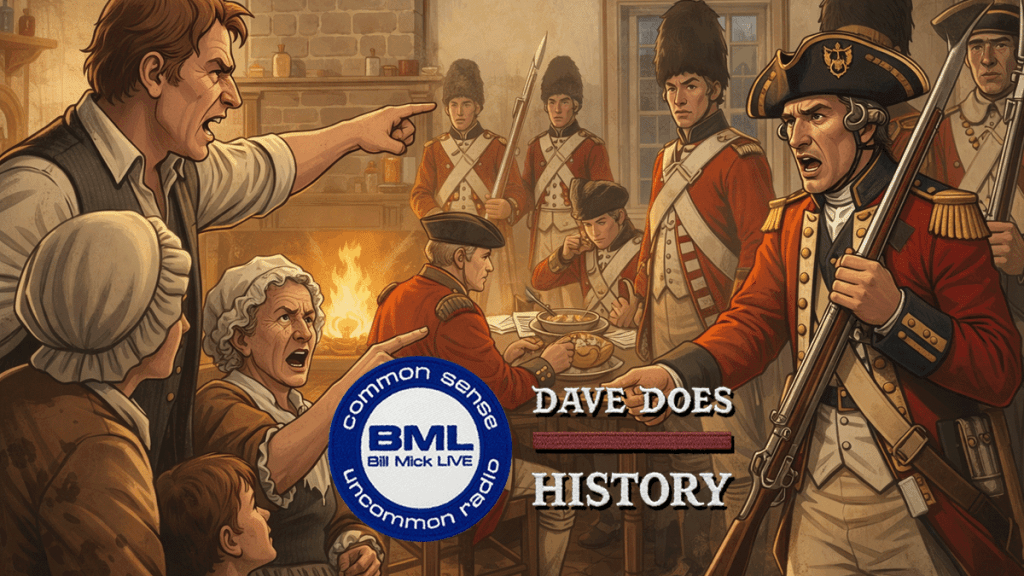
 DAVE DOES HISTORY
Leave a comment