
The Romans thought they had seen it all. They had defeated Carthage, crushed Gaul, beaten the Macedonians, and turned the Mediterranean into a Roman lake. Their legions marched across Europe like a force of nature, leaving roads, cities, and tax collectors in their wake. And then, in September of the year 9 CE, three of those legions vanished into the forests of Germania. Not defeated, not scattered, not routed, obliterated. An entire Roman army wiped from the earth by tribes that Rome had dismissed as backward and uncivilized. The story that followed was so traumatic that Augustus himself is said to have pounded his head against a wall, crying out in despair: “Quinctilius Varus, give me back my legions!”
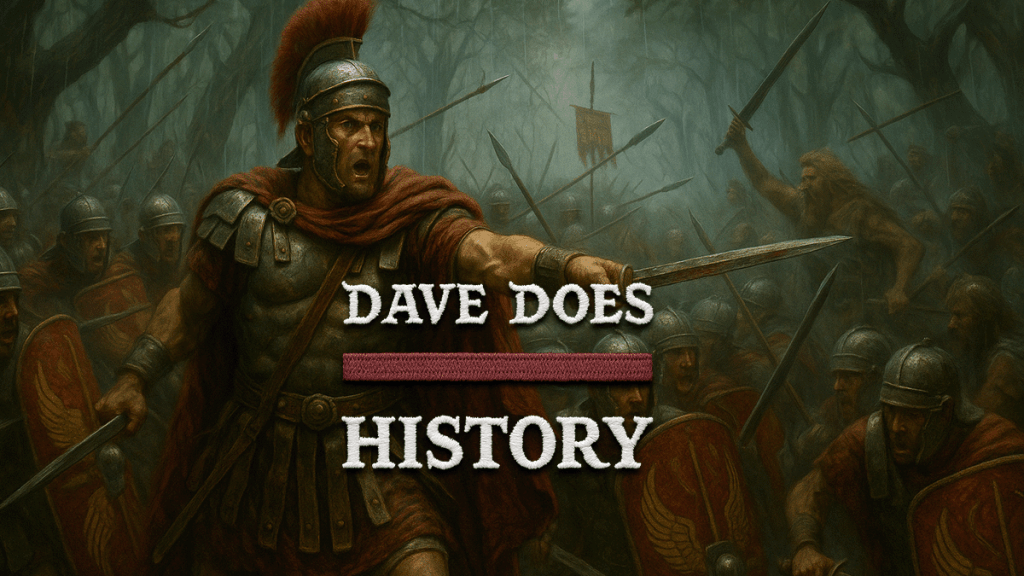
The Battle of the Teutoburg Forest was more than a military disaster. It was the kind of catastrophe that forces empires to rethink their limits. Rome had believed Germania would become just another province, like Gaul or Spain. Instead, the tribes of the north showed that Rome could bleed, and bleed heavily. The repercussions of that four-day ambush would ripple across centuries, shaping Europe in ways Augustus could never have imagined.
Rome’s interest in Germania began with Caesar. During his conquest of Gaul, he occasionally crossed the Rhine to chase Germanic raiders, but he never lingered. Caesar was pragmatic enough to see that the dense forests, scattered tribes, and poor farmland were not worth the trouble. Augustus, on the other hand, was obsessed with expansion. Empire, in his eyes, was a measure of permanence, and permanence required borders that looked strong on a map. To him, the Rhine was too flimsy. Better to push forward to the Elbe, secure the frontier, and Romanize everything in between.
So the generals went to work. Drusus, Augustus’s stepson, marched deep into Germania between 12 and 9 BCE, building forts, beating tribes, and even reaching the Elbe River before dying from a riding accident. His brother Tiberius continued the effort, scattering tribes, deporting troublemakers, and creating a chain of Roman bases. By 6 CE, Germania between the Rhine and Elbe looked, at least on paper, like another province. Roman law courts sat in judgment. Roman administrators collected taxes. Roads stretched across tribal land, built by soldiers who thought they were securing a permanent frontier.
But the Germans were not Gauls. They had no great cities to seize, no centralized kings to negotiate with, no system of wealth and tribute Rome could easily exploit. They were tribes, independent, fractious, but fiercely proud. They did not see Roman law as civilization. They saw it as arrogance. And their tolerance ran out when Publius Quinctilius Varus showed up.
Varus was a man better suited for the Senate floor than a battlefield. He had governed provinces before, but what people remembered most about him was not his brilliance but his cruelty. Tacitus described him as heavy-handed, and Velleius Paterculus, who actually liked Varus, admitted that he ruled Germania “as if the people were already enslaved.” He was the sort of Roman who thought the stick worked better than the carrot. Taxes went up. Punishments grew harsher. Resentment simmered.
Into this environment stepped Arminius. A Cherusci noble, Arminius had been raised in Rome as a hostage, standard practice for sons of tribal leaders Rome wanted to keep on a leash. He spoke Latin, wore Roman armor, and carried Roman citizenship. He even held the rank of eques, a Roman knight. He had fought for Rome in Pannonia, seen the legions in action, and knew their strengths and their weaknesses. When he returned to Germania, he saw an opportunity: unite the tribes and use Rome’s arrogance against it.
By the summer of 9 CE, Arminius had formed a conspiracy. He convinced Varus there was an uprising to the north, a rebellion that needed to be crushed before it spread. Segestes, Arminius’s own father-in-law, warned Varus that his son-in-law was lying. Varus dismissed the warning. After all, Arminius was a knight, a trusted Roman ally. Segestes, in Varus’s eyes, was just another jealous tribal rival. And so, ignoring the voice of caution, Varus ordered three legions, XVII, XVIII, XIX, out of their secure camps and into the woods.
The march west began in September. It was supposed to be routine, the legions heading to winter quarters along the Rhine. Instead, it became a nightmare. Imagine the column: nearly 20,000 men, stretched out over miles, with wagons, servants, and camp followers trailing behind. Roman armies were formidable when they could march on roads, build fortified camps, and fight on open ground. But here, the ground was mud, the roads were little more than trails, and the forests swallowed visibility.
On the first day, the rain came. Not a drizzle, but a downpour that turned everything to sludge. The soldiers’ armor weighed them down, shields became slippery, and pack animals floundered. Then came the first strikes, arrows and javelins out of the trees, quick raids that disappeared before the legions could form up. Varus ordered his men to camp for the night, but the damage was done. Morale sagged, nerves frayed.
On the second day, the attacks intensified. The column narrowed into a stretch of land between Kalkriese Hill and a bog, a choke point perfect for ambush. There, the Germans had built an earthen wall, giving them cover and high ground. From behind it, Arminius’s warriors launched their assault. Roman shields locked together, but the formations crumbled in the mud. Officers tried to rally their men, but the column stretched too far, communication collapsed, and panic spread. The Germans struck and retreated, struck and retreated, whittling the legions down.
By the third day, the Romans abandoned much of their baggage train in a desperate attempt to move faster. Exhaustion and fear stalked every step. They tried to fight through open ground, but cavalry and infantry collided in chaos. More tribes joined Arminius each day, swelling his numbers while Roman losses mounted.
On the fourth day, the survivors stumbled into yet another ambush. The weather turned worse, the wind cutting, the rain unrelenting. Surrounded and shattered, command broke down completely. Numonius Vala tried to flee with the cavalry and was cut down. Eggius led a final stand and fell. Ceionius surrendered. And Varus, the man who had led them into the trap, fell on his sword, preferring death to the humiliation of capture.
The slaughter was total. Tacitus later wrote that the Germans sacrificed officers to their gods, mutilated bodies, and nailed Roman heads to trees. The legionary eagles, the sacred standards, were taken. Perhaps 15,000 to 20,000 Romans died in those forests. Only a handful escaped back across the Rhine with the news.
Rome reeled. Augustus tore his clothes, refused to cut his hair or beard, and walked the halls of the palace crying, “Quinctili Vare, legiones redde!” “Quinctilius Varus, give me back my legions!” Those legion numbers, XVII, XVIII, XIX, were retired forever, as if the Empire itself wanted to erase the shame.
Tiberius rushed to the Rhine, shoring up defenses and preventing Arminius from carrying the war into Gaul. But the psychological blow was immense. Rome had been humbled by people it barely considered civilized. And Germania, that dream of a new province, suddenly looked like a black hole of blood and treasure.
Yet Rome was not done.
In 14 CE, Augustus died, and Tiberius became emperor. To avenge the disaster, he sent his nephew Germanicus into Germania with a massive army. Germanicus retraced Varus’s route, came upon the bones of the fallen, and ordered them buried with honor. Tacitus paints the scene: bleached skeletons scattered across the ground, skulls nailed to trees, broken weapons littering the earth. Roman soldiers wept as they laid their comrades to rest, haunted by the ghosts of the disaster.
Germanicus fought a series of campaigns, defeating tribes at the Weser River and the Angrivarian Wall. He recovered two of the lost eagles and inflicted heavy losses. Arminius himself survived, but his coalition frayed. The tribes were never as united again. Still, Tiberius, ever the pragmatist, recalled Germanicus in 16 CE. The cost was too high, the terrain too unforgiving, and the reward too thin. Honor was satisfied, vengeance complete. Germania, he decided, was not worth conquering. The Rhine would remain the border.
And so it was.
The legacy of the Teutoburg Forest is hard to overstate. Rome’s expansion stopped. Germania remained outside the Empire, its tribes developing in their own direction. Those tribes, Franks, Goths, Saxons, would one day flood across Roman borders and help bring down the Western Empire.
For the Germans, Arminius became a legend. Rediscovered in the Renaissance, renamed “Hermann,” he became the poster child of German unity, celebrated as the man who first stood up to Rome. In the 19th century, when Germany was unifying under Prussian power, a colossal monument to Hermann rose near Detmold, close to the battlefield. Today, it still stands, a reminder that in one sodden forest, the most powerful empire in the world was stopped cold.
The Battle of the Teutoburg Forest is remembered not because Rome lost a fight, it had lost plenty before, but because of what it meant. It showed that Rome’s reach had limits, that not every land could be paved with Roman roads and stamped with Roman law. It was a forest full of ghosts and a turning point in history. Augustus could scream for his legions all he wanted, but they were gone, swallowed by mud, trees, and men who refused to be conquered.
And that is why, two thousand years later, we still remember Teutoburg. Not as a footnote, but as the day Rome learned it was mortal.



 DAVE DOES HISTORY
Leave a comment