
Elisabeth Amalie Eugenie of Bavaria, the woman the world would come to know simply as Sisi, lived her life as if she were caught in a tragic opera staged on the stiffest set in Europe. She was born on Christmas Eve in 1837, in the Bavarian House of Wittelsbach, and from the start her story veered away from the expectations placed on most royal children. Her father, Duke Maximilian Joseph, was not exactly the model of sober aristocratic responsibility. He loved music, traveling circuses, and the kind of spontaneous freedom that terrified royal courtiers but delighted children.
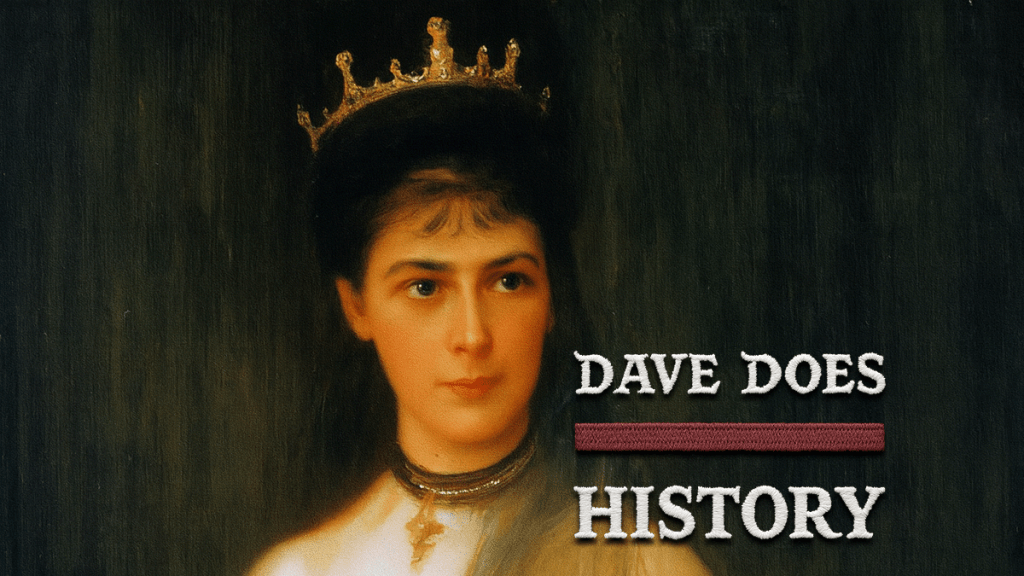
The family lived at Possenhofen Castle, not in some marble-floored palace filled with whispering ministers, but in a rambling house near the lakes and woods of Bavaria. Sisi grew up in an atmosphere of freedom that was closer to a Romantic poet’s dream than a dynastic nursery. Lessons could be skipped if the sun was shining, horses could be ridden across the countryside instead of standing stiff in some tutor’s parlor. Her childhood had none of the rigid discipline that so often broke noble children into obedient heirs. That freedom was intoxicating, but it left her completely unprepared for the world into which she was suddenly thrust as a teenager.
When she was fifteen, she accompanied her mother and older sister Helene on a journey that was meant to shape Helene’s future, not hers. They traveled to Bad Ischl, where the young Emperor Franz Joseph I of Austria was expected to propose marriage to Helene. The arrangement made sense. Helene was the eldest, steady and suitable, and Franz Joseph’s mother, Archduchess Sophie, was determined to see it through. But dynastic plans have a way of crumbling when they collide with human passion. Franz Joseph laid eyes on Elisabeth and that was the end of it. Against his mother’s firm insistence, he chose the younger sister. Within days the betrothal was announced, and by April 1854, the sixteen-year-old Elisabeth was married, swept from her carefree Bavarian adolescence into the suffocating ritual of the Habsburg court.
This was no ordinary adjustment. Imagine being raised in a household where your father wandered off to fairs and your mother let you gallop horses in the hills, then suddenly finding yourself locked inside the most rigid court in Europe, where every meal, every gown, every word spoken was weighed, judged, and documented. Elisabeth adored her husband, but she also recognized the tragedy of her situation. “I love the emperor so much,” she said, “if only he were not the emperor.” Love might have carried her through, but the court of Vienna was a machine, and it had little use for a free spirit.
Her mother-in-law, Archduchess Sophie, was the true ruler of that machine. She was known in the palace as “the only man in the Hofburg,” a sharp tongue wrapped in iron will. She seized Elisabeth’s children as soon as they were born. The Empress’s first two daughters, Sophie and Gisela, were raised not by their mother but by Sophie’s strict hand. Elisabeth felt the loss keenly. She once wrote that her children had been taken away, that they were departed from her. And the whispers around the court grew louder with every year she failed to produce a male heir. Anonymous pamphlets circulated, one of them bluntly stating that the natural destiny of a queen was to give an heir to the throne and that if she succeeded, her ambition should end there. The cruelty of that sentiment is hard to miss. For a woman raised on freedom, reduced to the status of a broodmare, life in Vienna was suffocating.
When her first daughter, little Sophie, died at the age of two while traveling in Hungary, Elisabeth was devastated. The depression that followed would return in waves for the rest of her life. Her body began to fail her in ways doctors could not explain. She coughed, fainted, complained of weakness, but these illnesses vanished when she escaped the court. They were as much psychological as physical, her body rebelling against her gilded prison. And so she traveled, often under the excuse of ill health, leaving her surviving daughter Gisela behind. It was less abandonment than desperation, a woman fleeing a cage too heavy to endure.
If Elisabeth struggled within the palace walls, she discovered her voice and influence beyond them, and nowhere more so than in Hungary. The Austrians had long viewed their Hungarian subjects with suspicion, but Elisabeth found in Hungary a place that felt like home. On her first visit in 1857, she discovered people who met her not with rigid formality but with open warmth. She learned their language, embraced their customs, and in return they adored her. She confided that her innermost soul reached out to them, and they returned her affection long after her death. In her, they saw not a distant empress but a sympathetic ally.
Her relationship with Hungary gave her unexpected political weight. She urged Franz Joseph to trust Count Gyula Andrássy, a Hungarian leader many in Vienna despised. She wrote to her husband that she had done everything in her power and that if he ignored her advice, the consequences were his alone. For once, her voice carried weight. In 1867, the Austro-Hungarian Compromise created the dual monarchy, and Elisabeth was crowned Queen of Hungary. The coronation was not just ceremony. It was recognition that she had bridged a political divide her husband could not. As a coronation gift, she and Franz Joseph received the palace at Gödöllő, and Elisabeth found real happiness there. Ten months later she gave birth to her youngest child, Marie Valerie, in Buda. She called her the Hungarian child, and unlike her earlier children, she raised this one herself. She poured all her repressed maternal energy into her youngest daughter, determined to do for her what she had been denied with the others.
But no coronation, no palace, no favored child could shield Elisabeth from the blows life had yet to deliver. In 1889, her only son and heir, Crown Prince Rudolf, was discovered dead at Mayerling alongside his mistress in what was officially declared a suicide pact. The Mayerling incident sent shockwaves through Europe. It was scandal, tragedy, and dynastic disaster rolled into one. For Elisabeth, it was the final wound. She dressed in black for the rest of her life and never truly recovered. Her melancholy deepened into something closer to despair.
Elisabeth’s way of coping was as obsessive as it was tragic. She clung to her beauty as if it were the last remnant of her identity. She was tall, nearly five foot eight, and she kept her weight fixed at about 110 pounds. She laced her corsets so tightly her waist measured just sixteen inches. Modern doctors have no hesitation in labeling her practices disordered eating, even anorexia. She consumed little, exercised relentlessly, and kept her body under iron control. Her hair reached her ankles and required three hours of daily care. She bathed in olive oil, took cold showers, fenced, rode horses for hours, walked for miles, and never stopped moving. She transformed her body into both a shield and a prison.
Yet she was not shallow. Beneath the vanity was a restless intellect. She devoured literature, especially the works of Heinrich Heine, whose melancholy verse matched her own moods. She wrote poetry of her own, much of it inspired by Heine, much of it serving as a secret diary. She referred to herself as Titania, Shakespeare’s fairy queen, a wandering spirit never at rest. Her poetry is full of yearning for escape, for flight, for a place where she might be free of the burdens of crown and court. She once wrote, “For me earth holds no corner to build a lasting nest.”
Her wanderlust took her across Europe and beyond. She often traveled incognito, using pseudonyms like Countess of Hohenembs, to slip past the public gaze. She commissioned the Achilleion palace on Corfu, a monument to Greek myth and her own yearning for beauty and solitude. She wandered from health resort to seaside town, more shadow than sovereign, a queen determined to outrun her own despair.
In the end, despair caught her in the streets of Geneva. On September 10, 1898, Elisabeth was walking along the lakeside, about to board a steamship, when an Italian anarchist named Luigi Lucheni lunged at her with a sharpened file. The blow pierced her heart, though the thin weapon and her tight corset slowed the bleeding. She managed to walk back to the pier and board the ship before collapsing. She died at 2:10 that afternoon, sixty years old. Lucheni later claimed he did not mean to kill her specifically, only that he wanted to strike down a sovereign, any sovereign. Fate put Elisabeth in his path.
The aftermath was chaotic. Lucheni, furious that Geneva had abolished the death penalty, demanded to be tried elsewhere so he could be executed. Instead he was sentenced to life in prison, where he eventually killed himself. The assassination prompted an international conference on anarchist violence, one of the first attempts to coordinate against what we would now call terrorism. Franz Joseph mourned his wife by creating the Order of Elizabeth, a charitable foundation in her name. But it was her death itself, violent and senseless, that transformed her into a legend.
In life, Elisabeth had been a woman of contradictions, restless, melancholic, beautiful, and trapped. In death, she became myth. Franz Joseph lived on, dutiful and predictable, while Elisabeth became frozen in time, remembered as forever youthful, forever tragic. She had refused to be photographed after her early thirties, ensuring that her image in public memory would remain that of a young beauty rather than the grief-stricken widow she became.
Her story has been told and retold in plays, operas, ballets, films, and television dramas. The 1950s Sissi trilogy starring Romy Schneider presented her as a fairy tale princess, a romantic heroine rather than a deeply troubled woman. That romantic image persists in popular imagination, even as historians emphasize her depression, disordered eating, and melancholy. She has become a tourist attraction, with museums and memorials drawing crowds in Austria and Hungary. Her palaces remain shrines to her memory.
Why does she endure? Because Elisabeth represents a universal longing. She was a woman caught between two worlds, born to freedom but bound to duty, adored by millions yet desperately lonely, powerful in her influence yet powerless in her own life. She embodied the contradictions of modern royalty, the glittering spectacle that hides deep personal cost. She demanded self-determination in a world that denied it to her, and in doing so, she left behind a legacy that still captivates.
Her story is not simply one of beauty and tragedy. It is a reminder that behind every crown is a human being, fragile, flawed, and yearning for freedom. Elisabeth of Austria remains unforgettable not because she reigned, but because she refused to be defined by her reign. She remains unforgettable because she was, above all else, human.




 DAVE DOES HISTORY
Leave a comment