
Special Guests Lena and Graham from the Patrol Reports Podcast join us today to talk about the first US Submarine attack in history… during the Revolutionary War…
On the night of September 7, 1776, New York Harbor looked like a wooden forest, crowded with the towering masts of the Royal Navy. The British had come to town, and they came in force. Admiral Richard Howe’s fleet lay at anchor, its warships bristling with cannon, their lanterns glowing against the dark water. The American cause seemed desperate. Washington’s Continental Army had been chased from Long Island, morale was flagging, and the future looked grim. But one small wooden contraption, barely ten feet long and shaped like two turtle shells strapped together, was about to make history. It was called the Turtle, and it carried with it the audacious hope that a single man in a box beneath the waves could strike terror into the mightiest navy on earth.
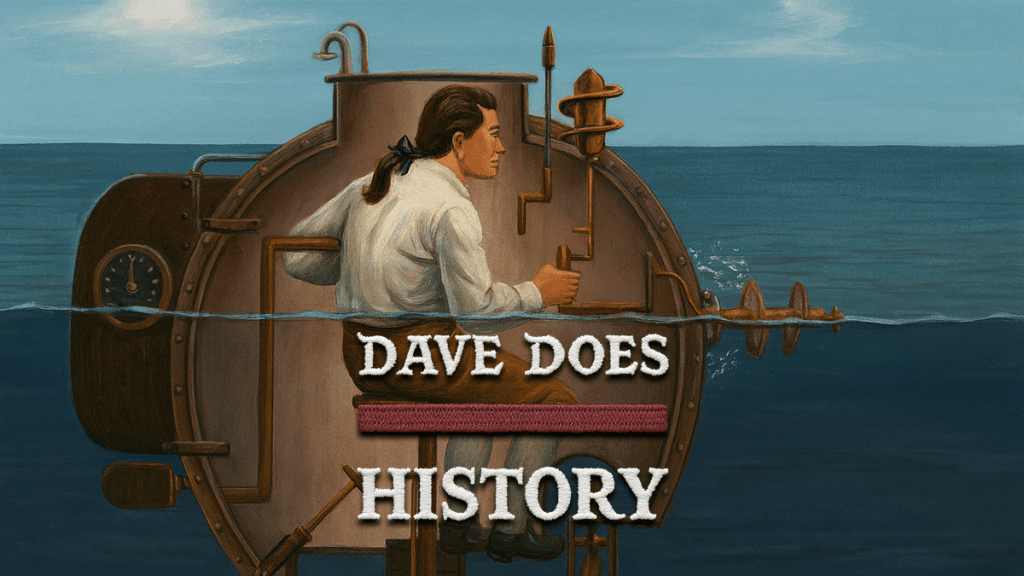
The Turtle was the creation of David Bushnell, a man who lived in the seam between science and revolution. Bushnell had been a Yale student when the war broke out, more comfortable with books than bayonets. At Yale he discovered that gunpowder could be detonated underwater, a trick no one had managed before. That spark of an idea grew into something extraordinary. If explosives could work underwater, why not use the ocean itself as a battlefield? Why not create a vessel that could creep below the surface and plant an explosive charge against an enemy ship? It was the kind of idea that seemed half insane, half brilliant, and it was just mad enough to fit the desperate moment of 1776.
Bushnell did not work alone. He had the help of Isaac Doolittle, a skilled clockmaker and brass founder from New Haven, who built the delicate inner workings of the craft. Doolittle was no mere tinkerer. He was a craftsman of gears and screws, and he supplied Bushnell with the brass fittings, pumps, and instruments that turned an idea into something seaworthy. A carpenter named Phineas Pratt gave the Turtle its wooden shell, shaping oak planks into a hull that looked suspiciously like a beer keg. Bushnell’s brother Ezra also lent a hand, helping to build the machine that would test the patience of history. Together this odd fellowship produced a one-man submarine in a world that had never seen such a thing.
The Turtle was not much to look at. Ten feet long, six feet tall, and three feet wide, it was built for a single operator. Its oak planking was smeared with tar to keep out the sea, and iron bands wrapped around it for strength. The man inside would sit on a small seat, hunched over like a monk at prayer, and use his arms and legs to crank the strange contraption forward. For horizontal motion there was a hand-cranked screw propeller, though eyewitnesses later described it more like a paddle blade than the screw design we know today. For vertical motion, to rise or sink, there was another propeller driven by foot pedals. A ballast system, operated by foot pumps and valves, allowed water to flood in or be expelled. If things went badly, there was a 200-pound lead weight that could be dropped to send the Turtle shooting back to the surface. Bushnell had invented nothing less than the first practical ballast system, a principle that submariners still use today.
Inside, conditions were primitive. There was enough air for about half an hour before the pilot would start gasping. Six small windows made of thick glass gave a glimpse of the surface light when near the top, but deeper down the operator worked in near-total darkness. For illumination, Bushnell and Doolittle turned to nature. They coated needles on the compass and depth gauge with foxfire, a glowing fungus found on rotting wood. In warm weather it emitted a ghostly green light, enough to guide a man in the dark belly of the machine. But when the harbor turned cold, the foxfire failed, and the pilot was left blind. Imagine sitting in a wooden keg, cranking furiously under the water, with only your guesswork to tell you where you were.
The Turtle carried a weapon as strange as itself. Bushnell had designed a floating mine, a powder magazine packed with 150 pounds of gunpowder and rigged with a clockwork timer. The plan was for the operator to maneuver beneath an enemy ship, use a hand drill to screw the mine into the hull, release it, and pedal away before the clock triggered an explosion. It was a diabolical idea, combining Yankee ingenuity with a willingness to test the limits of sanity. If it worked, it could change the course of the war. If it failed, the operator would be left trapped in a wooden coffin beneath the harbor.
Bushnell himself could not test the machine. He had fallen ill, and so the duty fell to Sergeant Ezra Lee of the Continental Army. Lee was no sailor, no diver, and certainly no submariner. He was a soldier with enough courage, or perhaps recklessness, to climb into Bushnell’s invention and try it out. On the night of September 7, Lee clambered into the cramped interior, shut the hatch, and began pedaling toward history. His target was HMS Eagle, Admiral Howe’s flagship, a seventy-four gun ship of the line riding proudly at anchor off Governor’s Island.
Picture the scene. Above the water, the British fleet slept in confidence, their lanterns swaying, their decks quiet. Below, a lone American soldier sweated and strained in a contraption no bigger than a rowboat, pumping furiously against the tide. The Turtle crept toward the looming shadow of the Eagle. It was the first underwater attack in history, and no one else on earth knew it was happening.
Lee reached his target. He guided the Turtle beneath the Eagle’s hull and tried to attach the explosive charge. Here history turned against him. The Eagle’s hull was sheathed in copper, a new technology meant to protect ships from rot and barnacles. Lee’s drill skittered uselessly against the metal. He tried again and again, sweating in the stifling dark, air running low, lungs screaming. Nothing worked. The copper defeated him. At last, exhausted and gasping, he released the mine into the current and pedaled away. Minutes later the charge exploded with a thunderous roar, but by then it had drifted harmlessly into open water. The Eagle remained untouched.
Lee returned, battered but alive. He had not sunk the British flagship. He had not changed the course of the war. Yet he had done something no one had ever done before. He had piloted a submarine into battle and survived to tell the tale. The Turtle would make a few more attempts, none successful, before it was lost when the tender carrying it was sunk by the British. Bushnell salvaged what he could, but the Turtle’s career as a weapon was over. Its place in history, however, was secure.
So what do we make of the Turtle? As a weapon, it failed. It never sank a ship, never forced the British out of New York, never lived up to its daring promise. But as an idea, it was revolutionary. Bushnell and his collaborators proved that the sea was not safe, that even the largest warship could be vulnerable to attack from below. They invented principles that still guide submarines today: ballast tanks, propellers, underwater mines, and timed explosives. They forced the Royal Navy, if only for a moment, to consider that the waters of New York were not entirely theirs.
The Turtle also planted a seed in the American imagination. The notion that a single individual, armed with nothing but ingenuity and courage, could strike at the great empire resonated with the spirit of the Revolution. The image of Ezra Lee sweating in his little wooden keg, trying to drill a hole in the belly of the Eagle, was almost absurd. Yet it was also heroic. It spoke to the willingness of ordinary men to try the impossible. The Revolution was full of such moments, when desperation gave birth to invention, when boldness mattered more than certainty.
Bushnell himself lived to see the world catch up with his ideas. Submarines would not play a decisive role in the Revolutionary War, but they would reappear in the Civil War, when the Confederate submarine Hunley sank the USS Housatonic in 1864. From there the line runs straight to the steel monsters of the twentieth century and the nuclear leviathans of today. Every submarine, from the U-boats of Germany to the boomers of the U.S. Navy, carries a bit of Bushnell’s imagination. The Turtle did not win its battle, but it won a place in the genealogy of naval warfare.
And perhaps that is the lesson of the Turtle. Failure in the moment can still be success in the long view. Bushnell’s invention did not save New York. It did not terrify Admiral Howe. But it showed the world what was possible. It proved that beneath the calm surface of the water, danger could lurk. It gave birth to a new form of warfare. Sergeant Ezra Lee may have pedaled home in defeat, but he carried with him the first chapter of a story that would shape centuries.
When we think of September 1776, we often remember the defeats, the retreat from New York, the gloom that hung over Washington’s army. Yet hidden in that same month is a story of invention and daring, a story of a man in a barrel daring to take on an empire. It is the story of the Turtle, the world’s first submarine, and its lonely attack on HMS Eagle.
It was a failure.
It was a joke.
It was a miracle.
It was history.


 DAVE DOES HISTORY
Leave a comment