
Buffalo, New York. September 6, 1901. The Pan-American Exposition was in full swing. People streamed through the gates to marvel at electric lights, mechanical wonders, and the promise of a new century. The exposition was a celebration of progress, and at its heart stood the Temple of Music, a building of ornate curves and gilded decoration designed to impress. That afternoon it would host the president of the United States, William McKinley, for what was billed as a simple public reception.

McKinley walked in with the easy grace of a man accustomed to crowds. He had always loved pressing the flesh, greeting strangers with the same steady smile he gave his closest friends. He considered it part of his job, and not just a duty but a joy. Inside, a line of well-wishers formed, each one eager for the fleeting honor of shaking the president’s hand. Some carried small tokens, some had nothing more than words of admiration. And a few feet away stood a man whose hand was wrapped in a handkerchief, waiting his turn. His name was Leon Czolgosz, and he was not there to praise the president. He was there to end him.
This is the story of how one of America’s most popular presidents met his fate at the hands of a bitter anarchist. It is the story of how a nation that thought itself secure in its prosperity was jolted into a new century. And it is the story of how William McKinley’s death brought Theodore Roosevelt into the White House, setting America on a course no one could have foreseen.
William McKinley had come a long way to reach that moment. Born in 1843 in the small Ohio town of Niles, he grew up in a family that worked hard and held fast to faith and community. At eighteen, when the Civil War erupted, he enlisted in the Union Army and served under Rutherford B. Hayes, who would later become the nineteenth president of the United States. McKinley proved himself at Antietam, carrying food and coffee to men under fire, an act of simple courage that earned him promotion to second lieutenant. By the time the war ended, he had risen to the rank of brevet major, a title that would stick with him for the rest of his life. He returned home with a taste for leadership and a deep loyalty to the Union he had helped preserve.
After the war he studied law, built a modest practice in Canton, Ohio, and soon found his way into politics. As a Republican, he won election to Congress, where he became known for his steady advocacy of high tariffs. To McKinley, protective tariffs were not simply about profits for manufacturers; they were about wages for working men. He believed a strong tariff wall kept American industry safe and American workers well paid. In 1890, as chairman of the House Ways and Means Committee, he sponsored what became known as the McKinley Tariff, the highest protective tariff the country had seen. It was not universally loved, and it cost him his seat that year, but it made his name.
With the backing of Mark Hanna, a wealthy industrialist with a keen political sense, McKinley rebounded. He won the governorship of Ohio in 1891 and again in 1893. Hanna, seeing the chance to place his friend on a larger stage, began laying the groundwork for a presidential bid. When the 1896 campaign came, McKinley was ready.
The contest between McKinley and William Jennings Bryan was one of the most dramatic in American history. Bryan stormed across the country, preaching his “Cross of Gold” and calling for the free coinage of silver to help indebted farmers. McKinley, by contrast, stayed home in Canton, greeting delegations from his front porch and delivering carefully prepared remarks. It was a front porch campaign, dignified and deliberate, in stark contrast to Bryan’s whirlwind. McKinley stood for the gold standard and stability. With Hanna raising enormous sums from business interests and funding an unprecedented publicity machine, McKinley won decisively. He became the first president since 1872 to win a clear majority of the popular vote.
Once in office, McKinley signed the Dingley Tariff into law, another record-setting wall of protection for American industry. But his presidency quickly turned outward. In 1898, tensions with Spain over Cuba erupted into war. The destruction of the battleship USS Maine in Havana harbor and the clamor of sensationalist newspapers pushed the United States into conflict. The Spanish-American War was brief, lasting only a few months, but it reshaped the nation. Victory brought Puerto Rico, Guam, and the Philippines under American control, while Cuba gained independence. For the first time, the United States stood as a global empire.
This new role brought criticism from anti-imperialists, but McKinley defended America’s obligation to govern “alien peoples” until they were ready for self-rule. At home, prosperity returned, and the people rewarded him with re-election in 1900, once again defeating Bryan. By the summer of 1901, McKinley was a president at the height of his power and popularity.
The Pan-American Exposition in Buffalo was the perfect stage for him. The exposition was meant to showcase not only technological wonders but also the rising stature of the Americas in the world. McKinley planned to deliver a speech that would chart a new economic vision. On September 5, before a crowd of fifty thousand, he declared, “The period of exclusiveness is past,” urging the nation to embrace reciprocal trade agreements and to abandon the idea that America could sell everything and buy nothing. It was a shift in thinking, a sign that even the staunchest tariff man saw the need for international cooperation.
But McKinley had a weakness. He liked to be accessible. Security worried him, not for himself, but because he feared it would make him seem distant. Cortelyou, his secretary, fretted about the reception planned at the Temple of Music. Twice he removed it from the schedule, and twice McKinley restored it. “Why should I? No one would wish to hurt me,” the president insisted.
Out in the city, Leon Czolgosz was waiting.
Czolgosz’s path to that moment had been anything but steady. Born in 1873, he grew up in Michigan, the child of Polish immigrants. His family moved often, scraping by in industrial towns. By 1893, Leon was working at a wire mill in Cleveland when the Panic struck. Wages fell, strikes broke out, and he lost his job. Blacklisted, he returned under the name Fred Nieman, a bitter joke on himself. Nieman meant “nobody”.
The experience scarred him. He retreated into books and radical pamphlets, devouring the ideas of anarchists who railed against capitalism and state power. He became fascinated by Gaetano Bresci, the anarchist who assassinated King Umberto I of Italy. By 1901, he was hovering on the fringes of anarchist circles, even approaching Emma Goldman. But Goldman and others found him strange, unreliable, and possibly dangerous. They suspected him of being a government agent. In truth, he was a lone figure, isolated and growing more convinced that he must act.
To Leon, William McKinley represented everything he despised. The president was the symbol of a system that gave much to a few and little to the many. In his confession he said, “I killed President McKinley because I done my duty. I didn’t believe one man should have so much service, and another man should have none”. When he read that McKinley would be in Buffalo, he bought a revolver, wrapped it in a handkerchief, and went to the fair.
The Temple of Music was crowded that Friday afternoon. A line of people filed in to greet the president. A group of soldiers in dress uniforms stood along the aisle, their glittering presence meant to impress but in reality blocking the view of detectives. The rule requiring open, empty hands had fallen by the wayside.
At 4:07 p.m., Leon stepped forward. His right hand was wrapped as if injured. McKinley, seeing it, reached with his left hand in a gesture of kindness. Two shots rang out. One bullet glanced off a button on his coat. The other struck home, tearing into his abdomen.
The crowd surged. Soldiers and guards slammed into Czolgosz, pummeling him with rifle butts. Some called for his immediate death. McKinley, bleeding and pale, spoke with surprising calm. “Don’t hurt him. Don’t let them hurt him.” To Cortelyou, he whispered, “My wife—be careful how you tell her—oh, be careful.”
Doctors rushed him to the exposition hospital. It was not equipped for such a crisis. The best surgeon in town, Dr. Roswell Park, was unavailable. In his place, Dr. Matthew Mann, a gynecologist, took charge. By lamplight, he opened the president’s abdomen, stitched stomach tears, and tried in vain to locate the bullet. It was never found.
For several days, hope flickered. McKinley seemed to rally. He asked about the exposition and about the public’s response to his speech. Newspapers reported encouraging bulletins. Vice President Roosevelt, reassured, left Buffalo and headed to the Adirondacks. The nation breathed easier.
Then, on September 13, everything changed. Infection spread along the bullet’s path. Gangrene set in. The president’s condition collapsed. He whispered to those around him, “It is useless, gentlemen. I think we ought to have prayer.” To Ida, frail and sickly, he offered words of comfort. “We are all going, we are all going. God’s will be done, not ours.” At 2:15 in the morning of September 14, William McKinley was gone.
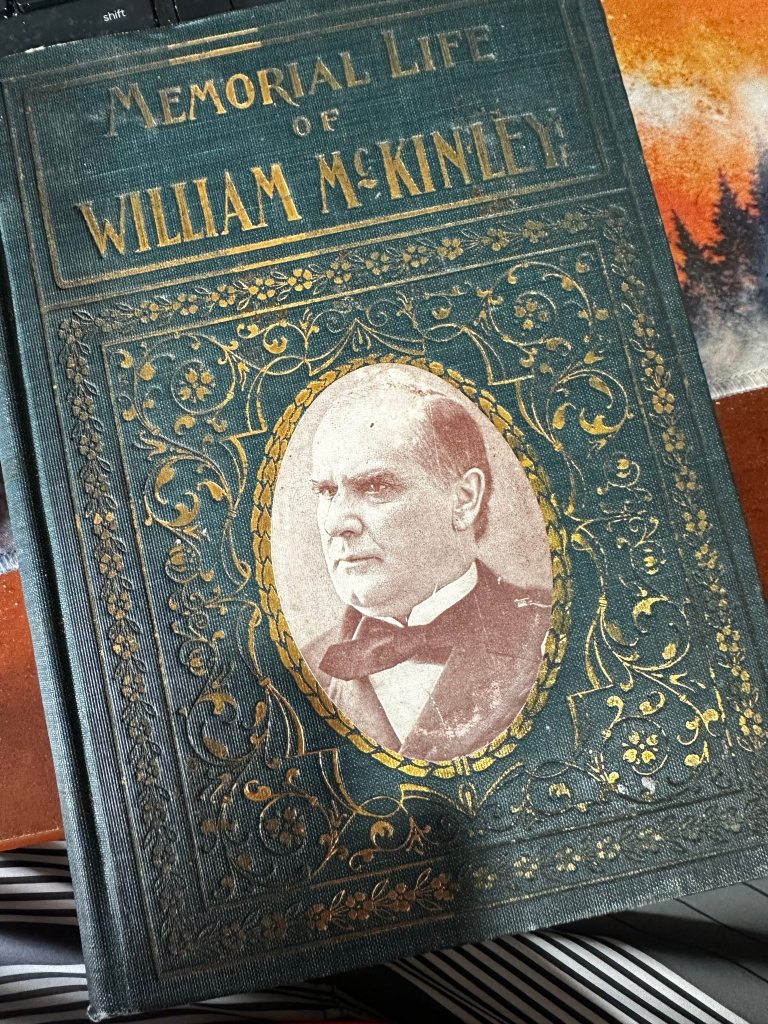
The nation was stunned. Funeral trains bore his body first to Washington, then to Canton, Ohio. Everywhere, crowds gathered in silence. On the day of his burial, trains across the country halted, telegraph operators fell still, and Americans paused in unison. It was as if time itself stopped for five minutes to honor the fallen leader.
Meanwhile, the fate of Leon Czolgosz was sealed. His trial began just nine days after the president’s death. The proceedings lasted eight hours. His defense called no witnesses. He refused to cooperate. After half an hour of deliberation, the jury declared him guilty. On October 29, he was strapped into the electric chair at Auburn Prison. His final words were defiant: “I killed the president because he was the enemy of the good people—the working people.” Sulfuric acid was poured over his body to ensure no trace remained.
Buffalo never embraced its place in history. The Temple of Music was demolished. The Pan-American Exposition faded. Today, only a boulder marks the site of the assassination. Unlike Ford’s Theatre or Dealey Plaza, Buffalo chose silence. For years, it was known derisively as the “assassin city.”
But the consequences of that September afternoon were immense. In 1902, the Secret Service began guarding presidents full-time. Anarchists across the country faced raids, harassment, and vigilante attacks. The fear of radical violence helped lay the foundation for the modern FBI. The presidency itself changed. Out went the gentle, frock-coated dignity of McKinley. In came Theodore Roosevelt, young, brash, and energetic. As Mark Hanna grumbled, the country had inherited “that damned cowboy.” Roosevelt’s style and vision would drive America headlong into the twentieth century, reshaping the office of the presidency and the role of the United States in the world.
Leon Czolgosz called himself Nieman, nobody. In a sense, he was right. He was a lonely figure, distrusted by his own movement, forgotten by history except as an assassin. But with two shots in Buffalo, he turned himself into a hinge on which history swung. McKinley’s death was not just the loss of one man but the end of an era.
Out of the Temple of Music, America stepped into a stormy voyage, guided now by a very different kind of leader.


 DAVE DOES HISTORY
Leave a comment