
The summer of 1778 found the Revolution at a crossroads. The war had already seen stunning American victories like Saratoga, where British General Burgoyne surrendered his entire army, but it had also seen disasters, retreats, and long winters of misery. Into that mix came a new player, an old enemy of Britain and an unexpected friend to the struggling United States: France. The French had finally recognized the American cause and agreed to fight alongside the rebels. This was not just about ideals of liberty. It was about revenge. France had been waiting for a chance to stick it to Britain ever since losing most of its empire in the Seven Years’ War. By 1778, the moment had arrived.
The first real test of this new alliance came in Rhode Island. The British had occupied Newport since December of 1776. From their position on Aquidneck Island they controlled one of the finest harbors on the American coast, a perfect base for ships to harass New England’s trade and threaten the surrounding countryside. The Americans hated it but lacked the strength to push them out. Now, with French ships on the horizon and American troops gathering, the patriots believed the day of liberation had come. It was going to be a joint operation, and if all went well, a symbolic victory proving the alliance could actually work.
The French sent Admiral Comte d’Estaing, a man of experience and pride, with twelve ships of the line and thousands of troops. The Americans put Major General John Sullivan in command, supported by Nathanael Greene, the local Rhode Islander who knew the terrain, and the fiery young Marquis de Lafayette, who seemed to live for the chance to throw himself into battle. Washington himself had called for 5,000 men to be raised for the operation. Militias from Rhode Island, Massachusetts, Connecticut, and New Hampshire answered the call, along with Continental regulars and artillery. Among the most remarkable units present was the 1st Rhode Island Regiment, sometimes called the “Black Regiment,” a multiracial force of free Blacks, enslaved men promised freedom for service, Native Americans, and white colonists. Their presence was a quiet but powerful rebuke to anyone who doubted their place in the fight for independence.
The plan was daring. The Americans would cross from Tiverton onto Aquidneck Island, advancing down the eastern shore. The French would stage on Conanicut Island and cross from the west, pinching the British between them. With luck, the defenders of Newport would be forced to surrender. But luck is a fickle ally, and in 1778 it seemed to side with the British.
Right from the start, tempers flared. Sullivan, impatient to seize ground, moved his troops onto Butts Hill before the French were ready. The British had abandoned the position, and Sullivan thought it too valuable to leave unoccupied. The French saw it differently. They considered his move a breach of the agreement and a show of arrogance. D’Estaing and his officers grumbled about the Americans’ lack of discipline. Sullivan grumbled about French pride and slow pacing. The seeds of mistrust were planted before a shot was fired.
Meanwhile, General Sir Robert Pigot, the British commander in Newport, was not idle. He pulled in his forces, reinforced the defenses, scuttled several Royal Navy ships to block the harbor, cut down orchards to clear firing lanes, and drove livestock into the city to deny supplies to the invaders. His army included British regulars, Loyalists, and thousands of tough German auxiliaries under General Friedrich Wilhelm von Lossberg. If the French and Americans thought Newport would fall easily, Pigot was determined to prove them wrong.
Then came the storm. On August 9, the British fleet under Admiral Howe arrived off Point Judith, forcing d’Estaing to sail out and meet them. Just as the two sides maneuvered for battle, a hurricane roared up the coast. For two days it lashed the ships with screaming winds and towering seas. Rigging was ripped apart. Masts snapped. Ships scattered far and wide. D’Estaing’s flagship took a pounding so severe that it was nearly unseaworthy. Howe’s fleet was also battered. When the storm cleared, both admirals limped back with shattered fleets.
For the Americans, this was the breaking point. They had counted on French naval power to trap the British in Newport. Without it, their siege was a risky gamble. Sullivan begged d’Estaing to stay, even in his crippled condition, but the French admiral refused. His ships needed repair, his officers were pressing him, and he judged the British too strong behind their works. He sailed for Boston on August 22, leaving Sullivan in the lurch.
The reaction was furious. American soldiers who had cheered the alliance weeks earlier now cursed the French. Sullivan declared that the departure was “derogatory to the honor of France.” Militia, whose terms of service were short to begin with, melted away in anger or discouragement. A force that had numbered over ten thousand shrank rapidly. Sullivan, faced with the news that Clinton was preparing a relief force in New York, decided he had no choice but to withdraw to the northern end of the island and prepare to evacuate.
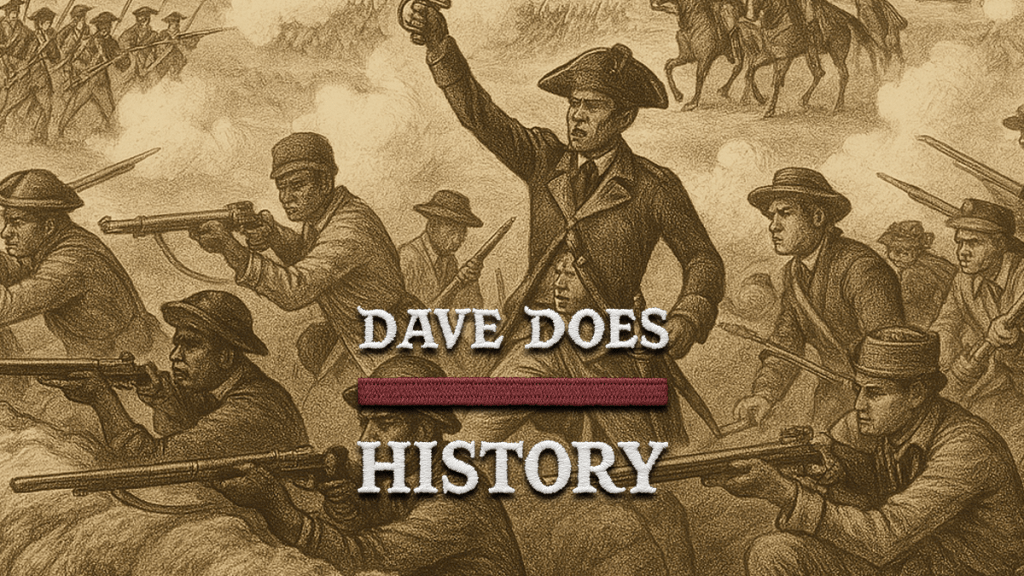
The British were not going to let him leave quietly. On August 29, as Sullivan’s men held their lines north of Newport, Pigot sent out his troops to strike. The American left, anchored near Quaker Hill, faced British troops under General Francis Smith. Henry Brockholst Livingston’s men resisted at first but were pushed back until John Glover’s Massachusetts men dug in behind stone walls and stopped the advance. On the right, the fight was fiercer. Hessian General Lossberg hurled 1,500 troops at the American positions near Turkey Hill, where Nathanael Greene commanded. At the forefront stood the 1st Rhode Island Regiment. Three times the Hessians stormed their redoubt. Three times the regiment threw them back with musket fire and bayonet. Their stand became the stuff of legend, a rare moment when America’s experiment in equality made itself known on the battlefield.
British ships tried to help by sailing close and firing into Greene’s flank, but American artillery pounded them so hard that they pulled back. Greene counterattacked, pushing Lossberg’s men off the slopes, though the Hessians soon regained their ground. By midafternoon the battle sputtered to an end. Both sides had fought hard, both had suffered, and neither had achieved a decisive breakthrough.
Casualty figures tell only part of the story. The British lost perhaps 260 men killed, wounded, or missing. The Americans lost around 200. The numbers were not staggering, but the psychological toll was heavy. The Americans had fought bravely, but without French support the larger goal of retaking Newport was impossible. That night, Sullivan’s men withdrew in good order to the mainland. The British still held Newport, and Pigot claimed the field, though his failure to destroy or trap Sullivan earned him sharp criticism from Clinton.
What followed was a storm of another kind, a political one. Sullivan’s angry words about the French reached d’Estaing, who was already defensive about his decision. The alliance itself seemed threatened. Cooler heads prevailed. Congress and Washington urged restraint, reminding the generals that France’s friendship was too important to squander over wounded pride. Lafayette rode to Boston to smooth things over, his youthful charm and enthusiasm doing much to patch the rift. D’Estaing, though stung by criticism, even offered to march his troops overland to aid the Americans, though the plan went nowhere. The lesson was clear: alliances are hard, especially when the partners speak different languages, have different military cultures, and are prone to suspicion.
In the end, Newport remained in British hands until October 1779, when the garrison finally withdrew as the war shifted elsewhere. Rhode Island’s economy was shattered by years of occupation. Farmers returned to burned fields, stripped orchards, and ruined homes. Yet the memory of the battle endured. It was not the victory the patriots had hoped for, but it had shown they could stand toe-to-toe with British regulars and Hessian veterans. It had also proven that Black and Native soldiers were just as capable as anyone else, something that would echo in the long fight for recognition and equality.
Today, the battlefield is marked and preserved. Butts Hill Fort still stands, earthworks shaped by men who expected to face the fury of the British army. Quaker Hill, where Glover’s men stood behind stone walls, is part of the historic landscape. The scuttled hulks of HMS Cerberus and HMS Lark still lie underwater, reminders of Pigot’s desperate measures. Fort Barton in Tiverton, the Conanicut Battery, and the Joseph Reynolds House where Lafayette once stayed all speak to the layers of history in that campaign. In 1974 the Battle of Rhode Island site was declared a National Historic Landmark, and in recent years groups like the Battle of Rhode Island Association have worked to keep its story alive.
The battle was a strange hybrid of success and failure, courage and disappointment. It showed the Americans at their best in moments of stand-up fighting, and at their worst in the collapse of militia morale and bitter words against their allies. It showed the French as both essential and unreliable, a reminder that nations act from self-interest more than noble ideals. Above all, it marked a moment when the Revolution nearly tore itself apart from the inside, yet somehow held together long enough to fight another day.
History does not always hand us clean victories. Sometimes it gives us muddled outcomes that test our patience and faith. The Battle of Rhode Island was one of those. But even in the muddle, there were flashes of brilliance, like the 1st Rhode Island Regiment standing firm against wave after wave of Hessians, or Lafayette racing to patch up an alliance that was worth more than any single battle. Those moments matter. They remind us that independence was not won by perfection but by perseverance, by men and women who kept going even when plans fell apart and storms wrecked fleets. That is the real lesson of Rhode Island, a battle that ended with retreat but carried within it the stubborn spirit that would one day make retreat impossible.



 DAVE DOES HISTORY
Leave a comment