
What connects a beheaded English king, a Catholic heir, a Dutch invasion, and Thomas Jefferson’s most famous sentence? That is where we went this week on Dave Does History with Bill Mick. The line from the Declaration of Independence, “a long train of abuses and usurpations,” is not just lofty rhetoric. It is borrowed straight out of England’s own revolution, weaponized by Jefferson to indict George III and remind Parliament of its own past.
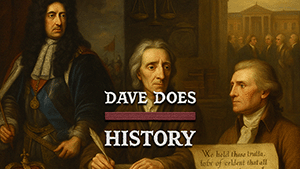
We started in a surprising place: the movie National Treasure. Nicolas Cage may have been wrong to justify stealing the Declaration, but he was right about the importance of that line. Jefferson was not writing in a vacuum. He was steeped in a century of English constitutional crises. To understand the Declaration, you have to roll the clock back to the mid-1600s and the English Civil War. King Charles I went from five foot six to four foot eight, literally, when Parliament ended his reign with an axe. That bloody lesson laid the groundwork for arguments over monarchy, parliament, and the rights of the people.
Enter Sir Robert Filmer, who defended absolute monarchy with biblical authority, claiming kings inherited power directly from Adam. His book Patriarcha gave monarchists an intellectual fig leaf: to obey the king was to obey God. For a while, it worked. But the tide turned with Charles II (Chuck Squared, as I call him) and his openly Catholic brother James II. Between rotten boroughs, the Popish Plot, and standing armies, England felt itself slipping toward Catholic absolutism. When James II had a Catholic son, the nation revolted again. Parliament invited William and Mary to take the throne in 1688, launching the Glorious Revolution. And it was here that John Locke wrote his Second Treatise of Government, dismantling Filmer’s divine-right fantasies and declaring that all men are born free, equal, and governed only by consent.
Fast forward to Philadelphia, 1776. Jefferson knew Locke’s words, and so did Adams and Franklin. When Jefferson wrote of a “long train of abuses,” he was echoing Parliament’s own justification for removing the Stuarts. He was not inventing revolution; he was reminding the world that Americans were simply walking the same path the English had walked before. By lifting that language, Jefferson forced Parliament to look in the mirror. Either they believed in the principles they once shouted, or they had become hypocrites. Tyranny was tyranny, whether it wore a crown in 1688 or 1776.
This week’s episode pulled back the curtain on how much American independence owes to English precedent. Jefferson’s genius was not just in his philosophy. It was in turning England’s own arguments back on them. That is why the Declaration still resonates. It is not a rebellion out of thin air, but the rightful child of an older fight for liberty.

 DAVE DOES HISTORY
Leave a comment