
On the morning of August 24, 1938, an American pilot named Hugh Woods climbed into the cockpit of a Douglas DC-2 airliner at Hong Kong’s Kai Tak Airport. To him, it was just another day of ferrying passengers across war-torn China, another run for the China National Aviation Corporation. To the passengers, it was a flight of business and necessity, not of adventure. They were bound for Chungking, the wartime capital of Chiang Kai-shek’s government, a safe haven, or at least safer than the cities being pounded daily by Japanese bombers. But this particular day would be different.
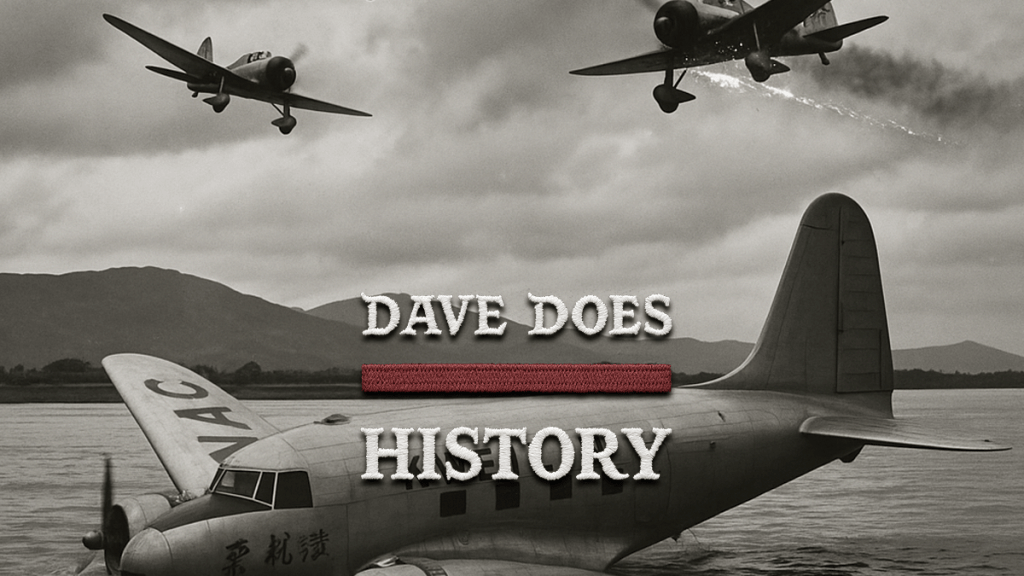
By the time the Kweilin’s engines cooled on the Pearl River outside Zhongshan, China, fifteen of the eighteen people who had boarded her in Hong Kong were dead. Most had been machine-gunned after the aircraft had already landed safely on the water. And history had been made, in the worst possible way. For this was the first time a civilian airliner had ever been deliberately shot down by hostile aircraft. It was a line crossed. Once crossed, it would never be uncrossed.
The Kweilin was a Douglas DC-2, tail number 32. She was named for the city of Guilin, but she carried the markings of the CNAC—China National Aviation Corporation. The airline was technically Chinese, but it operated with Pan American Airways support. Many of the pilots were American. The crews were a mixture of American and Chinese. Captain Hugh Woods was one of those Americans. He had flown the dangerous routes across China long enough to know that the Japanese air force was everywhere. By 1938, Japan had already occupied much of northern China. They bombed Chinese cities with impunity. They strafed roads and rivers. They claimed it was all about fighting Chinese soldiers, but everyone in China knew the truth: civilians were targets too.
Still, civilian airlines operated. They had to. China’s cities and officials needed connection, commerce, and communications. That morning, fourteen passengers climbed aboard with Woods and his three crewmates: copilot Lieu Chung-chuan, radio operator Joe Loh, and a steward. At 8:04 a.m., Woods pushed the throttles forward and lifted the Kweilin into the humid Hong Kong air. The route was straightforward: Hong Kong to Wuzhou, then onward to Chungking and Chengdu. For the passengers, it was routine. For Woods, routine meant keeping a sharp eye on the sky.
Climbing through 6,000 feet, Woods saw what he dreaded. Japanese fighters. Accounts differ on what exactly they were. Some say Mitsubishi A5M “Claude” monoplanes. Others describe older Nakajima biplanes fitted with pontoons. Whatever they were, Woods knew them well enough. He also knew the rules of survival. He turned back toward the British colony, hoping the fighters would not pursue him into neutral territory. When they disappeared, he cautiously turned again to resume course. But they returned, and this time they meant business. The fighters closed in. There could be no mistake. This was no warning pass, no feigned interception. They opened fire.
The Kweilin was an unarmed passenger plane, with nothing more dangerous aboard than mailbags and a few briefcases. Woods shoved the control column forward, sending the DC-2 into a dive. He threw the aircraft into a tight spiral, trying to shake the attackers, hunting for cloud cover or water. He chose the Pearl River. Against impossible odds, he succeeded. Woods leveled off just above the water, cut the switches, feathered the props, and brought the big airliner down in a river landing smooth enough that everyone walked away unhurt. The Kweilin bobbed on the current. Woods exhaled. For a brief moment, it looked like he’d pulled it off. But then the Japanese fighters returned.
What followed turned the incident from tragedy to atrocity. The Kweilin was a civilian aircraft, floating harmlessly, passengers alive, waiting to be rescued. The Japanese fighters circled, then strafed. Again and again, they dove on the floating airliner, raking it with machine-gun fire. Woods shouted for passengers to get into the water. He ordered his crew to help. He himself dived into the Pearl River, striking out for a sampan on the shore. Behind him, the airliner was riddled with holes. Nine of the dead bore multiple bullet wounds, one victim hit thirteen times. Among the victims were women, a five-year-old boy, and a baby. Chinese bankers, government officials, and diplomats were killed. Hu Yun, chairman of the Bank of Communications, Xu Xinliu of the National Commercial Bank, and Central Bank executive Wang Yumei—all lost. Dr. Liu Chung-chieh, a former Chinese minister to Berlin, died as well. Only three people survived: Captain Woods, radio operator Joe Loh, and a single passenger named Li Chai-sung. The Kweilin herself drifted downstream, slowly sinking, until only a wing and the tail were visible above the surface.
The question was asked at once: why? Why this flight, this aircraft, these people? The most likely answer was political assassination. It was widely believed the Japanese thought Sun Fo, the son of China’s founding father Sun Yat-sen, was aboard. Sun Fo was a high-profile political figure, and eliminating him would have been a coup. His secretary had even announced that Sun Fo would be on the Kweilin. In truth, Sun Fo had taken another flight. If it was an assassination attempt, the Japanese pilots had murdered fifteen people for nothing. Officially, Japan denied everything. Their government claimed the fighters had merely “chased” the Kweilin because it behaved suspiciously. They refused to accept responsibility for civilian aircraft operating in what they deemed a war zone. Yet Japanese press outlets privately admitted the truth. A Hong Kong–based Japanese-language newspaper bluntly stated that the “wild eagles” had sought Sun Fo.
The outrage was immediate. The Kweilin Incident was unlike anything seen before. Civilians had died in war zones before, but never like this, never aboard a clearly marked passenger airliner. In the United States, newsreels carried the story. One titled “Kweilin Tragedy” featured an interview with Woods and showed footage of the bullet-riddled wreck, scattered mailbags, and mutilated bodies. It played to sellout crowds in Hong Kong. American public opinion, already souring on Japan, hardened further. Yet outrage did not translate into action. The U.S. government expressed sympathy but did not intervene. China called for justice, but justice never came. For the Japanese, it was business as usual. For everyone else, it was a grim new reality: civilian aircraft were no longer safe in wartime skies.
You might think the Kweilin’s story ended at the bottom of the Pearl River. But in one of those strange twists history seems to love, the aircraft was salvaged. Pulled from the water, rebuilt, and refurbished, she was renamed Chungking and given a new registration number, CNAC 39. Her old name was avoided, lest passengers balk at flying aboard a plane with such a cursed history. The Chungking flew again, but her reprieve would not last.
On October 29, 1940, American pilot Walter “Foxie” Kent landed the Chungking at Changyi Airfield in Yunnan. Unbeknownst to him, Japanese fighters had just raided the strip. As the aircraft rolled to a stop, they returned. The first burst of gunfire struck the cockpit and killed Kent instantly. By the time the attack ended, nine more were dead, including passengers and crew. The Chungking burned to slag. This time, she would never fly again. By 1940, such attacks were no longer unprecedented. The world had grown grimly accustomed to civilians being targeted from the air. But for those who remembered the Kweilin, the irony was bitter: the same aircraft, the same kind of attack, two years apart.
The Kweilin Incident remains a turning point in aviation history. Before August 24, 1938, it was assumed that civilian airliners, clearly marked and non-threatening, would be spared. After the Kweilin, that assumption was dead. The precedent did not fade. Decades later, the world would again gasp in horror when Korean Air 007 was shot down by the Soviets in 1983, when the U.S. Navy mistakenly destroyed Iran Air Flight 655 in 1988, and when Malaysia Airlines Flight 17 was brought down over Ukraine in 2014. Each time, the comparisons were drawn back to that first time, when the Kweilin was hunted from the sky. For the passengers aboard, the Kweilin Incident was the end. For the world, it was the beginning of a new and darker chapter in the history of flight.
Captain Hugh Woods survived, but he carried the memories of that day for the rest of his life. He had landed his aircraft safely, a feat of skill and courage, only to watch helplessly as his passengers were slaughtered. He swam through machine-gun fire, dragging himself to safety, knowing most of the people he was responsible for were dead behind him. That is the tragedy of the Kweilin. Not just that civilians were killed, but that they had been saved once already, only to be executed where they floated.
August 24, 1938, should have been just another day in the routine of a commercial airline. Instead, it became a date that marked the beginning of a terrible reality: in modern war, no one is truly safe.



 DAVE DOES HISTORY
Leave a comment