
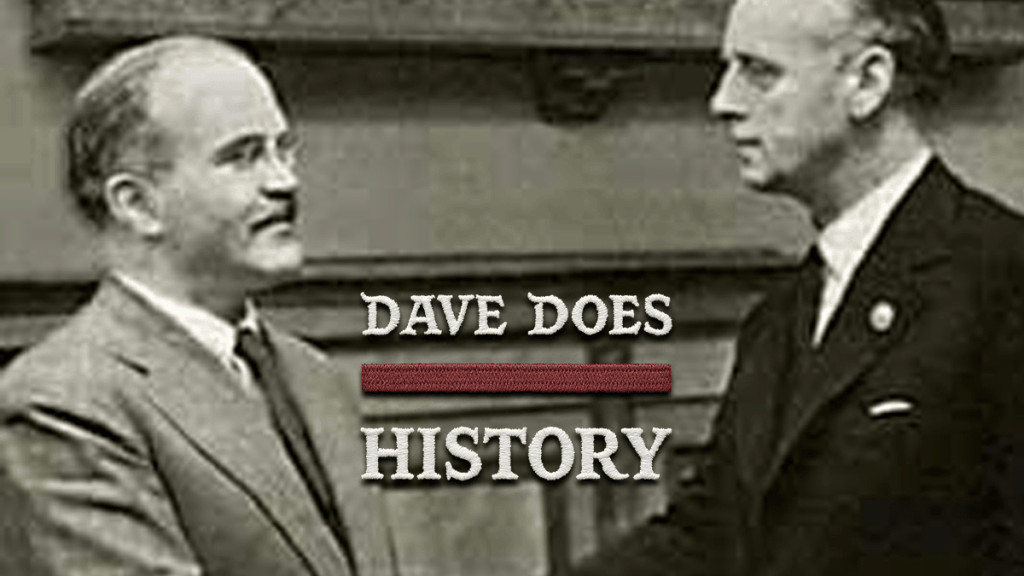
On the evening of August 23, 1939, a photograph was taken inside the Kremlin that, to this day, ought to make the blood run cold. At the table sat Joachim von Ribbentrop, Hitler’s foreign minister, pen in hand, and Vyacheslav Molotov, Stalin’s trusted diplomat. Hovering behind them with an oddly satisfied grin was Joseph Stalin. They had just signed the Molotov-Ribbentrop Pact, a document whose public terms promised peace between Germany and the Soviet Union, but whose secret clauses carved up Eastern Europe like a butcher portioning a carcass. In that moment, two regimes that loathed each other shook hands, and the fuse for the Second World War was lit. For too long, history has let Stalin hide in Hitler’s shadow. The Soviet Union was not merely a victim of Hitler’s later betrayal. It was an accomplice in starting the war and in enabling the Holocaust that followed in Poland.
The Soviet Union’s role in this pact was not the product of naiveté or inevitability. Stalin had choices, and he made them with ruthless calculation. Throughout the 1930s, Moscow had danced uneasily with Britain and France, trying to arrange a collective security agreement against Hitler. But Stalin had watched as Britain and France appeased the German dictator at Munich in 1938, selling out Czechoslovakia without even inviting the Soviets to the table. He saw Western hesitation, deep anti-communist suspicion, and a willingness to sacrifice Eastern Europe if it kept Hitler pointed eastward. That convinced him the democracies were unreliable partners. At the same time, Stalin’s own house was in chaos. His purges between 1936 and 1939 had gutted the Red Army. The most reliable estimates suggest half of his officer corps was shot or imprisoned, including Marshal Tukhachevsky, perhaps the brightest military mind the Soviets possessed. Those left in uniform were described as inexperienced, disorganized, and demoralized. Foreign observers doubted the Red Army could even hold the line against a German onslaught. Stalin knew it too. What he needed most was time, and Hitler was offering it.
The dismissal of Maxim Litvinov in May 1939, a Jewish foreign minister who still pushed for alliances with Britain and France, was not a minor reshuffling. It was a signal. Stalin replaced him with Molotov, a loyal yes-man, and opened the door to Berlin. As Stalin told his inner circle, it was in the Soviet Union’s interest for Germany and the West to fight each other, and to fight for as long as possible, until both were exhausted. This was not the posture of a leader striving to prevent catastrophe. It was the strategy of one determined to benefit from it.
The Molotov-Ribbentrop Pact contained two layers. The public layer was bland enough: a promise of ten years of peace, a vow not to join any coalition hostile to the other, and a pledge to resolve disputes through diplomacy. It looked like a defensive arrangement, a guarantee that the Soviet Union would not be dragged into Hitler’s coming storm. But the second layer, the secret protocol, told the real story. Poland was to be divided. Germany would take the west, the Soviets the east. The Baltic states of Latvia, Estonia, and later Lithuania were consigned to Soviet control, as was Bessarabia, then part of Romania. Finland was listed in Stalin’s sphere. In other words, Hitler and Stalin agreed to dismember sovereign nations and absorb them into their empires. It was a cynical division of spoils dressed up as diplomacy.

For Hitler, the benefits were immediate. He could now invade Poland without fearing a Soviet response. No two-front war. No repeat of 1914. For Stalin, the pact meant breathing room to rebuild his battered army and extend his reach into Eastern Europe. Both sides drank champagne that night, with Stalin toasting Hitler as a man of peace. The world was stunned. A week later, German troops stormed across the Polish border.
On September 1, 1939, World War II officially began with the German invasion of Poland. The Luftwaffe bombed cities and rail lines. Panzer divisions sliced through Polish defenses. Britain and France declared war on Germany within days, though their response was timid and half-hearted. For two weeks, Poles fought desperately, believing they faced a single enemy. Then came the knife in the back. On September 17, the Red Army rolled in from the east, citing the need to protect Ukrainians and Belarusians. In reality, it was executing the pact’s secret protocol. German and Soviet troops met in the middle. At Brest-Litovsk, they even staged a joint parade. Photographs show Nazi and Soviet officers standing shoulder to shoulder, smiling as Poland ceased to exist. On September 29, the two powers formalized their partition with the Boundary and Friendship Treaty. Stalin had helped erase a nation, and he did it willingly.
This collaboration went far beyond maps and parades. Stalin supplied Hitler with what he needed to fight. In February 1940, a commercial agreement delivered over a million tons of grain, nearly a million tons of oil, hundreds of thousands of tons of cotton, and vital minerals from the Soviet Union to Germany. These shipments kept the Nazi war machine humming at a time when Germany lacked the resources to sustain a long war. Stalin also granted the Germans access to Basis Nord, a secret submarine base on Soviet soil, and allowed German ships to use the Northern Sea Route across the Arctic, bypassing British blockades. These were not neutral acts. They were acts of partnership, enabling Hitler’s conquest of Denmark, Norway, France, and the Low Countries. Every bomb dropped on London in 1940 was fueled, in part, by Soviet oil.
Meanwhile, in Poland, the consequences of the pact were monstrous. Under German occupation in the west and center, atrocities began immediately. Massacres of civilians erupted within days. In over thirty towns and villages, German units executed Poles and Jews. The plan known as Intelligenzaktion targeted the Polish elite—teachers, priests, officers, politicians—for extermination. By the winter of 1939, Jews were being forced into ghettos, cut off from food and medicine. Thousands died from hunger and disease. These ghettos became the testing grounds for what would evolve into the Final Solution. Auschwitz, Treblinka, Majdanek—these camps were all built on land seized because Stalin had agreed to let Hitler take it. Without the pact, the machinery of the Holocaust in Poland could not have operated as it did.
In the Soviet-occupied east, the picture was no less grim. The NKVD rounded up hundreds of thousands of Poles and deported them to Siberia and Central Asia. Estimates range from 350,000 to 1.5 million. Many never returned. Between a quarter million and a million perished in exile, victims of starvation, cold, and overwork. In the Katyn Forest in 1940, Soviet officers executed more than 22,000 Polish military officers, policemen, and intellectuals, burying them in mass graves. For decades, Moscow denied responsibility, blaming the Nazis, until documents proved otherwise. The Soviets also annexed the Baltic states, occupied Bessarabia, and attacked Finland, demanding territory and punishing resistance with brutal force. Wherever the Red Army advanced, repression followed.
The Molotov-Ribbentrop Pact was not a shield against Hitler. It was a deal with him. It bought Stalin time, but it also gave Hitler the freedom to ignite a world war. Soviet resources kept Germany afloat in its first campaigns. Soviet soldiers marched alongside Germans in dividing Poland. Soviet terror in the east mirrored German terror in the west. Together, they ensured that Poland was crushed and that millions of Jews and Poles would be trapped in a nightmare from which few emerged.
When Hitler turned on Stalin in June 1941 with Operation Barbarossa, the pact collapsed in blood. Stalin, who had ignored warnings from his own spies and from Western governments, was stunned. The Soviets then recast themselves as victims, joining the Allied cause. After the war, Soviet propaganda insisted the pact was forced upon them, a temporary expedient to buy time. The secret protocols, revealed at Nuremberg, told a different story. For decades, Moscow denied they even existed. Only in 1989 did the Soviet Union finally admit the truth.
The long shadow of August 23, 1939, lingers. Poland remembers being carved up, abandoned to two predators. The Baltic states remember their annexation. Jews remember that the ghettos and camps of Poland were made possible by the pact that gave Hitler free rein. History cannot erase Hitler’s ultimate responsibility for the Holocaust, but neither should it excuse Stalin’s. He was not an unwitting victim of German aggression. He was a willing partner in unleashing the catastrophe.
The Molotov-Ribbentrop Pact deserves to be remembered for what it was: the moment when two totalitarian regimes joined hands to plunge the world into war. Stalin believed he was playing a clever game of realpolitik, buying time and territory while his enemies destroyed each other. In the end, he succeeded only in unleashing forces that killed tens of millions, Jews and Poles first among them. The lesson of that pact is brutal but clear. When leaders choose expediency over morality, when they bargain away the lives of others for temporary gain, the result is not peace. It is catastrophe. And on that summer night in Moscow, Stalin chose catastrophe.


 DAVE DOES HISTORY
Leave a comment