
By the summer of 1777, the British believed they had found the key to ending the rebellion. The idea was simple in theory but treacherous in execution: isolate New England from the rest of the colonies by seizing control of the Hudson River Valley. General John Burgoyne’s army would move south from Canada, while two other British forces would converge from the west and the south. If the plan worked, New England would be cut off and left to wither on the vine.

The plan was already fraying by mid-summer. The western column under Barry St. Leger had been stopped at Fort Stanwix. The southern column under General William Howe never came at all. That left Burgoyne pushing into New York with 8,000 men and a supply situation that worsened by the day.
To keep his army moving, Burgoyne ordered Lieutenant Colonel Friedrich Baum, a German officer serving with Brunswick dragoons, to lead a foraging mission toward Bennington. Burgoyne believed the town was defended by only a small, demoralized militia. In truth, the Americans had been preparing for this.
The citizens of the New Hampshire Grants, the territory we now call Vermont, had appealed to nearby states for help. New Hampshire responded by promoting John Stark to brigadier general and authorizing him to raise a militia. Stark was a seasoned fighter with service at Bunker Hill, Trenton, and Princeton. In just six days he had 1,500 men ready to march.
In Manchester, Vermont, Stark joined forces with Colonel Seth Warner and his Green Mountain Boys, survivors of the hard-fought battle at Hubbardton. Massachusetts militia and local volunteers joined them. By mid-August, the American force numbered roughly 2,000 to 2,500 men.
Baum’s detachment, by contrast, was a mixed force of about 800. His core troops were Brunswick dragoons, supported by British sharpshooters, Loyalist militia, Canadian irregulars, and Indigenous warriors. Baum had fought in Europe, but his battlefield command experience was thin compared to Stark’s years of frontier and Revolutionary service.
On August 14, 1777, American militia skirmished with Baum’s men near Bennington. Heavy rain the following day halted both sides, giving time for reinforcements to arrive. Burgoyne sent Lieutenant Colonel Heinrich von Breymann with 550 to 650 men to support Baum. Stark called for more troops, and Warner’s Green Mountain Boys began moving toward the fight.
During the lull, American spies posing as Loyalists entered Baum’s camp. They took the loyalty oath, received identifying cards, and learned valuable details about the German positions. Because many of Baum’s troops spoke no English, they were simply told not to fire on men carrying those cards.
On the morning of the 16th, Stark rallied his men, telling them they would fight “for their natural rights as Englishmen.” His plan was to hit the enemy from multiple directions at once. The attack began with American units closing in on Baum’s position from several sides. The Loyalist and Indigenous contingents melted away early in the fight, but the German and British troops held their ground for two hours until their ammunition was gone.
In a last effort to break free, Baum’s dismounted dragoons charged with sabers. The attack failed. Baum was mortally wounded, and his surviving men surrendered.
As the Americans began collecting supplies and prisoners, Breymann’s reinforcements appeared. Stark’s men, spread out and disorganized, struggled to hold the line. At that critical moment, Warner and the Green Mountain Boys arrived. The fresh troops counterattacked, forcing Breymann to retreat and abandon his artillery.
The Americans lost about 30 killed and 40 to 42 wounded. The British and their allies lost more than 200 killed, with roughly 700 captured. All of Baum’s supplies, weapons, and artillery fell into American hands. The victory had immediate and far-reaching consequences.
Burgoyne’s already thin army was now smaller by nearly 1,000 men. More importantly, his Indigenous allies, unimpressed by the fight and concerned about their own security, began leaving the campaign. Without them, Burgoyne lost vital scouts and skirmishers. Two months later, at Saratoga, Burgoyne would surrender his army.
The win at Bennington also sent a surge of confidence through the Patriot cause. News of the victory helped convince France that the Americans could hold their own in the field. French recognition and open alliance would follow in 1778, bringing troops, supplies, and naval power into the war.
Today, Vermont remembers August 16 as Bennington Battle Day, a state holiday honoring the men who stood their ground in 1777. The battle actually took place in present-day New York, but the British objective had been the military stores at Bennington. Each year, historical reenactments, ceremonies, and gatherings at the Bennington Battle Monument keep the memory alive.
The Battle of Bennington was more than a local skirmish over supplies. It was a blow to Burgoyne’s campaign, a rallying point for the American cause, and a key step toward the decisive victory at Saratoga. In a war often fought on grand fields and in major cities, it was a rural fight in the hills of New England that helped turn the tide toward independence.



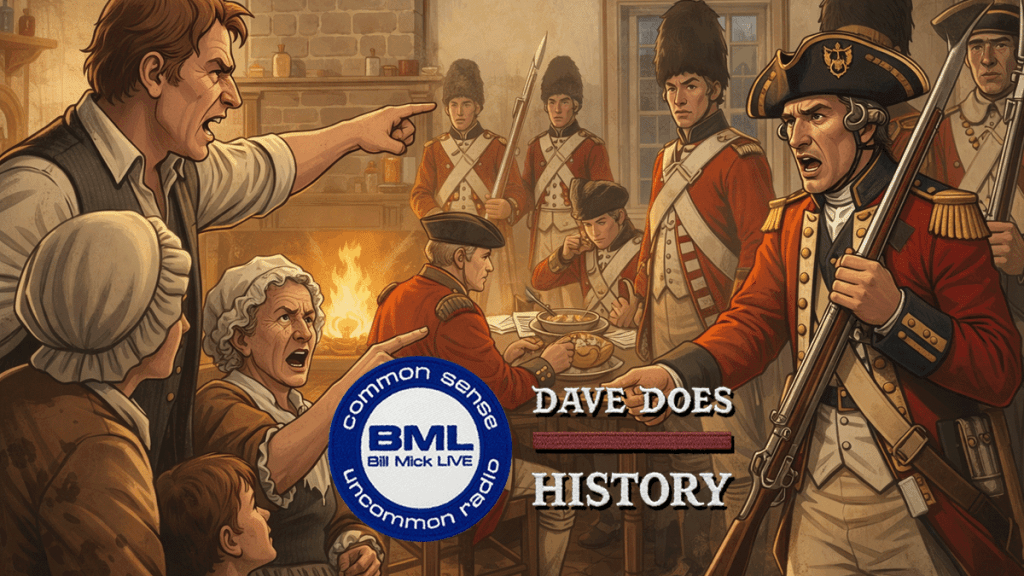
 DAVE DOES HISTORY
Leave a comment