
Amelia Earhart’s name still floats like a wisp of jet stream across the skies of history. Not because of how her story ends, but because of the soaring way she lived it. She wasn’t trying to be a hero. She just had a stubborn fascination with the sky and a remarkable knack for making it hers. This is the story of the barnstormer from Kansas who rewrote what was possible for women and pilots alike, then vanished into legend.
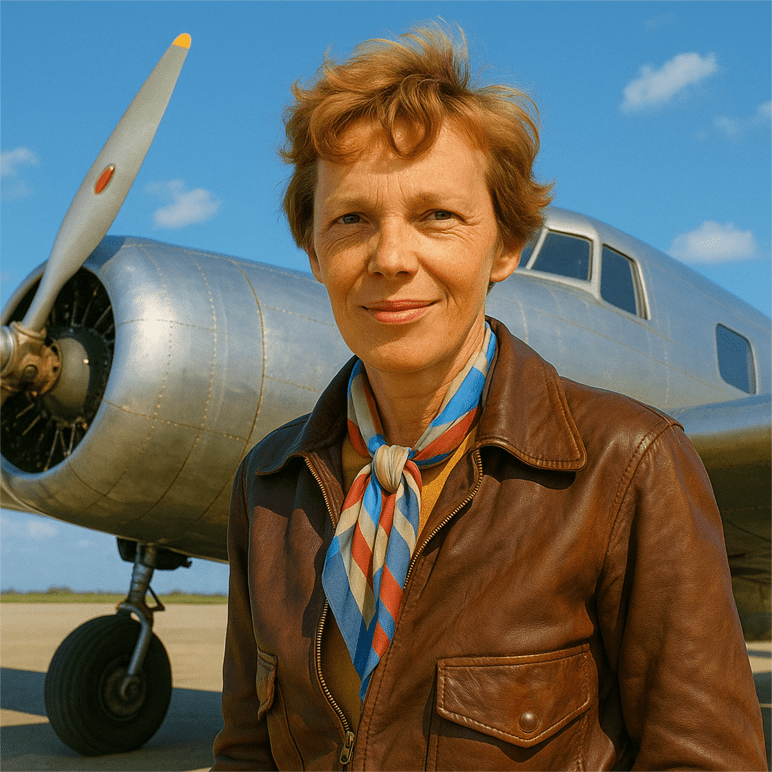
Born July 24, 1897 in Atchison, Kansas, Amelia wasn’t the kind of child who played quietly. She climbed trees, built ramps off tool sheds, and preferred boots to dolls. Her early life was scattered across various cities, her family pushed and pulled by her father’s job and alcoholism. Despite these shifts, she remained curious and resolute. That sense of self would never leave her. During World War I, while helping wounded soldiers in Toronto as a nurse’s aide, she first heard the stories of pilots. They struck a chord in her that would echo for decades.
In 1920, Amelia took a short ride in a plane over Long Beach, California. Ten minutes in the sky, and she was hooked. Not as a pastime, but as a calling. She took lessons from Neta Snook, an experienced female pilot, and saved enough money working odd jobs to buy a yellow Kinner Airster biplane. She named it “The Canary.” By 1922, she had flown it to 14,000 feet, setting an altitude record for women. The skies weren’t crowded with female flyers at that time. Earhart stood out not just because she was one of the few, but because she never acted like she didn’t belong.
In 1928, a group of backers including George Palmer Putnam came looking for the “right sort of girl” to fly across the Atlantic. Amelia agreed to the trip but insisted on more than being a passenger. She crossed the ocean aboard the Friendship, earning international fame, even if she didn’t get to touch the controls much. She returned to a ticker-tape parade in New York and a reception at the White House. America had its first true “aviatrix,” and she embraced the spotlight, using it to encourage women to pursue their own ambitions.
But fame wasn’t enough. In 1932, she became the first woman to fly solo across the Atlantic, battling weather and mechanical issues before landing in a pasture in Ireland. That same year, she published her second book and kept flying. More solo flights followed. In 1935, she took off from Hawaii and landed in California. No woman, or man for that matter, had done that solo before. Later, she flew from Los Angeles to Mexico City.
She joined Purdue University as a career counselor for women and used her influence to push for female empowerment in fields that rarely welcomed it. She co-founded the Ninety-Nines, an organization for women pilots that still exists today. She even launched a line of functional, stylish clothing designed for “the active woman.” Her style, her grit, her humility. They blended into something magnetic.
Amelia had always looked outward. The earth had grown familiar. The final challenge she eyed was the whole world. In 1937, she set out to fly around it with Fred Noonan as her navigator. They traveled 22,000 miles in a Lockheed Electra, crossing continents and oceans. By late June, they reached Lae, New Guinea. The next stretch, over 2,500 miles of open Pacific to Howland Island, would be the most difficult. It was July 2. They took off and were never seen again.
Radio contact with the Coast Guard cutter Itasca confirmed they were close, but couldn’t locate the tiny island. Her final transmission suggested she was running low on fuel. Then, silence. No wreckage. No parachutes. Just the void.
Theories abounded. Some say the plane crashed and sank. Others claim the Japanese captured her. But the most compelling to me is the Nikumaroro theory. It’s logical and rooted in real signals, artifacts, and geography. Gardner Island, now called Nikumaroro, lies south of Howland. Radio transmissions thought to be from Earhart continued for days after her disappearance. Debris matching the Electra’s materials was later found. The island’s reef could have served as a landing strip. They may have survived for a time, sending signals until the tide pulled the plane under.
Nothing has ever been proven conclusively. But the mystery doesn’t overshadow the mission. Amelia Earhart changed aviation, and she changed expectations. For pilots, for women, for everyone who ever wondered if it was okay to want more. Her name appears on airfields, awards, even a crater on the moon.
And while we may never find her plane, we still find her spirit in the clear resolve of someone who dared to try.
She flew until there was no sky left.




 DAVE DOES HISTORY
Leave a comment