
Before sunrise on July 19, 1845, Lower Manhattan stirred under the weight of another blistering summer. Most of the city slept, unaware that a moment of carelessness or perhaps a faulty flame in a whale oil shop would turn calm into catastrophe. The fire began in the early hours inside J.L. Van Doren’s candle and whale oil business at 34 New Street. A single blaze, born in a building filled with some of the most flammable materials imaginable, found plenty to feed on. Within minutes, flames spilled from building to building, hopping rooftops and crawling down alleys with frightening speed.
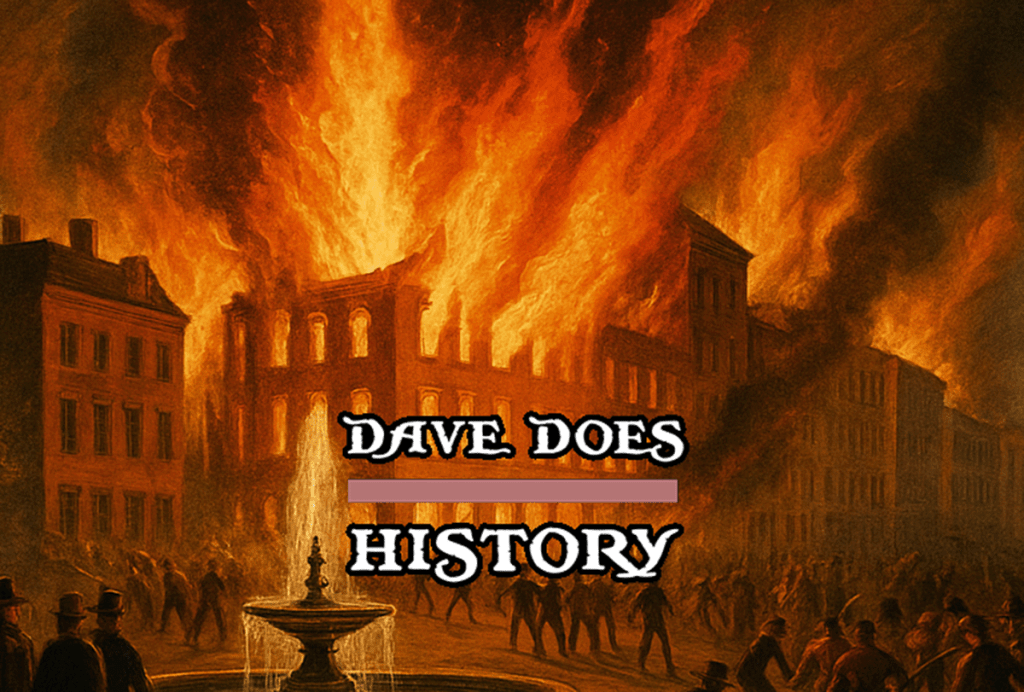
The City Hall bell rang out just after 3 a.m., rousing the volunteers of the Fire Department of New York, a group that still served without pay, relying more on grit and camaraderie than equipment or coordination. Chief Engineer Cornelius Anderson rushed to the scene. Retired firemen and crews from as far away as Newark, Williamsburg, and Brooklyn joined the effort. For all their heart, they faced a beast they could barely touch.
About an hour into the fight, the fire reached a warehouse owned by Crocker and Warren at 38 Broad Street. It wasn’t just any warehouse. Inside were barrels of saltpeter, a key ingredient in making gunpowder. Fire doesn’t need an invitation to wreak havoc, and this was more than a warm welcome. Flames reached the storage area and set off what witnesses would later describe as a cannon-like series of eruptions. The first explosion tore through buildings, splintered facades, and sent masonry flying through the air. A blast wave hurled bricks into Beaver Street and knocked bystanders off their feet. Some said the sound was heard across the harbor in Sandy Hook.
Engine Company 22 had been stationed near the warehouse. They had managed to get a hose line inside, dragging it up the staircase to try and douse the flames from within. Black smoke poured down the stairs like a vengeful spirit. Foreman Garrett B. Lane, sensing the danger, ordered his men out. Fireman Francis Hart Jr. barely escaped by climbing to the roof and jumping his way across the nearby buildings. Five minutes later, the warehouse blew sky high. Hart’s survival was miraculous. Others were not so lucky. Augustus Cowdrey of Engine Company 42 was thrown by the second explosion and never seen again. His crew searched the rubble for days. His name now rests on a firefighter’s memorial in Trinity Churchyard, etched in granite so the city never forgets.
The fire raged for over ten hours. By the time the last flames died, 345 buildings had been reduced to char and ruin. Thirty people were dead. Property losses climbed into the millions. The blast had flattened most of Broad Street and its surroundings. Flames reached as far as Bowling Green. The city’s financial heart had been gutted.
Looting swept through the area as soon as it became clear the fire was unstoppable. Thieves pretended to help rescue goods from homes and shops, only to vanish into the smoke with stolen valuables. Two elderly women were conned out of everything they owned by smooth-talking young men who offered to help carry their things. Tragedy has always had a way of bringing out both the noblest and the worst in people.
Speculation ran wild in the days that followed. Many believed Crocker and Warren had illegally stored gunpowder along with their saltpeter. The city jailed them while the investigation dragged on. Some pointed fingers at the gasworks down the street. Chief Anderson made it clear. The explosion had happened long before the fire reached the gas house. In the end, no evidence of gunpowder was ever found, and the charges quietly faded.
As devastating as it was, the fire also proved something. Back in 1815, the city had banned wooden buildings in the most congested parts of Manhattan. The 1835 fire had forced further reforms. This time, those changes paid off. As the flames reached neighborhoods rebuilt in brick, stone, and iron, the fire stalled. Buildings constructed under the newer codes stood strong.
Another key to survival that day was the Croton Aqueduct. Completed in 1842, it had only recently begun delivering fresh water to the city. It wasn’t perfect, but it was enough. Without that steady supply of water, the fire might have turned all of Manhattan south of Wall Street into a graveyard of smoldering ruins.
The fire also pushed the city to reconsider how it handled emergencies. The volunteer system had its limits. Too many men with too little coordination and too few resources. The city formed the Exempt Fireman’s Company, made up of veteran volunteers who were no longer required to serve in the militia or on juries. It was a stopgap, but it was something. Twenty years later, the city would take the final step and form a professional, paid fire department. That fire, as horrible as it was, lit the way forward.
Today, most New Yorkers walk through the Financial District with no clue that it once burned to the ground. Trinity Church still stands. If you look closely in the graveyard, you’ll find the tall obelisk that bears the names of those who died trying to stop the fire. Cowdrey is there. So are many others.
This wasn’t just a fire. It was a reckoning. A city that had been warned twice before had finally started to learn. The pain of 1845 became the blueprint for safety. The loss became the seed of reform. In the end, the Great Fire of 1845 didn’t just burn buildings. It cleared the way for a safer, stronger New York.



 DAVE DOES HISTORY
Leave a comment