
Today on Dave Does History, we’re cracking open one of the dustier chapters of the American presidency—one that begins not with fireworks and fanfare, but with cherries and spoiled milk. When President Zachary Taylor died unexpectedly on July 9, 1850, the nation turned to a man most Americans barely knew: Vice President Millard Fillmore. What followed was a presidency built on compromise, cautious pragmatism, and just enough action to hold the country together—for a while. Fillmore didn’t make grand speeches or lead men into battle. He was, by many accounts, a decent man in an indecent time. In today’s episode, we’ll explore Fillmore’s rise from a log cabin in upstate New York to the highest office in the land, the political drama that defined his presidency, and why history has been, let’s say, less than kind to his legacy. Strap in. It’s time to meet the most forgotten man ever to save a Union.
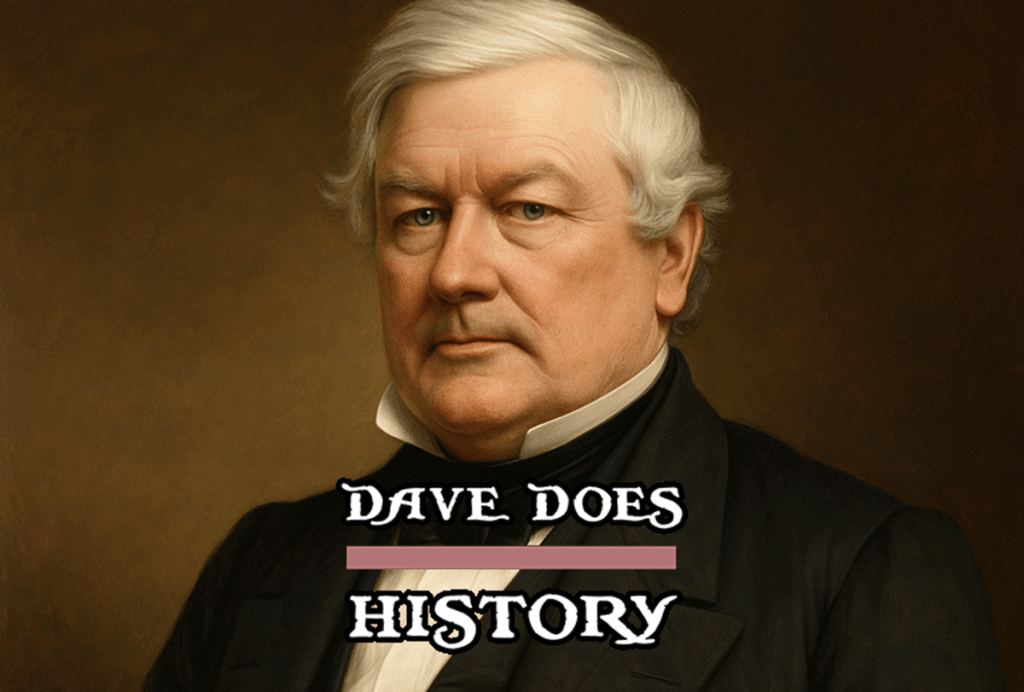
On July 10, 1850, a quiet, serious man named Millard Fillmore took the oath of office as the 13th President of the United States. It wasn’t the grand celebration he might have imagined when he joined the ticket two years earlier. He was sworn in before a joint session of Congress by William Cranch, the same judge who had administered the oath to John Tyler a decade earlier. Just one day before, President Zachary Taylor had died suddenly after suffering a mysterious intestinal illness. Chilled milk and cherries on a scorching Fourth of July likely did him in. The man known as “Old Rough and Ready,” the war hero who stood firm in battle, had been brought down by bad refreshments and a heatwave. Into the vacuum stepped Fillmore, quiet, unpopular with Taylor’s Cabinet, and until now more or less sidelined.
Fillmore hadn’t clawed his way to the presidency with grand speeches or battlefield glory. His was a slower rise, built on methodical effort and a stubborn refusal to quit. He was born in a log cabin in New York’s Finger Lakes region in 1800, the second of eight children. His family was dirt poor. Fillmore was apprenticed to a cloth maker at 15, barely educated, and only found his footing when he started borrowing books from a circulating library. He eventually studied law, worked odd jobs to buy out his apprenticeship, and scraped his way into the profession. Along the way, he fell in love with a redheaded classmate named Abigail Powers, who became his wife and his strongest supporter.
Fillmore entered politics through the Anti-Masonic Party, a strange but very real force in 1820s New York. He later joined the Whigs, aligned himself with Thurlow Weed and Henry Clay, and served in the state legislature and then in Congress. He was not flashy. He was never the first name on anyone’s list. But he was competent, organized, and able to broker deals. As chair of the House Ways and Means Committee, he played a key role in crafting the protective Tariff of 1842. In New York, he served as the state’s first elected comptroller and was praised for stabilizing the banking system and expanding the Erie Canal.
In 1848, the Whigs turned to war hero Zachary Taylor for their presidential nominee, hoping to capture votes with military charisma. But Taylor was a Louisiana slaveholder, and that made Northern Whigs nervous. They needed someone from a free state with good Whig credentials. Fillmore, ever the reliable workhorse, got the nod for vice president. He campaigned quietly, made no speeches, and avoided controversy. When the Taylor-Fillmore ticket won the election, Fillmore hoped to have a say in the new administration. That dream was dashed almost immediately. Taylor and his inner circle froze him out, preferring to take advice from Weed and Senator William H. Seward. Fillmore was cut off from patronage, from influence, and from power.
But he did have one job, and it turned out to be a critical one. As Vice President, Fillmore presided over the Senate at a time of bitter division. The Compromise of 1850, proposed by Clay, was meant to stave off disunion. The country was splitting at the seams over the question of slavery in the new territories acquired from Mexico. Clay’s Omnibus Bill aimed to satisfy both North and South by admitting California as a free state, organizing the Utah and New Mexico territories with no restrictions on slavery, ending the slave trade in Washington, D.C., and strengthening the Fugitive Slave Act. The debates were explosive. At one point, Senator Henry Foote of Mississippi pulled a pistol on Thomas Hart Benton of Missouri right there on the Senate floor. Fillmore, trying to maintain order, was blamed for letting it escalate. He was walking a tightrope over a bonfire.
And then Taylor died.
When Fillmore took the reins, he moved quickly. He accepted the Cabinet’s resignations and built a new team, putting Daniel Webster in as Secretary of State. That alone signaled a sharp shift in direction. Taylor had opposed the compromise. Fillmore embraced it. He worked with Senator Stephen Douglas to break up the Omnibus Bill into separate measures and used the power of the presidency to push them through. By September, the five core elements of the Compromise were law. The South got its Fugitive Slave Act. The North got California as a free state. The union, for the moment, held together.
But peace came at a price. The Fugitive Slave Act required citizens in free states to aid in the capture of runaway slaves and denied accused fugitives a trial by jury. It enraged many in the North and shattered Fillmore’s support among anti-slavery Whigs. He had once said slavery was an evil, but he believed it was protected by the Constitution and thus not a problem the federal government could solve. That view may have made sense to lawyers and legal scholars, but it didn’t hold up well in a country tilting toward war.
Fillmore’s presidency had other chapters too. He expanded American influence in the Pacific by sending Commodore Matthew Perry to open trade with Japan. He resisted French ambitions in Hawaii and disavowed unsanctioned American attempts to seize Cuba. On the domestic front, he approved treaties with Native tribes that pushed them onto reservations and presided over further westward expansion. These moves aligned with the mindset of the time but led to suffering and destruction among Native peoples.
By 1852, the Whig Party was in shambles. Fillmore wanted the nomination, but his own party couldn’t decide between him and two others. The Whigs lost the election, and Fillmore found himself politically homeless. He ran again in 1856 under the banner of the Know Nothing Party, winning only Maryland. He retired to Buffalo, stayed active in civic life, and helped lead the University of Buffalo until his death in 1874.
Millard Fillmore was never anyone’s first choice. He wasn’t charming or bold or inspiring. He was, as one historian put it, proof that a man of modest talents and great persistence could still reach the highest office in the land. He didn’t save the Union, but for a few fragile years, he held it together. As humorist Dave Barry once quipped, “The Earth did not crash into the sun.” For a presidency born in tragedy and held together with compromise, that may have been enough.



 DAVE DOES HISTORY
Leave a comment