
This week on Dave Does History during Hour 3 of Bill Mick Live, the Liberty 250 series continues with a powerful look at the events of 1774, when the British Crown crossed a line the American colonies would not ignore. Bill opens the hour with a sharp comparison to current events, noting how even modern governments can overplay their hand when imposing taxes. Dave picks up the thread and leads us back in time to examine what happens when government power meets local resistance.

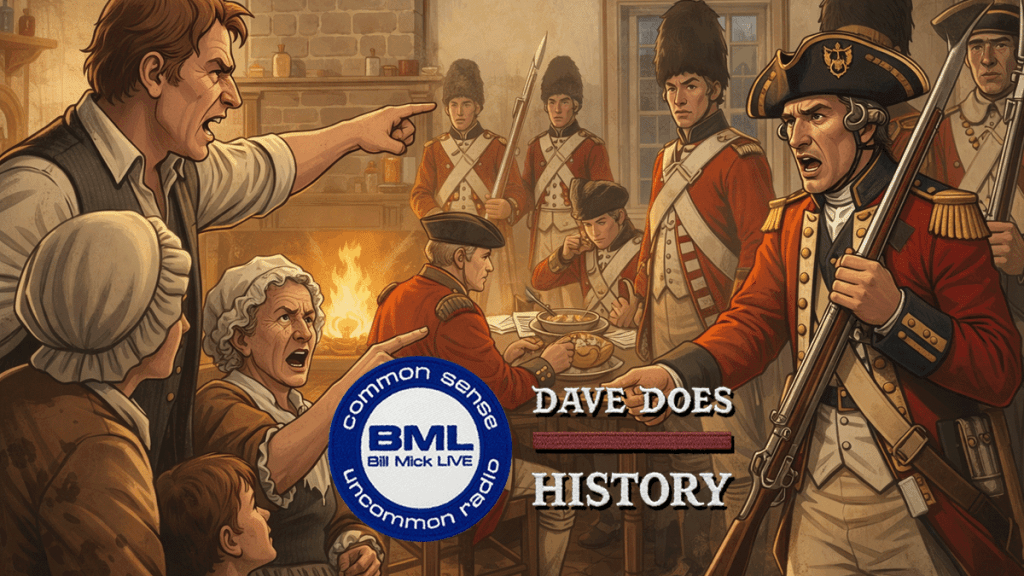
The main focus is the set of laws known in America as the Intolerable Acts. Passed by Parliament in response to the Boston Tea Party, these laws were designed to isolate and punish Massachusetts. They closed the Port of Boston, dissolved the colonial government, protected British officials from local justice, and placed troops directly among civilians. What the British called order, the colonists saw as tyranny.
The conversation also explores the lesser-known but equally explosive Quebec Act. Though not intended as a punishment, it struck a deep nerve among New England Protestants by extending protections to French Catholics in Canada. This act fueled fears of religious overreach and added religious fervor to the growing political crisis.
Dave draws a striking historical parallel to the 1497 Cornish Rebellion in England. Just as Cornwall resisted taxes for a war they had no interest in, so too did the people of Massachusetts resist policies imposed by a distant government. But where Henry VII wisely backed down to preserve peace, George III and Parliament doubled down. That choice lit the fuse.
What followed was not chaos, but coordination. Colonists organized Committees of Correspondence, built networks of support, and issued public declarations. The Suffolk Resolves flatly rejected the Intolerable Acts and pledged to raise a militia. In Virginia, the Fairfax Resolves laid out colonial rights and urged the formation of a unified political body. These efforts would lead directly to the gathering of delegates at Carpenters’ Hall in Philadelphia on September 5, 1774.
The First Continental Congress was not a call for independence. It was a call for respect, rights, and redress. But for the first time, the colonies were no longer speaking past each other. They were speaking together. And that voice said, clearly and without hesitation, that they had endured enough.
Listen to this week’s episode of Dave Does History to hear how thirteen colonies found their shared resolve and took the first step toward becoming one nation. Available now on the Bill Mick Live show page and your favorite podcast app.

 DAVE DOES HISTORY
Leave a comment