
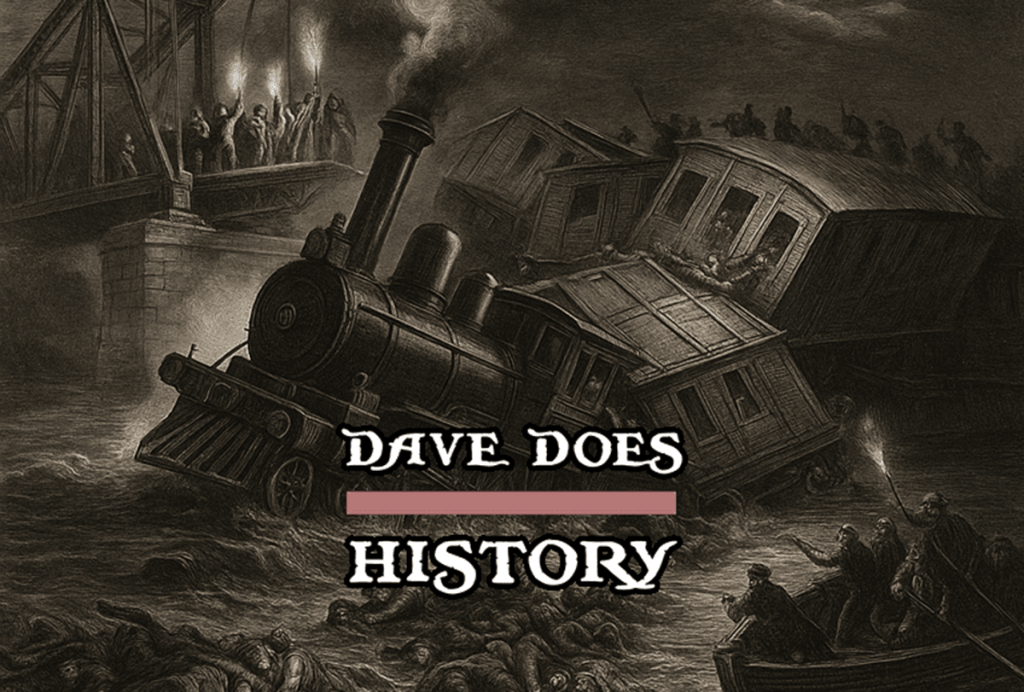
Late on a quiet summer night in 1864, a train full of exhausted immigrants rattled westward across the Province of Canada, bound for Montreal. They were German and Polish families, fresh off the ships from Hamburg, hungry and hopeful for a new beginning in the New World. Crammed into what were little more than converted boxcars, they carried everything they owned. That train, overloaded and undermanned, never reached its destination. At 1:20 a.m. on June 29, 1864, it plunged off an open swing bridge into the Richelieu River near Beloeil, Quebec. Ninety-nine souls died instantly. One more succumbed to injuries soon after. It remains the deadliest passenger rail disaster in Canadian history.
The story should have begun with a warm welcome. Instead, it began with confusion. When the immigrant ship docked near Quebec City, nobody knew how many passengers were on board or what their condition was. There were no interpreters. No plans. No colonist cars, which hadn’t even been invented yet. These families were herded onto rough freight cars with hastily cut windows and wooden benches. Nine of these cars were strung together with a single aged passenger coach and a brake van at the rear, slapped together with urgency, not safety.
It was a patchwork train pulled together in a railyard swamped with human cargo. The station agent who cobbled it together described it as a sea of humanity. And yet, despite the overload and chaos, the train set off late in the day, long after the scheduled traffic had cleared the rails. Somewhere between Levis and Richmond, the first crew handed off their duties. But the second crew was barely fit for the job. The engineer, William Burnie, was a yard man, not a road man. He had no experience with the route. He’d just been promoted 11 days earlier. When he protested that he wasn’t qualified, his manager told him plainly: take the engine or lose your job.
His fireman was on his very first shift. The brakemen were newly hired and had no idea what lay ahead. Only the conductor, Thomas Finn, had any real experience. It was a five-man crew, running in darkness, operating equipment that predated air brakes, with link-and-pin couplers and crude handbrakes. The engine’s only real stopping power came from the brake wheel on the rear van and a screw brake on the tender.
As the train made its way westward, it eventually approached the Richelieu River. There, a swing bridge spanned the channel between Otterburn Park and Beloeil. It had been opened to allow barges and a steamer to pass. A red warning light about a mile up the track signaled danger. By law, all trains were required to stop before crossing. But in practice, crews rarely did. The bridge was almost always closed by the time scheduled trains arrived. This train wasn’t scheduled.
The problem was clear. The engineer didn’t know the route. The brakemen didn’t know the grade. And the conductor couldn’t even reach the brake wheel, which was blocked by frightened passengers standing in every available space. The train was hurtling downhill toward the bridge, heavy and overloaded, with no way to stop.
At 1:20 a.m., the inevitable happened. The engine roared forward onto the open span and vanished into the river below. The rest of the train followed, eleven cars crumpling one atop another, smashing onto a barge and collapsing into the Richelieu’s dark water. A blue mass of mangled limbs, shattered timbers, and twisted iron lay in a pile of horror. Survivors later said it looked as though a giant press had crushed the entire train into an unrecognizable tangle. Bodies, clothing, loaves of bread, and luggage were all twisted together in a grotesque tableau of what should have been the beginning of new lives.
Rescue came from the river itself. Crews from the steamer and barges, along with locals from Beloeil and surrounding towns, chopped through the splintered boxcars to free survivors. Some swam to shore, dazed and bleeding. Others were hauled from the river in near silence. There were no screams. Just shock and the slow work of pulling broken bodies from the wreckage.
Montreal responded quickly. The Grand Trunk Railway, afraid of public backlash and already deep in debt, sent workers to help. Irish, British, and German aid societies provided support. Makeshift hospitals sprang up in nearby homes and sheds. In Montreal, the Protestant and Catholic hospitals overflowed. Among those treating the wounded was a young visiting doctor from Newfoundland named Thomas Roddick. So affected was he by what he saw that he scrapped his plans for further studies in Edinburgh and stayed in Montreal. He went on to become one of Canada’s most respected surgeons and was later knighted by King George V. His path began with the blood and chaos at Beloeil.
The dead were buried in both Mount Royal and Catholic cemeteries. But not everyone was given a proper resting place. Some were never identified. Their names lost, their hopes for a new life sunk in the dark water with the train.
The blame game began before the bodies were even cold. Newspapers roasted the engineer. Courts later convicted him of negligence. Burnie admitted he didn’t know the route and hadn’t seen the warning light. Still, he knew he was supposed to stop. He served time, but his real sentence was the ruin of his spirit. Though still in his twenties, he died not long after. Forgotten by the company, remembered only by a few who later tried to clear his name.
But Burnie wasn’t the only one at fault. The Grand Jury issued a damning indictment of the Grand Trunk Railway, calling its management shameful and the real cause of the catastrophe. Their only punishment was a slap on the wrist, a reprimand for inadequate supervision. No fine. No reform. Business carried on.
Eventually, telegraph communication was added to the swing bridge. Procedures improved. Air brakes became standard. Colonist cars were developed, and immigrant transport became safer and more dignified. But for 100 souls in 1864, those changes came too late.
The Boeloeil disaster isn’t just a story of a train wreck. It’s a story of immigrants caught between hope and carelessness, of corporate greed and human cost, and of ordinary people stepping up when systems failed. It reminds us what happens when responsibility is shrugged off, and how quickly lives can be shattered when corners are cut. It’s also a story of those who lived, who rebuilt, and whose descendants kept the memory alive.
One retired locomotive engineer put it best: imagine the terror Burnie felt in that final moment, realizing he couldn’t stop what was coming, seeing that red light too late, knowing he was taking hundreds of innocent people with him. That kind of fear should never be part of anyone’s new beginning.


 DAVE DOES HISTORY
Leave a comment