
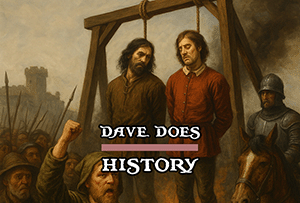
The English hanged a blacksmith and a lawyer at Tyburn on a warm June 27, 1497. Their names were Michael An Gof and Thomas Flamank, and the crime was treason. But if you ask the Cornish, then or now, the real crime wasn’t theirs. It was the betrayal of a people by a distant king who neither knew them nor cared to.
The Cornish Rebellion of 1497 wasn’t born in taverns or whispered in secret. It started openly, in the clear air of St. Keverne on the Lizard Peninsula, where a blacksmith named Michael Joseph spoke out against a tax that made no sense to his people. England was raising money to wage war against Scotland, supposedly to crush a Yorkist pretender named Perkin Warbeck. To the Cornish, it was lunacy. Scotland was hundreds of miles away, and Warbeck meant nothing to them. They saw it for what it was: a power play among kings and courtiers, and one they were being forced to bankroll.
Then came the insult to injury. Henry VII, ever the centralizer, had suspended the Stannary Parliaments. These were ancient local courts that governed Cornwall’s vital tin mining industry. Tin was the lifeblood of the Cornish economy, and now it was being throttled from Westminster. The people didn’t just lose income. They lost autonomy. They lost dignity.
Michael An Gof wasn’t a noble or a war hero. He was a smith. Loud, fiery, the kind of man who didn’t wait his turn to speak. But when it came time to resist, his voice rang out clear. He had the courage to do what few dared. When he reached Bodmin, the movement picked up steam. There he met Thomas Flamank, a sharp and educated lawyer who added not only brains to the cause but legitimacy. Flamank’s father was actually one of the very tax commissioners implementing Henry’s policy, which made his defection all the more stinging.
Flamank didn’t call for the king’s head. He called for justice. He blamed two of Henry’s top men, Cardinal Morton and Sir Reginald Bray. He said it wasn’t the king but his advisors, and if they could just bring a petition to London, the king might see reason. It was a bold assumption.
Still, their army grew. At its peak, it numbered 15,000. From Cornwall to Devon to Somerset they marched, gaining food, recruits, and a following. At Wells, they were joined by a minor noble, Lord Audley. He was broke, bitter, and looking for purpose. He found it in rebellion. With Audley at the head, they pressed on toward London.
They made it. All 250 miles. London, the heart of the kingdom, now faced a rabble of Cornishmen with no cavalry, no artillery, and barely a sword between ten of them. But they had guts, and that counted for something. The problem was, they thought it might count for more.
They camped at Blackheath, just as Jack Cade’s rebels had done a generation earlier. They hoped the people of Kent would join them. Kent had a long tradition of revolt. But not this time. Kent stayed quiet. London locked its gates. No welcome wagon. Just a storm brewing to the north.
Henry, caught by surprise in the north, marched hard with a force that swelled to over 25,000. His plan was to wait until Monday, June 19, to crush them. But Henry had a superstition. Saturday was his lucky day. So, on June 17, he struck.
The Cornish held the high ground at Blackheath. They even had a few gunners and archers, who gave Lord Daubeny’s spearmen a rough time crossing Deptford Bridge. But it wasn’t nearly enough. Daubeny broke through. The rebels were surrounded. Flamank and Audley were captured in the fight. An Gof tried to flee and claim sanctuary but didn’t make it. The whole thing was over before noon. About a thousand Cornish lay dead.
On June 27, Flamank and An Gof were tied to hurdles and dragged through the streets of London. At Tyburn, they were executed. The sentence was to be hanged, drawn, and quartered, the highest punishment for traitors. But Henry showed a sliver of mercy. They were hanged until dead before being butchered. Their heads went up on London Bridge. Their bodies were quartered. Plans to send the remains back to Cornwall were scrapped. Henry, for all his ruthlessness, feared that would light another fire.
Lord Audley, being a noble, was beheaded cleanly the next day.
The aftermath was brutal. Massive fines, land seizures, and years of economic punishment rained down on Cornwall. But Henry had learned something too. In 1508, he quietly restored the Stannary privileges and allowed the tin industry to breathe again.
And Cornwall never forgot. In 1997, on the 500th anniversary of the march, Cornishmen retraced the rebels’ steps from St. Keverne to London in a tribute they called “Keskerdh Kernow” — Cornwall marches on. Statues were raised. Plaques were hung. Songs were sung. And the words of Michael An Gof still echo: “A name perpetual and a fame permanent and immortal.”
They weren’t kings. They weren’t generals. They were a blacksmith and a lawyer. But in the eyes of Cornwall, they were heroes. And in the hearts of those who value liberty and local rule, they still are.



 DAVE DOES HISTORY
Leave a comment