
On a hot June day in 1775, as the smell of war still hung in the air after the battles of Lexington and Concord, a group of weary, determined men gathered in Philadelphia’s Independence Hall and did something radical. They voted to create a unified fighting force drawn from across the thirteen colonies to take on the most powerful military on the planet. They didn’t call it the United States Army, not yet. They called it the Continental Army. It wasn’t much to look at. Ragtag farmers and tradesmen with worn boots and mismatched coats, some carrying their grandfather’s musket, others with nothing but a pitchfork and righteous anger. But it was the beginning of something that still stands strong today.
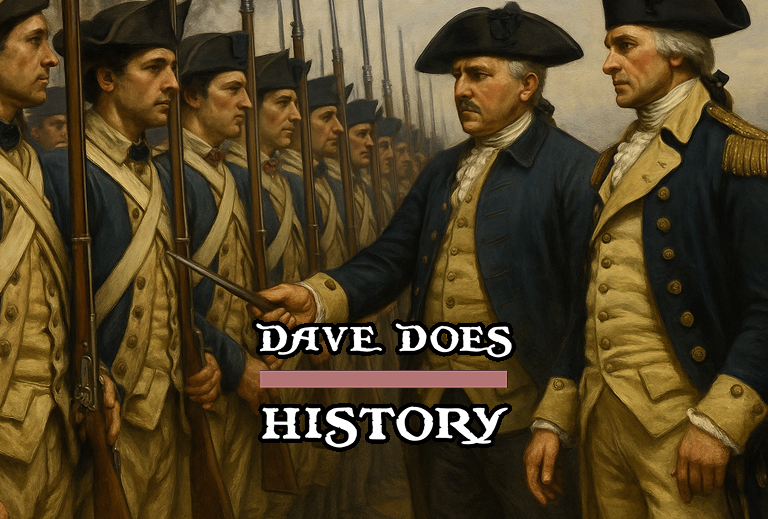
The Continental Army didn’t spring from thin air. Before 1775, colonial defense relied on local militias, part-time volunteers who grabbed a musket when danger came to their doorstep. These militias were useful for short bursts of action, but they weren’t trained for sustained warfare against a professional enemy. After Lexington and Concord, it became clear to the delegates in Philadelphia that a serious war was coming. If the colonies were to stand a chance, they needed more than passion. They needed discipline, structure, and a national force.
On June 14, 1775, Congress resolved to form just that. They pulled together the troops already besieging British forces in Boston and added more from Pennsylvania, Maryland, and Virginia. They picked a commander the next day. George Washington. A Virginian with a long military pedigree, a tall, imposing presence, and a reputation for courage and restraint. Washington didn’t draw a salary. He only asked that his expenses be covered. That humble, self-sacrificing approach to leadership set the tone for the Army he was about to build.
It wasn’t easy. Washington took command of men who were, by and large, used to choosing their own officers and heading home when they got bored. There were no training manuals, no uniforms, no standardized weapons. Some men had flintlock muskets. Others had squirrel rifles. Some had nothing. Washington inherited a logistical nightmare and a loose collection of volunteers with more passion than preparation. But he rolled up his sleeves and got to work.
One of Washington’s first acts was to organize this chaotic mass into a proper army. He grouped them into regiments, brigades, and divisions. He established command structures. He insisted on military discipline. The first real hurdle came not from the British, but from Congress. Many in Philadelphia were suspicious of standing armies. To them, it sounded a lot like tyranny. They preferred short-term enlistments, afraid that long-term military service would turn the army into a tool for oppression. Washington, who understood that war doesn’t work on a six-month schedule, begged Congress to rethink that. He warned them that soldiers whose enlistments expired in the middle of a campaign could mean disaster. He was right. More than once, he found himself trying to keep an army together with nothing more than appeals to honor and country.
Still, he fought with what he had. And while the early campaigns brought more defeats than victories, Washington learned and adapted. His losses in New York in 1776 were painful. At Fort Lee and Fort Washington, the army lost cannons, supplies, and morale. But then came Trenton. Then Princeton. Washington crossed the Delaware River on Christmas night in a desperate gamble. His men, freezing and hungry, attacked Hessian mercenaries and won. Those victories were small in military terms, but they were enormous in spirit. For the first time, Americans started to believe they could win.
And yet, for every step forward, there was a punch to the gut. In 1777, the British captured Philadelphia. Washington lost battles at Brandywine and Germantown. Meanwhile, a rival general, Horatio Gates, scored a victory at Saratoga. Whispers began to circulate. Maybe Washington wasn’t up to the task. A group of officers and politicians, known now as the Conway Cabal, tried to nudge him aside. Washington didn’t rant or threaten. He stood tall, remained calm, and let his dignity do the talking. The storm passed. His leadership held.
That winter, Washington brought his men to Valley Forge. It was hell. Cold, hunger, disease. Soldiers wrapped their feet in rags. Some had no coats. But it was also the turning point. Washington brought in a Prussian drillmaster, Baron von Steuben, who turned that scrappy bunch of volunteers into a professional fighting force. Von Steuben barked orders in broken English and swore like a sailor, but he taught them how to fight. How to march. How to be a real army. The transformation was nothing short of miraculous.
By the summer of 1778, those lessons paid off at Monmouth, where the Continental Army stood its ground against the British in a brutal, sweltering battle. Washington’s troops weren’t just surviving anymore. They were fighting toe to toe.
The war dragged on, shifting southward. In the Carolinas, General Nathanael Greene took over for the disgraced Gates and led a campaign that wore down the British with relentless harassment. At Cowpens and Guilford Courthouse, the British won on paper but bled heavily. They couldn’t afford that kind of victory. Eventually, Washington saw his chance. With help from the French navy and General Rochambeau, he marched his army to Virginia. In October 1781, at Yorktown, the British surrendered. The war was effectively over.
After the Treaty of Paris, Washington did something that stunned the world. He gave up power. He resigned his commission and went home. Monarchs and generals across Europe couldn’t believe it. This man had led a revolution, commanded an army, and won a war. And he just walked away. That act wasn’t just a gesture. It was a cornerstone of American values. Civilian control over the military. Service, not self-interest. It set the tone for every generation of soldiers that followed.
Most of the Continental Army was disbanded by 1783. Only a few companies remained to guard supply depots at Fort Pitt and West Point. And yet, from those humble roots, the modern United States Army was born.
Washington, even in retirement, knew that peace was fragile. He penned a document called “Sentiments on a Peace Establishment,” arguing for a small but professional standing army. He called for military academies, centralized logistics, and a trained national militia. Congress, as usual, ignored most of it. But his ideas lingered. When he became the first President in 1789, he got to work again, this time laying the foundation for the permanent army we know today.
What the Continental Army created wasn’t just a military force. It was an institution grounded in the ideals of the Revolution. It represented unity among states that often couldn’t agree on anything. It showed that ordinary people could rise to extraordinary heights. It gave America its first taste of professional excellence born from shared hardship and sacrifice.
Today’s U.S. Army still traces its roots directly back to that moment in June 1775. In fact, June 14 is officially celebrated as the Army’s birthday. Some of the Army’s oldest units, like the 181st Infantry and the 69th New York, can trace their lineages back to the Continental era. The Army’s enduring motto, “This We’ll Defend,” comes straight out of that tradition. The core values etched into every soldier — loyalty, duty, respect, selfless service, honor, integrity, and personal courage — are echoes of those freezing nights at Valley Forge and those desperate charges at Yorktown.
The uniforms have changed. The weapons are lightyears beyond a Brown Bess musket. But the heart of the Army remains the same. It’s still about defending a free people. Still about standing up when others sit down. Still about service before self.
And the legacy runs deeper than lineage or mottos. It lives in the culture of today’s Army. In the belief that every soldier, no matter their background, has value and purpose. The Continental Army included Black Americans, Native Americans, and immigrants who barely spoke English. Washington didn’t care. If you could carry a musket, you were needed. That inclusive spirit has remained. The Army has always been a place where the content of your character matters more than your pedigree.
The Continental Army also planted the seeds of military innovation. Von Steuben’s drill manual, the famous Blue Book, was the first of its kind for the American Army. It became the gold standard, used well into the 19th century. The Continental Army introduced structured training, battlefield tactics, and the idea of a centralized supply chain. Those concepts evolved into West Point, the Joint Chiefs, and today’s global logistics network that keeps troops supplied from Fort Liberty to the front lines.
But perhaps the greatest legacy of the Continental Army is the ideal that military power must always serve the republic, not rule over it. That the soldier’s place is to defend freedom, not define it. That was Washington’s final gift. His refusal to seize power was the blueprint for everything that followed.
It’s easy today, in an age of satellites, cyber warfare, and aircraft carriers, to forget that our military might started with a few thousand men shivering in the Pennsylvania woods. But they were the tip of the spear. Their sacrifice carved out the freedoms we now defend.
So, the next time you see a soldier in uniform, remember they’re not just part of today’s Army. They’re part of Washington’s Army. The one that stood barefoot in the snow and still marched. The one that lost more battles than it won but never surrendered its cause. The one that gave us not just a country, but an example.
From Valley Forge to Baghdad, from the fields of Monmouth to the hills of Afghanistan, the spirit of the Continental Army endures. It lives on in the cadence of boots on parade grounds, in the oath taken by every recruit, and in that simple, stubborn promise: This We’ll Defend.



 DAVE DOES HISTORY
Leave a comment