
On June 8, 1967, in the sunlit waters of the eastern Mediterranean, an American ship flew the Stars and Stripes over calm seas. Her name was the USS Liberty, a lightly armed intelligence vessel serving under the National Security Agency. She carried 294 crew members, including sailors, Marines, and NSA linguists trained in Arabic and Russian. That morning, the Liberty cruised peacefully, 13 miles off the Sinai Peninsula, well within international waters. Overhead, Israeli reconnaissance planes circled the ship multiple times. The Liberty’s crew waved. Some even saw the pilots’ faces. At least eight overflights occurred in the hours before the attack. No warnings were given. Nothing seemed out of place. Then everything changed.
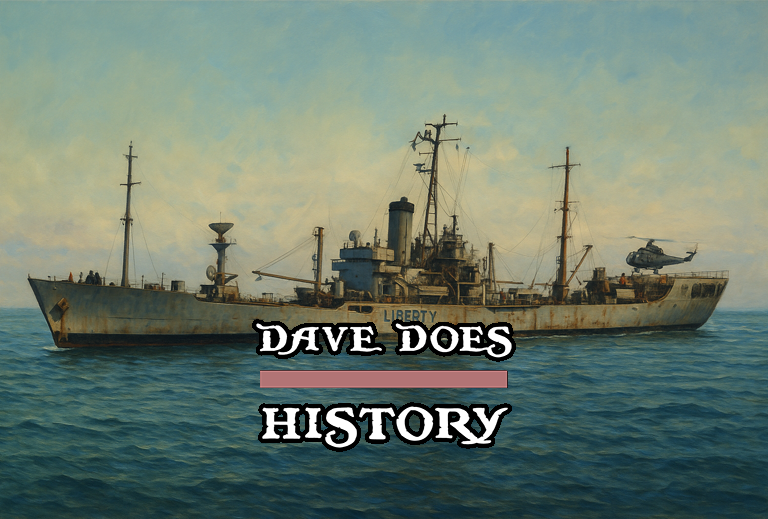
Just after 2 p.m., without any warning or provocation, Israeli Mirage fighter jets launched a fierce attack. The aircraft fired rockets, napalm, and cannon shells into the Liberty. The American flag was hit and fell. Communications were knocked out. The bridge was peppered with bullets. Men died instantly. Others were maimed or burned alive. The crew scrambled to replace the flag with an even larger one, measuring seven by thirteen feet. Still, the attack continued.
After several minutes of this aerial assault, three Israeli torpedo boats charged toward the damaged Liberty. The Liberty tried to signal, but it was no use. The boats opened fire with machine guns and 40mm cannons. Then they launched five torpedoes. One found its mark, tearing through the starboard side of the ship below the waterline. That torpedo struck the NSA spaces. Twenty-five men were killed instantly. The sea poured in.
Some of the wounded tried to escape in lifeboats. The Israeli boats machine-gunned the lifeboats as they were lowered into the water. Even for a war zone, this was a violation of international law. When the smoke finally cleared, 34 Americans were dead. One hundred seventy-one were wounded. The Liberty was heavily damaged, riddled with more than 800 holes from rockets and shrapnel. Her hull gaped open. Flames tore through her decks.
And yet, she did not sink.
The Liberty limped away under the command of her wounded skipper, Commander William McGonagle. McGonagle was hit in the legs during the attack but refused to leave the bridge. He fought to keep the ship alive for over 17 hours, refusing painkillers and remaining at his post. He would later receive the Medal of Honor. Strangely, the ceremony did not take place at the White House as tradition dictated. Instead, it happened quietly at the Washington Navy Yard, with no press, no presidential presence, and no public acknowledgment. It was, like everything else surrounding the Liberty, treated as something to be hidden.
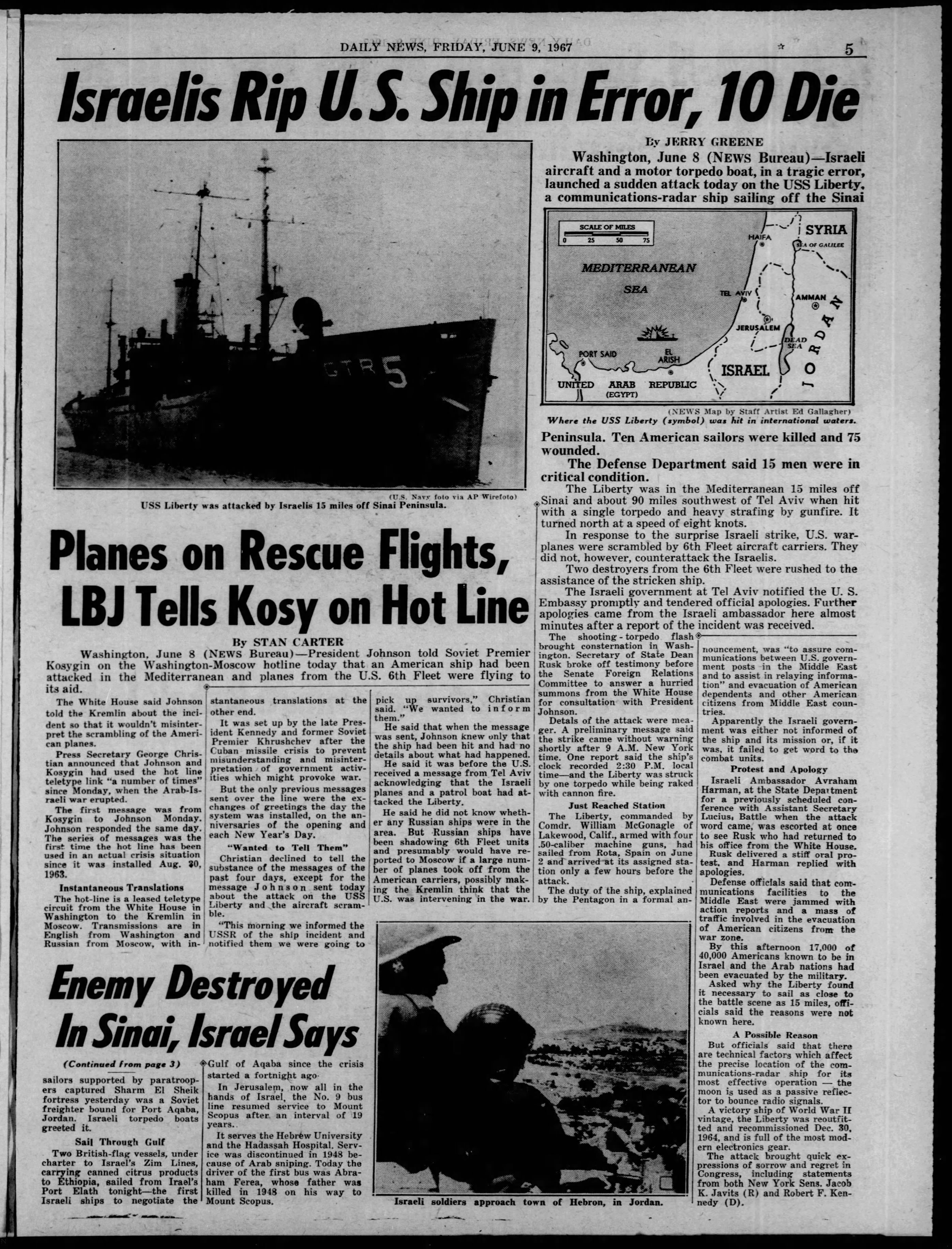
Immediately after the attack, Israel issued an apology. They claimed they mistook the Liberty for an Egyptian horse transport named El Quseir. They said it was a tragic case of mistaken identity. They offered compensation and called it an accident. That story has been repeated for decades, often without challenge.
But the survivors of the Liberty have never accepted it. Neither have a growing number of military officers, historians, and intelligence officials.
Let’s break down the official explanation. The Liberty was clearly marked. She flew a large American flag and bore the hull number GTR-5, painted in Latin letters, not Arabic. The weather was clear. Visibility was perfect. She moved slowly and predictably at five knots, not thirty as Israeli reports falsely claimed. Earlier in the day, Israeli reconnaissance pilots had identified her as an American ship. Israeli naval command even marked the ship as neutral on their operations board. Then, during a routine staff change, someone erased the Liberty’s designation. From that moment on, the official story goes dark.
Despite these facts, the United States accepted Israel’s apology. President Lyndon Johnson was managing the Vietnam War and carefully monitoring tensions with the Soviet Union. An open conflict with Israel was politically dangerous. According to a Newsweek reporter, Johnson privately admitted that he believed the attack was intentional but said he would not risk embarrassing a key ally. The cover-up began almost immediately.
The U.S. Navy’s Court of Inquiry wrapped up in just seven days. Only 14 survivors were interviewed. The investigation’s lead attorney, Captain Ward Boston, later swore in an affidavit that he and Admiral Isaac Kidd were ordered by Washington to conclude the attack was a mistake, no matter what the evidence showed. Boston and Kidd both believed the attack was deliberate. Boston called the official conclusion a lie.
Why would Israel attack a U.S. ship? There are several theories.
One of the most prominent is that Israel wanted to keep certain actions secret. On June 8, Israeli forces were preparing to invade Syria’s Golan Heights. Some reports allege that Israeli troops had committed atrocities in the Sinai against Egyptian prisoners of war. The Liberty, outfitted with top-secret surveillance gear, was in a perfect position to intercept communications. If Israel feared those transmissions would be picked up and reported to Washington, the Liberty may have been seen as a threat. A deliberate attack could remove that threat.
Another theory suggests Israel wanted to frame Egypt and draw the United States into the war. If the Liberty had been sunk without survivors and Egypt blamed, it might have triggered American retaliation. The Liberty’s initial distress signals did not identify the attackers, a detail that only adds fuel to the theory.
There is also the unexplained recall of U.S. aircraft. After the Liberty finally managed to get a message out, aircraft were launched from the USS America and USS Saratoga. Some reports indicate the planes were armed with nuclear weapons. They were en route to defend the Liberty when they were suddenly recalled. Secretary of Defense Robert McNamara and President Johnson allegedly ordered them back. Some say the reason was clear: Washington had already learned the attackers were Israeli and did not want to escalate the situation.
More evidence came to light in 2006 when the Chicago Tribune interviewed several intelligence officers who had been stationed aboard a U.S. Navy EC-121 aircraft. They reported intercepting Israeli communications that proved Israeli pilots had identified the Liberty as an American ship. Those tapes were never made public. The NSA later released only partial transcripts from after the attack. Tapes recorded during the attack remain classified.
The actions of the Liberty’s crew were nothing short of heroic. In the chaos of battle, a junior officer named James Halbardier crawled across the burning deck under Israeli fire to reconnect a damaged antenna. His actions restored the Liberty’s ability to transmit a distress signal. He received the Silver Star. Without him, the ship may have gone down unnoticed, and the story would have ended at the bottom of the sea.
After the attack, the Liberty limped to Malta for repairs. The damage was extensive. The ship was later decommissioned and scrapped. The crew returned home with injuries, trauma, and questions that would never be fully answered.
Despite the severity of the incident, no formal congressional investigation has ever been conducted. No Israeli officials were disciplined. The story faded from the headlines. The men who survived have spent their lives fighting to keep the memory alive and demanding accountability. Many of them believe that what happened to the Liberty was not just an attack, but a betrayal.
For decades, historians like Michael Oren and legal scholars like A. Jay Cristol have defended the Israeli narrative. They point to the chaos of the battlefield and insist the attack was a tragic error. But that narrative becomes increasingly hard to accept when you consider the timeline, the repeated overflights, the ship’s markings, and the reports from intercepted communications.
Many of the Liberty’s crew have gone public. They’ve spoken at memorials, written books, and sat for interviews. Some say they were ordered to keep quiet. Some were threatened with court-martial. But they have kept talking. They have refused to let the truth drown in the sea.
The Liberty’s crew received more than 200 Purple Hearts. They earned their medals with blood and steel. But what they never received was justice.
This is not about turning against an ally. This is about demanding accountability and honoring the truth. No alliance should be above the lives of American servicemen. No political strategy should overshadow justice.
The story of the USS Liberty is not just a historical mystery. It is a wound that has not healed. It represents the dangers of secret diplomacy, of compromised investigations, and of silence bought with political favors. It challenges us to consider what kind of nation we are if we cannot speak the truth, even when it is painful.
To this day, the attack on the Liberty remains a shadow over U.S.-Israel relations and a stain on the honor of our leadership. The survivors are still waiting for answers. The American people deserve the truth.
We owe it to those men. We owe it to history. We owe it to ourselves.



 DAVE DOES HISTORY
Leave a comment