
When most Americans think of George III, they picture a tyrant in a powdered wig, raving about taxes and trying to crush the spirit of liberty. That image, baked into our national memory by revolution and rebellion, is not entirely wrong—but it is far from the whole story. George III, born in 1738 and crowned king in 1760, was a complicated man trying to steer a sprawling empire through one of the most turbulent centuries in modern history.
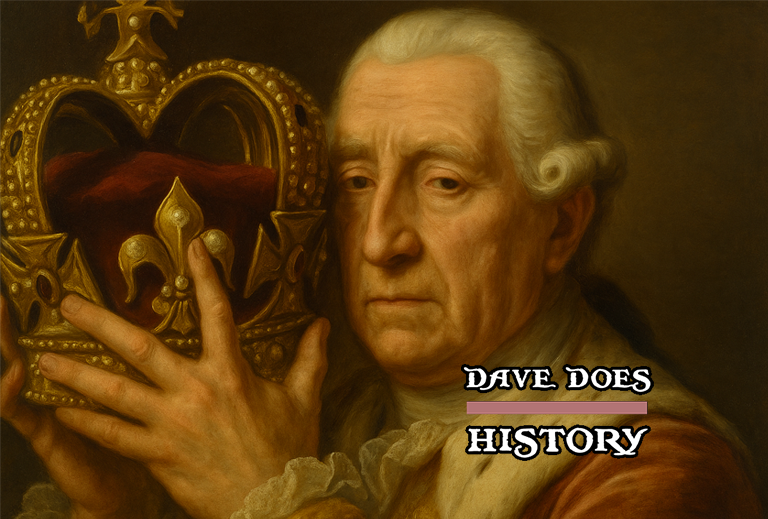
He was just twenty-two when he took the throne, the first monarch of the House of Hanover to be born in Britain and speak English as his first language. That mattered. George saw himself not as a foreign prince, but as a truly British king, grounded in the land and its traditions. When he married Queen Charlotte in 1761, they built a large family together, eventually raising fifteen children. He was deeply religious, intensely devoted to his wife, and surprisingly modest in his personal habits. For a king, he lived a pretty down-to-earth life.
George’s reign started in the wake of Britain’s victory in the Seven Years’ War. That win gave Britain control of huge swaths of North America, but it also left the empire drowning in debt. His first prime minister, Lord Bute, helped negotiate peace with France in 1763, but the financial problems lingered. George, practical and frugal, believed the American colonies should help pay for their own defense, especially since the war had been fought partly on their behalf. That belief would come to define—and haunt—his legacy.
The Stamp Act of 1765 and the Townshend Acts that followed were not his personal ideas, but he supported them. To George, it seemed fair. To the colonists, it looked like tyranny. What followed was a slow-motion train wreck: boycotts, protests, pamphlets, and eventually shots fired on the village green. As tensions spiraled, George remained firm. He believed deeply in the authority of Parliament and the unity of the empire. He was not trying to crush liberty—he thought he was preserving order.
Even as the colonies declared independence, George never saw himself as a villain. He took the rebellion as a personal betrayal. The Declaration of Independence painted him as a despot, listing a laundry list of abuses. In truth, George had far less control over colonial policy than Thomas Jefferson’s pen suggested. But in war, perception is everything.
George’s life after the American Revolution was no quiet retirement. He led Britain through the Napoleonic Wars and lived long enough to see the empire regain much of its global dominance. But by the 1780s, signs of mental illness began to appear. In 1788, he suffered a full-blown breakdown. He recovered temporarily, but his condition worsened in the years that followed. By 1810, he was permanently incapacitated, and his son served as Prince Regent until George’s death in 1820.
Despite his decline, George III left a real mark on British history. He was deeply involved in the arts and sciences, patronized scholars and architects, and took his role as a moral leader seriously. He never abandoned his faith, his wife, or his sense of duty. And that, more than the drama of revolution, might be what defined him most.
Which brings us to the film, The Madness of King George. As a historian, I find the film remarkable in how it handles the complexity of its subject. It does not try to excuse George’s political decisions by blaming them on his illness, nor does it imply that his mental state drove his opposition to American independence. Instead, it shows a man, not a symbol—a husband, a father, a ruler under pressure. The George of the movie is flawed and fragile, but also sincere and deeply human. American audiences often only see the caricature of the “mad king,” but this film offers something more. It is a chance to consider the other side of the story, to understand how revolutions are not just about policies, but about people trying to make sense of the world around them.
In the end, George III was not a tyrant in the mold of Caesar or Napoleon. He was a constitutional monarch trying, sometimes stubbornly, to do what he thought was right. He failed to keep the American colonies, but he never stopped trying to be a good king. That may not redeem him in every eye, but it certainly earns him a more nuanced place in the story of freedom and empire.




 DAVE DOES HISTORY
Leave a comment